Western military analysts are obsessed with the price tag of a Shahed-136. They call it "cheap." They call it a "lawnmower in the sky." They lean on the lazy narrative that Iran is simply flooding the zone with low-tech junk because they can’t afford a real air force.
This isn't just wrong; it’s a dangerous misunderstanding of modern attrition.
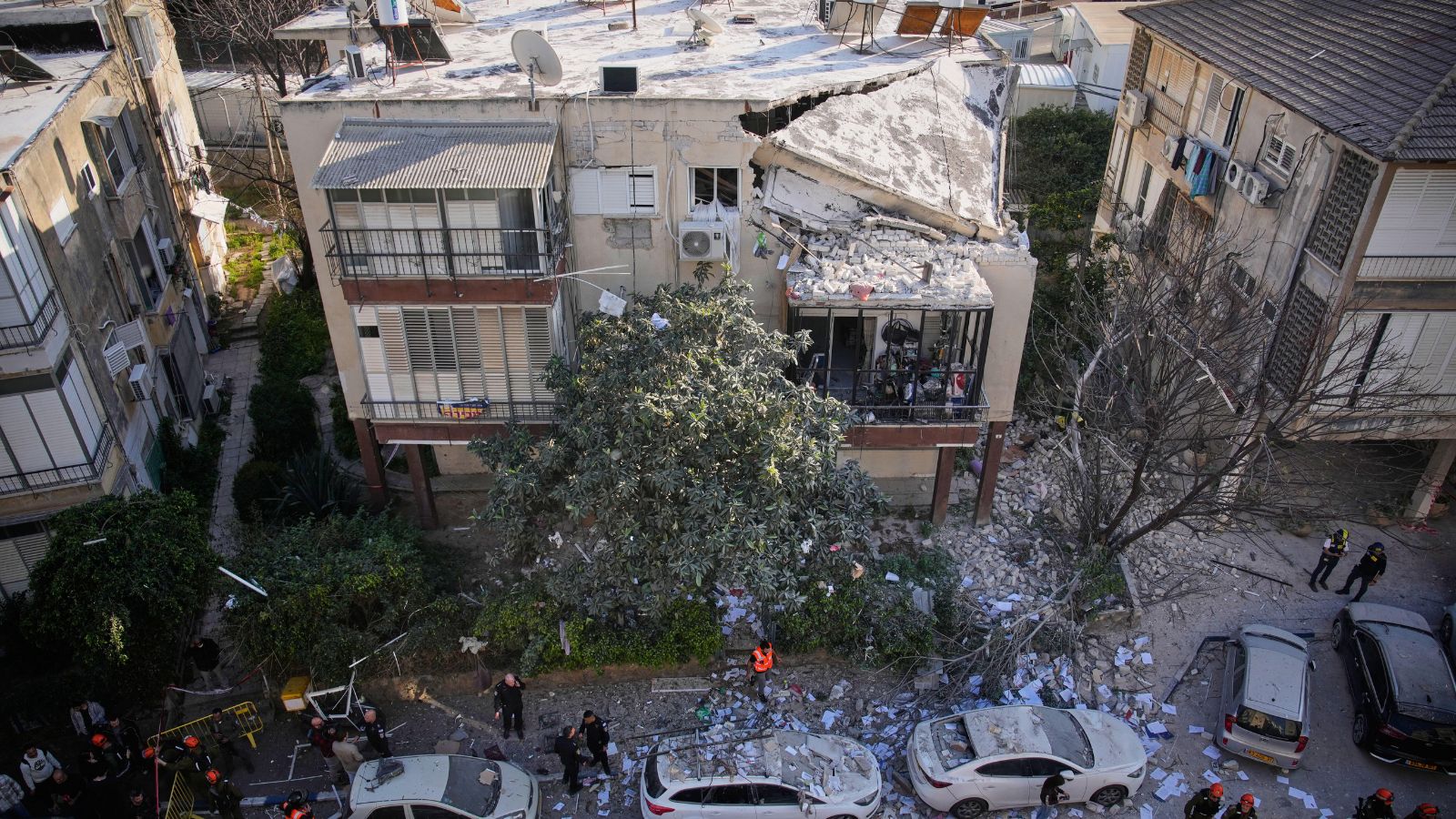
The media loves to highlight the 72-hour windows where hundreds of drones are launched across twelve nations. They frame it as a chaotic "unleashing" of havoc. In reality, these aren't just weapons. They are high-resolution probes designed to bankrupt the logic of Western integrated air defense systems (IADS).
If you are looking at the unit cost of the drone, you’ve already lost the war. You should be looking at the asymmetry of the intercept.
The Billion Dollar Math Trap
Let’s dismantle the "cheap drone" trope. When a $20,000 delta-wing drone flies toward a target, the defender has a choice. They can use a kinetic interceptor like a MIM-104 Patriot missile.
The math is brutal. A single Patriot interceptor costs roughly $4 million.
To ensure a high probability of kill ($P_k$), doctrine often dictates firing two missiles at a single incoming threat. That is $8 million spent to negate $20,000. This is not a sustainable defense strategy; it is a controlled demolition of the defender's treasury. Iran isn't trying to blow up every building they aim at. They are trying to force the West to trade gold for lead.
I’ve watched defense contractors pitch "solutions" to this for a decade. Most of them are just more expensive versions of the same failed logic. They want to build a better, faster, more "sophisticated" missile. They are trying to solve a 21st-century saturation problem with a Cold War procurement mindset.
It is Not About Tech, It is About Topology
The competitor pieces focus on the "havoc" caused by the impact. They miss the data harvested during the flight.
Every time a swarm is launched, the Iranian command structure isn't just looking for an explosion. They are mapping the electronic order of battle (EOB). They see which radar sites turn on, where the gaps in coverage exist, and how long the reload cycle takes for specific batteries.
The drone is a disposable sensor.
While the press shrieks about "havoc" in the Middle East, the Iranian engineers are likely refining the flight paths for the next iteration. They are turning the entire region into a live-fire laboratory.
Think about the physics of the Shahed-136. It uses a civilian-grade GPS and a basic internal combustion engine. It flies slow and low. This isn't because they can't make it go faster. It’s because flying at that altitude and speed forces the defender's radar to work in the "clutter" zone near the ground. It exploits the curvature of the earth and the limitations of look-down/shoot-down capabilities of aging fighter patrols.
Stop Asking if the Drones are Good
"Are Iranian drones effective?" is the wrong question.
The right question is: "Does the existence of these drones make traditional air superiority irrelevant?"
In 1991, during Operation Desert Storm, the US and its allies established total air dominance in days. They did this by destroying the enemy’s ability to see and react. Today, you can’t achieve that kind of dominance against a distributed, decentralized swarm capability. You can blow up a runway. You can't blow up every garage, basement, and shipping container in a 1,000-mile radius.
The "cheap" label is a coping mechanism. By calling them cheap, Western observers imply that they are inferior. But in the world of logistics, quantity has a quality all its own.
Imagine a scenario where 500 drones are launched simultaneously. Even with a 90% intercept rate—which is an incredibly generous assumption for any theater-wide defense—50 drones get through. If those 50 drones hit electrical substations or water desalination plants, the strategic objective is met. The 450 drones that were shot down weren't "failures." They were the cost of doing business. They were the chaff that allowed the 50 to survive.
The Electronic Warfare Delusion
The "experts" will tell you that electronic warfare (EW) is the silver bullet. "Just jam them," they say.
This ignores the reality of localized, pre-programmed inertial navigation. Modern iterations of these drones don't need a constant link to a satellite or a pilot. They can be hardened against GPS jamming by using visual odometry or simple terrain mapping.
If you jam a wide area, you are also jamming your own civilian infrastructure and your own military communications. The "bubble" of protection created by EW is often just as disruptive to the defender as it is to the attacker.
Furthermore, building a high-powered jammer makes you a massive target for anti-radiation missiles. You turn on the light to find the mosquito, and you end up showing the entire neighborhood exactly where you are standing.
The High-Tech Debt
We are currently witnessing the end of the era of the "exquisite" weapon system.
The West spends decades and billions developing a single platform like the F-35. It is a marvel of engineering. It is also a liability in a world of $20,000 kamikaze bots. If a $100 million jet is sitting on a tarmac and a $20,000 drone hits the cockpit, the drone wins.
The ROI is $5,000:1 in favor of the attacker.
We have optimized for "quality" to the point of extinction. We have built a military of Ferraris in a world that has decided to fight with a million Honda Civics.
The Middle East is currently the testing ground for this shift. The 12 nations mentioned in the news are just the map. The real story is the collapse of the traditional defense value proposition.
The Brutal Reality of Directed Energy
People often ask about lasers. "Why don't we just use lasers to burn them out of the sky for pennies a shot?"
It sounds great in a PowerPoint presentation. In the real world, lasers have massive power requirements, struggle with atmospheric conditions (dust, rain, fog), and require a "dwell time" on the target. In a swarm of 100 drones, a laser system might get five before the rest are on top of it.
Moreover, you can counter a laser with a $10 can of reflective paint or a sacrificial ablative coating.
We are looking for a technological "fix" for a fundamental mathematical problem. You cannot win a war of attrition when your defensive shots cost 200 times more than the incoming threats.
The Actionable Pivot
If you want to survive this shift, you have to stop thinking like a defender and start thinking like a bookie.
- Abandon the Interceptor Obsession: We need to stop buying $4 million missiles to kill $20,000 drones. The focus must shift to high-volume, low-cost kinetic solutions—think programmable 30mm or 40mm airburst ammunition. It isn't sexy. It doesn't make Lockheed Martin as much money. But it works.
- Decentralize Everything: Large, centralized airbases are death traps. If your entire strategy relies on a few "pivotal" hubs, you are giving the enemy a target they can't miss.
- Accept the Leakage: Military planners need to stop promising 100% protection. It’s a lie. Instead, focus on resilience—the ability to take a hit and keep functioning.
The "havoc" isn't coming from the drones themselves. The havoc is being caused by our refusal to acknowledge that the rules of engagement have fundamentally changed.
We are watching the democratization of precision strike capabilities. The monopoly on "smart" warfare is dead. Iran didn't just unleash a fleet of cheap drones; they unleashed a math problem that the West currently has no interest in solving.
Keep counting the drones if you want. I’ll be counting the empty missile canisters and the shrinking defense budgets.
The lawnmowers are winning because we are too proud to put down the scalpels and pick up a sledgehammer.