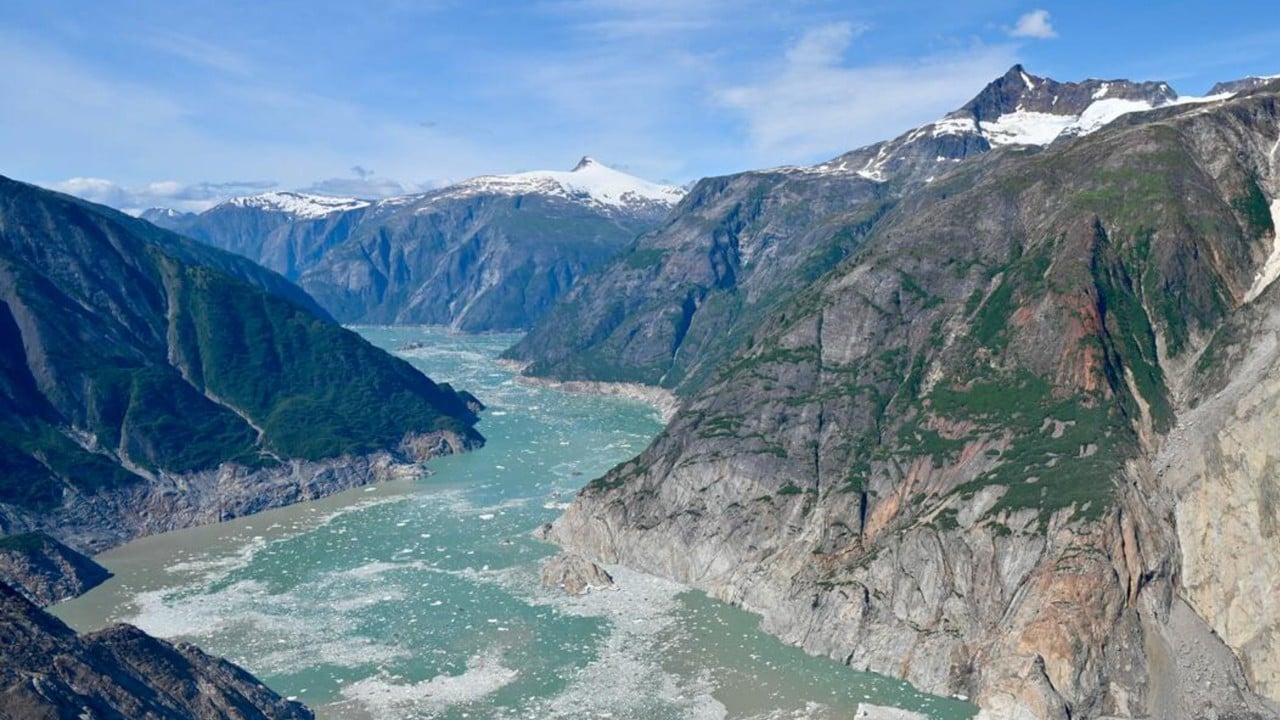
Gravity doesn't care about your plans. When a massive slab of Alaskan rock gave way in 2025, it didn't just fall into the water. It displaced a volume of ocean so violently that it created a literal wall of water higher than the Empire State Building. We’re talking about a 1,400-foot surge. That isn't just a "big wave." It's a geological reset button.
Most people hear the word tsunami and think of an earthquake in the middle of the Pacific. They picture a wave traveling thousands of miles to hit a beach in Hawaii or Japan. But what happened in Alaska was a megatsunami. These are different beasts entirely. They’re local, they’re fast, and they’re incredibly tall. If you’re standing on the shore when one starts, you don't have a twenty-minute warning. You have seconds.
The 2025 event is now officially the second-highest tsunami ever recorded in modern history. It only sits behind the legendary 1958 Lituya Bay event, which reached an insane 1,720 feet. For context, the tallest skyscraper in London wouldn't even poke its head out of the splash zone of this Alaska wave.
Why the Taan Fiord Slide Changed Everything
Geologists had their eyes on the Taan Fiord area for a while, but nobody predicted the sheer scale of the 2025 collapse. The mechanics are actually pretty simple to understand but terrifying to witness. Glaciers are melting at an accelerated rate. These glaciers used to act like massive icy buttresses, holding up the steep walls of the fjords. As the ice thins and retreats, that support vanishes.
You're left with millions of tons of unstable rock hanging over deep water. Add a bit of heavy rain or a minor tremor, and the whole mountain face zips down into the drink. In the 2025 Alaska case, the landslide hit the water with such force that it compressed the liquid and forced it up the opposite slope.
I’ve looked at the satellite data. The "run-up" height—the measurement of how far up the mountain the water actually reached—is what gives us that 1,400-foot figure. It stripped the soil and every single tree right off the bedrock. It left a "trimline," a visible scar on the earth that will be there for centuries.
The Empire State Building Comparison is Not Hyperbole
People love to say things are "bigger than a skyscraper" to get clicks. This time, the math actually backs it up. The Empire State Building stands at 1,454 feet if you count the tip. The peak of the 2025 Alaska surge hit roughly 1,400 feet.
Imagine standing on the observation deck of that building and looking at a wall of churning, grey seawater mixed with pulverized boulders and shattered trees. That was the reality in a remote corner of Alaska.
- 1958 Lituya Bay: 1,720 feet (The undisputed king of waves).
- 2025 Alaska Event: 1,400 feet (The new silver medalist).
- 1980 Mount St. Helens: 820 feet (Triggered by the volcanic collapse into Spirit Lake).
The difference between these and the 2011 Japan tsunami is the cause. The Japan disaster was a tectonic tsunami caused by the seafloor lifting. Those waves are usually "only" 30 to 100 feet high, but they carry a massive amount of energy across entire oceans. Megatsunamis like the one in 2025 are localized "splashes" on a gargantuan scale.
Climate Change is Carving New Hazards
We have to talk about the "why" behind this. It's not just bad luck. Alaska is the canary in the coal mine for landslide-induced tsunamis. As the permafrost melts, the "glue" holding these mountains together turns into mud.
Scientists at the Alaska Division of Geological & Geophysical Surveys have been shouting about this for years. They've identified dozens of sites where similar collapses are basically inevitable. Barry Arm is the one everyone is sweating over right now. If that slope goes, it could threaten cruise ships and fishing boats in Prince William Sound.
The 2025 event happened in a mostly uninhabited area. We got lucky. If that 1,400-foot wall of water hit a port or a tourist hub, the death toll would have been instant and total. There is no outrunning a wave that moves at hundreds of miles per hour in a narrow channel.
What This Means for Future Travel and Safety
If you're planning a trip to the Alaskan wilderness or taking a cruise through the fjords, you need to be aware. I'm not saying don't go—Alaska is stunning—but you should know the terrain.
Most people think they should look for a receding tide as a sign of an incoming tsunami. That’s true for ocean-crossing waves. In a fjord landslide, your first sign might be a deafening roar that sounds like a freight train. Or you might just see the mountain moving.
Survival Realities in Fjord Country
Let's be real. If you are on a boat in a narrow fjord and a 1,400-foot wave is triggered nearby, your options are basically zero. However, the energy of these waves drops off fast as they move away from the slide site.
- Monitor the USGS and NOAA alerts. They are getting better at placing sensors near high-risk slopes.
- Understand the "Trimline." If you see a clear line on the mountains where the trees suddenly stop and bare rock begins, you're looking at the ghost of a previous tsunami. Don't camp below that line.
- Get high. If you feel the ground shake or hear a massive crack from the mountains, don't look at the water. Move uphill immediately. Every foot of elevation counts.
The Scientific Community is Scrambling
The 2025 tsunami has forced a massive rewrite of our risk models. Before this, some researchers thought Lituya Bay was a once-in-a-thousand-year fluke. Now we’ve had two "thousand-year" events in less than 70 years.
NASA and the ESA are now using SAR (Synthetic Aperture Radar) to track mountain movement in Alaska down to the millimeter. They can see the ground "creeping" before it actually fails. This is our best shot at a warning system.
We need to stop treating these events as freak accidents. They are predictable results of a warming sub-arctic environment. The 2025 slide was a warning shot. The next one might not happen in a remote fjord. It could happen near a coastal town like Whittier or Seward.
Check the updated hazard maps from the Alaska Earthquake Center before you head out. They’ve added several new "red zones" based on the data from this most recent surge. Being informed is the only thing that beats a 1,400-foot wall of water. Don't wait for the roar to start thinking about your exit strategy. Get the maps, know the high ground, and keep your eyes on the slopes, not just the sea.