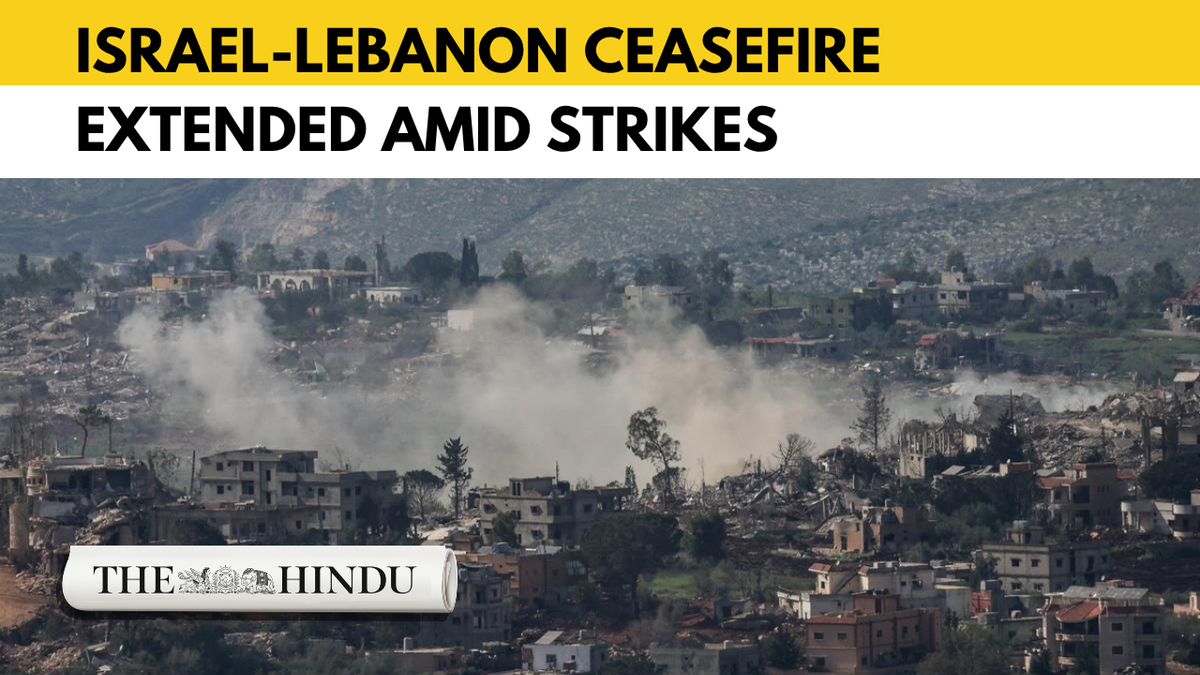
Mainstream foreign policy analysts are collective victims of a recurring delusion. Every time a diplomat pens a temporary truce, the media establishment throws a celebration. The latest 45-day extension of the Israel-Lebanon ceasefire is no exception. Commentators are wringing their hands over "fresh strikes" threatening a fragile peace, as if a few stray missiles are the problem.
They are looking at the entire chessboard backward.
The extension of a temporary ceasefire is not a victory for diplomacy. It is a strategic failure that guarantees a bloodier escalation down the line. We are told these extensions offer "breathing room" for a permanent diplomatic resolution. In reality, they serve as a logistical lifeline for insurgent forces and a political shield for governments unwilling to make hard choices. The conventional wisdom says ceasing fire saves lives. The geopolitical reality is that arbitrary pauses merely compound the body count by dragging out structural conflicts indefinitely.
The Illusion of the Reset Button
The fundamental flaw in standard geopolitical reporting is the belief that a ceasefire is a pause button. Journalists write about truces as if both sides freeze in place, contemplating the errors of their ways while international mediators craft a flawless treaty.
Having analyzed Middle Eastern proxy conflicts for two decades, I can tell you that the "pause button" does not exist. A ceasefire is an active, hyper-aggressive phase of asymmetric warfare.
When combat operations slow down, the real work begins. Ammunition depots are replenished. Broken command structures are re-established. Intelligence networks exploit the lull to map out the enemy’s newly exposed defensive positions.
Take a look at how Hezbollah historically utilizes tactical pauses. During periods of decreased kinetic activity, supply lines from Syria do not dry up; they accelerate. Rocket stockpiles are moved deeper into civilian infrastructure, buried under the guise of post-conflict reconstruction. On the flip side, the Israel Defense Forces (IDF) use these windows to recalibrate targeting banks, process drone surveillance data, and rotate exhausted reserve brigades back to the front lines.
By extending a ceasefire by 45 days, negotiators are not building a bridge to peace. They are subsidizing the next, more lethal phase of the war.
Dismantling the De-escalation Myth
Let’s answer the question the mainstream media refuses to ask: Why do "fresh strikes" occur during a ceasefire extension?
The lazy answer is that rogue elements or hardliners are trying to sabotage the peace. This premise is completely wrong.
[Ceasefire Declared] ──> [Asymmetric Re-arming] ──> [Probing Attacks] ──> [Inevitable Escalation]
Strikes during a truce are not anomalies; they are structural necessities for both factions.
- The Probing Mechanism: In a static conflict zone, you cannot afford to go blind. Small-scale rocket launches or targeted drone strikes are used to test the enemy's readiness. Does the Iron Dome still intercept at the same efficiency? Is the Lebanese border deployment still alert?
- The Leverage Game: Diplomacy is theater without kinetic leverage. If a state or proxy group stops firing entirely, they signal weakness at the negotiating table. The strikes are calculated messages: We are choosing not to launch a full offensive today, but we can do it tomorrow.
By treating every border skirmish as an existential threat to an idealistic peace, analysts miss the broader point. The strikes are proof that the underlying geopolitical friction has not been addressed. You cannot fix a fractured tectonic plate with a piece of diplomatic scotch tape.
Why 45 Days is the Worst Possible Timeline
In crisis management, there are useful timelines and destructive timelines. A 45-day extension falls squarely into the destructive category.
It is long enough to allow non-state actors to completely restructure their frontline tactical networks, yet short enough to prevent any real political compromise. True diplomatic breakthroughs require immense pressure. They require the imminent threat of catastrophic loss.
When you give political leaders a rolling 45-day escape hatch, you remove the incentive to make painful concessions.
- For Beirut: It allows a paralyzed government to avoid confronting the core issue: the state's total lack of a monopoly on violence and the continued armed presence of Hezbollah south of the Litani River.
- For Jerusalem: It provides a temporary political reprieve for a coalition government balancing domestic pressure for total victory against international demands for restraint.
- For Tehran: It keeps a regional proxy asset alive without committing to a full-scale regional war that could threaten the regime's survival.
Imagine a corporate scenario where a failing subsidiary is given a 45-day grace period every two months without changing its management or product line. The burn rate continues, morale plummets, and the inevitable bankruptcy is simply pushed to the next fiscal quarter. That is what the international community is doing on the blue line. They are financing a geopolitical burn rate.
The Brutal Truth About Conflict Resolution
The hardest pill for the international relations establishment to swallow is that some conflicts are resolved only when one side achieves its strategic objectives or can no longer physically wage war.
This is not an endorsement of violence; it is a historical fact. The concept of the "managed conflict"—the idea that you can keep a war at a low simmer indefinitely through international observers and periodic truces—is an expensive Western fantasy.
Look at the United Nations Interim Force in Lebanon (UNIFIL). Established in 1978, its mandate has been extended dozens of times. Has it prevented the weaponization of southern Lebanon? No. It has served as a human shield for the status quo, obscuring the reality that a heavily armed non-state military exists alongside a sovereign state.
The insistence on continuous, short-term ceasefires prevents a definitive conclusion. It creates a zombie conflict that periodically wakes up to butcher civilians and destabilize global energy markets before being forced back into a temporary, medicated sleep.
The Cost of the Contrarian Stance
Admitting that temporary ceasefires are counterproductive carries a heavy burden. The immediate downside to opposing an arbitrary truce is that the kinetic violence continues in the short term. It means accepting that the sirens will keep sounding in northern Israel and the airstrikes will keep leveling blocks in Beirut until a hard strategic equilibrium is reached.
But the alternative is worse. The alternative is a perpetual cycle of violence that kills ten people a week for a decade instead of resolving the core dispute in six months. It is a slow-motion catastrophe dressed up as humanitarian concern.
Stop asking if the 45-day ceasefire extension will hold. Start asking why we are still addicted to a diplomatic mechanism that has failed systematically for fifty years. The fresh strikes aren't breaking the peace; they are exposing the lie that peace ever existed.
Pull back the cameras, dismiss the envoys, and stop pretending that a pause is a solution.