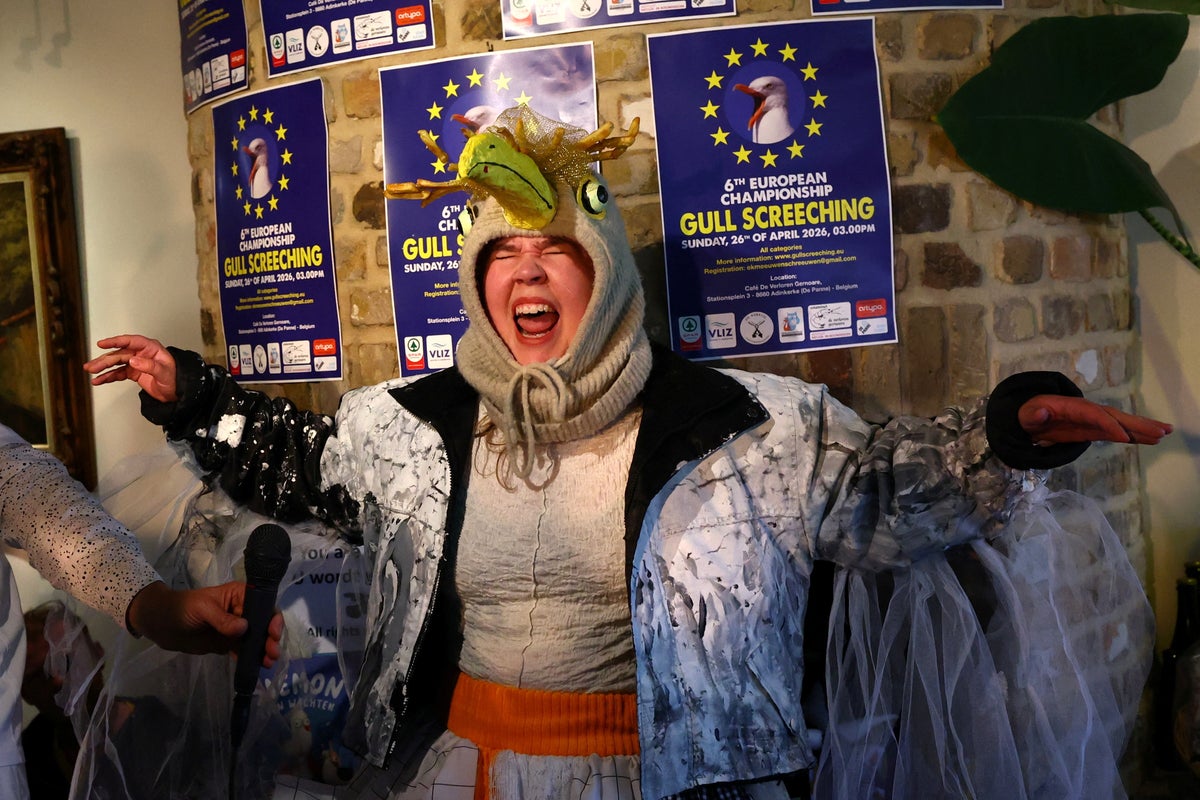
The North Sea wind does not negotiate. It whips across the promenade of De Panne, carrying the scent of salt, fried dough, and something distinctly avian. Most people spend their lives trying to ignore the seagull. We shoo them away from our chips. We curse when they leave chalky souvenirs on our windshields. We see them as winged scavengers, the noisy, uninvited guests of the coastline.
Then there is Jaroslav.
He stands on a makeshift stage, chest puffed out, eyes scanning a crowd that has swelled to hundreds. He isn't here to eat or to complain. He is here to scream.
This is the European Gull Screeching Championship. It sounds like the punchline to a joke told in a seaside pub after one too many Trappist ales. On paper, it is a gathering of eccentrics in a coastal Belgian town. In reality, it is a profound exercise in empathy, a bizarre masterclass in mimicry, and a testament to the human need to find connection in the most unlikely places.
The Anatomy of a Squawk
To the uninitiated, a seagull makes one sound: a loud, grating "ark."
The judges in De Panne know better. They sit behind a long table with the grim intensity of magistrates presiding over a capital case. They aren't looking for a simple impression; they are looking for the soul of the Larus argentatus, the European herring gull.
A truly competitive screech is a three-act play. It begins with the "long call," a series of repetitive notes that signal presence and territory. This moves into the "choking" sound, a rhythmic, guttural vibration used during nesting. Finally, there is the alarm call—the sharp, piercing cry that warns the colony of an approaching predator or a particularly promising unattended sandwich.
Jan Seys, a marine biologist and one of the founding architects of this madness, explains it through the lens of science rather than spectacle. Gulls are misunderstood. They are highly intelligent, social creatures forced into conflict with humans because we have occupied their habitats and provided them with a buffet of urban waste. By mimicking them, we stop seeing them as pests. We start seeing them as neighbors.
The Contenders
Consider the sheer vulnerability required to stand in front of a microphone and unleash a sound that would usually get you escorted out of a library.
There is a young man from the Netherlands, his face turning a shade of crimson that matches his windbreaker. He leans forward, hinges his jaw open at an angle that looks borderline anatomical, and lets out a series of rhythmic, barking cries. The crowd goes silent. For a moment, if you close your eyes, you aren't in a Belgian resort town. You are on a jagged cliffside in the middle of a storm.
Then there is the reigning champion, a man who has spent hours on his balcony practicing the specific "laughing" cadence of the gull. He doesn't just use his throat. He uses his diaphragm. He uses his hands to mimic the slight tuck of the wings.
Why do they do it?
The stakes are invisible. There is no massive cash prize. There is no sponsorship deal with a major binoculars manufacturer. The prize is a trophy, a few crates of beer, and the fleeting, glorious title of Europe’s best birdman. But the real draw is the community of the absurd. In a world that demands we be professional, polished, and productive at all times, there is a primal catharsis in being a bird for sixty seconds.
The High Cost of the Coast
Beneath the laughter and the feathered hats lies a harder truth about our changing relationship with the natural world. De Panne is a beautiful place, but like much of the European coastline, it is a site of friction.
As fish stocks fluctuate and traditional nesting grounds are developed into luxury apartments, gulls have moved inland. They have adapted. They have learned to open trash cans and identify the crinkle of a potato chip bag from half a mile away. This adaptation has turned them into villains in the public imagination. They are the "rats of the sky."
The championship acts as a bridge. It’s hard to hate a creature when you’ve spent the morning trying to replicate its language. The event has grown from a local lark into a continental phenomenon, drawing competitors from England, France, Germany, and beyond. It suggests that we are tired of the sanitized, predictable versions of nature we see on television. We want the messy, loud, aggressive reality of it.
We want to scream back at the wind.
The Physics of the Performance
The technical difficulty of a high-level screech is often underestimated. To hit the correct frequency, a performer must constrict the vocal cords while maintaining a high volume of airflow. It is a physical strain.
One competitor, a woman from France who traveled five hours just to compete, describes the sensation as a "vocal purge." You cannot half-heart a seagull impression. You have to commit. You have to forget about dignity. If you worry about looking silly, you have already lost. The judges look for "the look"—that specific, tilted-back posture of a gull claiming its territory.
The scoring is precise.
- Acoustic Accuracy: Does it sound like a bird or a person with a cold?
- Behavioral Mimicry: Is the body language correct?
- Public Empathy: Does the crowd feel a kinship with the performance?
The Echo on the Promenade
As the sun begins to dip toward the horizon, casting long, amber shadows across the sand, the final scores are tallied. The tension is real. People lean over the barricades, clutching their scarves.
When the winner is announced, they don’t give a polished victory speech. They don’t thank their agents. Instead, they step back to the microphone one last time. They take a deep breath, fill their lungs with that sharp North Sea air, and let out a cry so piercing and so authentic that a group of real seagulls, hovering near the pier, actually pauses in mid-air to look back.
For that one moment, the barrier between species dissolves.
The crowd erupts. It isn’t just applause for a winner; it’s a cheer for the ridiculousness of being alive. It’s a celebration of the fact that in a corner of Belgium, once a year, we decide that the most important thing we can do is stand on a stage and yell at the ocean.
We spend so much time trying to be heard, trying to be important, and trying to carve out our own little territories in the world. We build fences and write laws and strive for status. But standing there on the promenade, watching a man in a feathered suit scream at the clouds, you realize we aren't so different from the birds we mock. We are all just looking for a bit of sun, a bit of food, and someone to listen to our song.
The real seagulls eventually fly away, disappearing into the gray-blue haze of the sea. They leave behind a crowd of humans who are, for the first time in a long time, looking up at the sky with something that looks very much like respect.
The wind continues to blow. The chips continue to be stolen. And somewhere on a balcony in a quiet suburb, someone is already practicing their "long call" for next year, waiting for the moment they can finally find their voice by losing it in the cry of a bird.