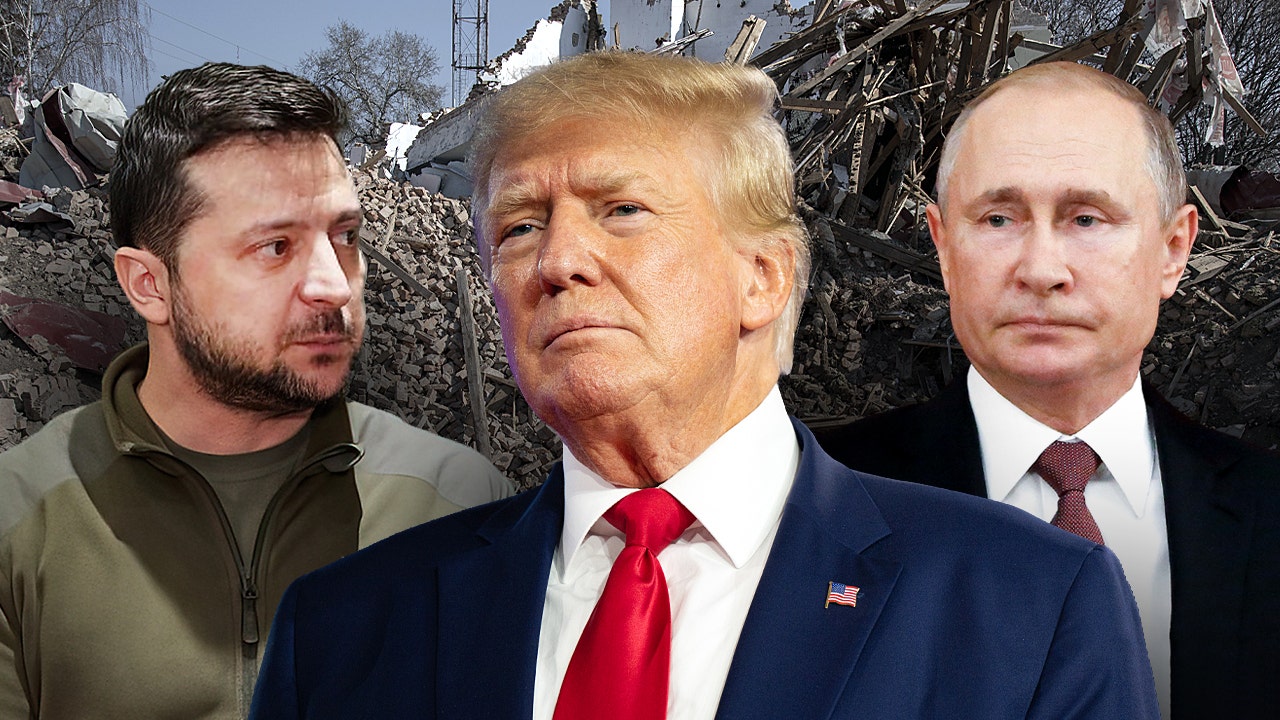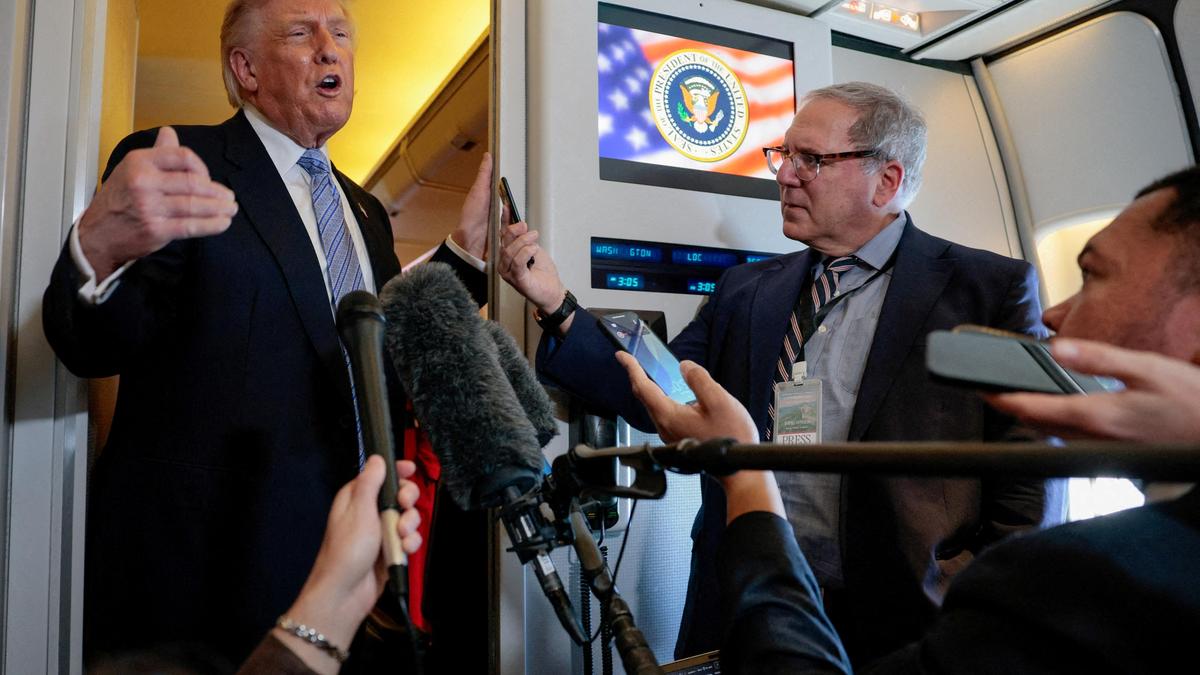
The traditional security architecture governing the Taiwan Strait is experiencing structural decoupling. Following the bilateral summit in Beijing between US President Donald Trump and Chinese President Xi Jinping, Washington’s long-standing policy of strategic ambiguity has shifted toward transactional calibration. When a US administration explicitly conditions a pending $11 billion arms modernization package on direct negotiations with Beijing while warning Taipei against a formal declaration of independence, the traditional geopolitical equilibrium collapses.
This transformation cannot be understood through the lens of standard political rhetoric. It requires a cold calculation of state survival, legal obligations, and defensive architecture. To evaluate this shifts, analysts must examine three core pillars: the legal friction between domestic law and executive transaction, the operational constraints of Taiwan’s defensive depth, and the economic calculus of microchip supremacy.
The Friction Function of Transatlantic and Transpacific Defense Assurances
The fundamental flaw in standard journalistic analysis is treating US-Taiwan relations as a series of discretionary political choices. In reality, the relationship is governed by a rigid legal framework that limits unilateral executive shifts. This dynamic operates via a three-part legal engine:
- The Taiwan Relations Act (TRA) of 1979: This statute mandates that the United States provide Taiwan with defense articles and services necessary to maintain a sufficient self-defense capability. It defines any non-peaceful determination of Taiwan’s future as a threat to the peace and security of the Western Pacific.
- The Six Assurances: Formulated in 1982, these non-binding guiding principles explicitly state that the US will not set a date for ending arms sales to Taiwan, will not consult with Beijing prior to conducting arms sales, and will not act as a mediator between Taipei and Beijing.
- The Executive Transaction Variable: The bottleneck occurs because while the TRA mandates the provision of defense capabilities, the Executive Branch retains total control over the execution, timing, and notification of specific foreign military sales (FMS) packages to Congress.
When the Executive Branch explicitly links the approval of an authorized arms package to direct conversations with a foreign adversary, a clear deviation from the Six Assurances occurs. This link transforms a statutory obligation into a negotiable asset.
The structural risk for Taipei is that its defense pipeline is heavily consolidated within the US defense industrial base. Delaying or freezing the $11 billion procurement package—which features high-mobility artillery rocket systems (HIMARS), advanced air defense platforms, and precision-guided munitions—creates an immediate capability gap.
Taiwan’s Ministry of Foreign Affairs, led by Lin Chia-lung, has responded by emphasizing that these sales are protected by American law and cannot be traded away as political concessions. However, this argument exposes a key structural vulnerability: domestic statutory intent cannot compel an unwilling executive to expedite supply chains or issue final export clearances.
Operational Calculus of the Asymmetric Defensive Depth
Taipei’s response to a shifting US security umbrella is driven by a calculated strategic pivot toward structural self-sufficiency and asymmetric deterrence. Taiwanese President Lai Ching-te's policy operates on the assumption that Taiwan is already a sovereign, independent state under the framework of the Republic of China, making a formal declaration of independence legally superfluous and strategically destabilizing.
To offset the risk of transactional abandonment by external partners, Taiwan’s military command is reallocating capital toward hard asymmetric denial capabilities designed to maximize the cost of a cross-strait amphibious invasion.
+-------------------------------------------------------------------------+
|                  Taiwanese Asymmetric Defense Framework                  |
+-------------------------------------------------------------------------+
|                                                                         |
|  [Forward Anti-Access Layer] ----> HIMARS Deployment                    |
|                                    - Targeted Geography: Penghu / Dongyin|
|                                    - Operational Goal: Chokepoint Denial |
|                                                                         |
|  [Coastal Littoral Interdiction] -> Anping-Class Fleet                  |
|                                    - Profile: Stealth Fast-Attack       |
|                                    - Payload: Anti-Ship Cruise Missiles |
|                                                                         |
|  [Passive Strategic Depth] ------> Semiconductor Monopolization         |
|                                    - Mechanism: Silicon Shield          |
|                                    - Target: Global Supply Interruption  |
+-------------------------------------------------------------------------+
The first structural adaptation is geographic forward-deployment. The planned deployment of HIMARS units to the outlying islands of Penghu and Dongyin directly targets the People's Liberation Army (PLA) transit routes. Dongyin sits near crucial maritime chokepoints, while Penghu commands the center of the Taiwan Strait. Equipping these specific geographies with long-range precision fires allows Taipei to shift its defensive perimeter from its main island coastline directly into the strait's transit corridors.
The second operational component is the completion of the Coast Guard Administration's 12-ship fleet of Anping-class patrol vessels. These stealth-capable, fast-attack catamarans are built on naval hulls and engineered for rapid conversion to carry anti-ship cruise missiles. This dual-use framework solves a critical bottleneck: it provides high-frequency gray-zone deterrence during peacetime while maintaining a distributed, low-signature missile launch network during active hostilities.
The Silicon Shield Paradox and Supply Chain Realism
The final pillar of Taiwan's strategic leverage is its global supply chain positioning, frequently termed the "Silicon Shield." This mechanism assumes that Taiwan's dominance in advanced semiconductor fabrication—specifically through Taiwan Semiconductor Manufacturing Company (TSMC)—renders the island too valuable for Western powers to lose, and too economically disruptive for Beijing to attack without devastating its own industrial base.
However, a cold analytical evaluation reveals that this shield is highly perishable. The global semiconductor landscape is undergoing rapid, subsidized diversification. The US CHIPS and Science Act, alongside similar European initiatives, has successfully forced the relocation of leading-edge node production (specifically 3-nanometer and below) to facilities within continental North America and Europe.
As advanced manufacturing capabilities scale globally over the next decade, the geopolitical cost function changes. The reliance of global technology ecosystems on the physical security of the Hsinchu Science Park decreases proportionally with every functional fab brought online overseas.
Consequently, the Silicon Shield operates on a diminishing timeline. Taipei cannot rely on tech-monopoly leverage as a permanent substitute for traditional military deterrence. If Western economies achieve a baseline of domestic semiconductor resilience, their willingness to absorb catastrophic maritime losses to defend the Taiwan Strait will face severe downward pressure.
The Strategic Playbook for Taipei
Faced with a US executive branch that prioritizes transactional diplomacy and a rising threat environment from Beijing, Taiwan must execute an immediate strategic pivot to secure its sovereignty.
First, Taipei must shift its defense procurement away from big-ticket, prestige platforms that rely on multi-year US bureaucratic approvals. Instead, it must reallocate capital toward massive domestic production of low-cost, high-attrition assets: loitering munitions, sea-skimming anti-ship missiles, and decentralized communication networks like low-Earth-orbit satellite clusters.
Second, the Taiwanese government must institutionalize its defense spending floor at a minimum of 3% to 3.5% of GDP. This serves two purposes: it builds genuine domestic defense sustainability and deprives foreign transaction-driven leaders of the political leverage to claim that Taiwan is "free-riding" on external security guarantees.
Finally, Taiwan must deepen its quiet, institutionalized intelligence and security cooperation with regional partners—specifically Japan and Australia—who view cross-strait security not through a transactional lens, but as a direct existential necessity for their own maritime supply lines. Security is no longer guaranteed by historic alliances or legal treaties; it is a variable function of domestic resilience and calculated asymmetric cost.