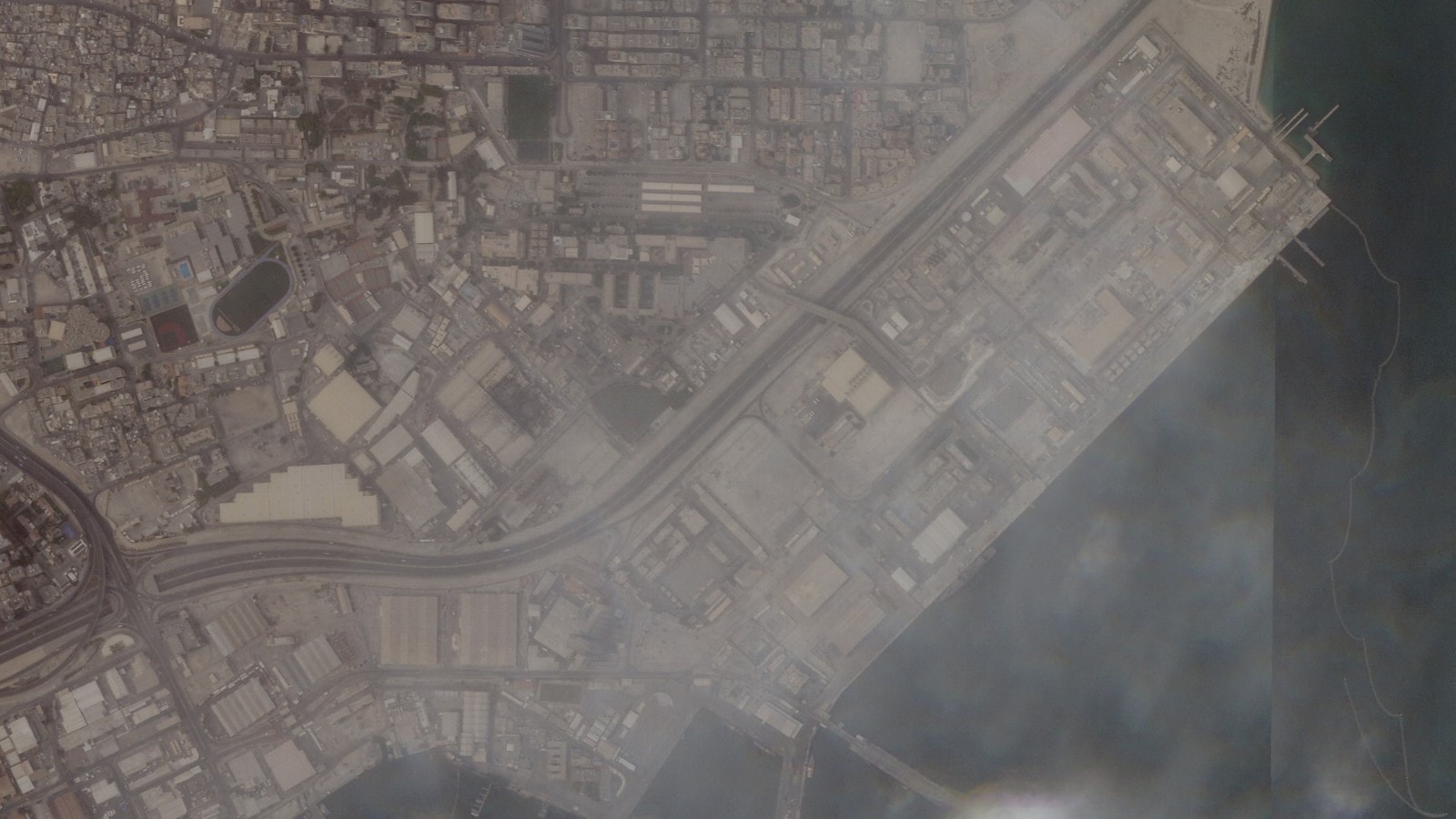
The humidity in Manama doesn't just sit on your skin; it weights your lungs, a thick, salty reminder that the Persian Gulf is always watching. On a clear night, if you stand near the gleaming skyline of the Financial Harbour, the water looks like polished obsidian. It is peaceful. It is also one of the most volatile stretches of liquid on the planet. For the people living here, the headlines about drone strikes and naval blockades aren't abstract geopolitical data points. They are the background radiation of daily life.
Bahrain is an island nation roughly the size of New York City’s five boroughs, yet it carries the strategic weight of a continent. To understand why a tiny archipelago finds itself in the crosshairs of a potential US-Iran conflagration, you have to look past the oil prices and the carrier strike groups. You have to look at the shadow cast by the Fifth Fleet. If you enjoyed this article, you might want to look at: this related article.
Consider a merchant sailor—let’s call him Elias—standing on the deck of a chemical tanker navigating the Strait of Hormuz. To Elias, the "tensions" described in Western media are felt as a rhythmic thrum of anxiety. Every small craft on the horizon is a question mark. Every radar blip is a heartbeat. When a tanker is struck, as has happened with increasing frequency in these contested waters, the global economy feels a tremor in the price of a gallon of gas. But Elias feels the spray of salt water and the very real possibility of fire.
The Unseen Fortress
The United States Naval Support Activity (NSA) Bahrain is not just a base. It is the nerve center for American maritime power in the Middle East. Over 7,000 service members and coalition partners live and work here. It is the home of the U.S. Naval Forces Central Command. If the Persian Gulf is a central artery of the world, Bahrain is the stent keeping it open. For another perspective on this event, see the latest coverage from NBC News.
But keeping that artery open comes with a price tag that isn't measured in dollars. It is measured in vulnerability. When Iran signals its displeasure with U.S. sanctions or regional policy, Bahrain becomes the most convenient "X" on the map. It is close. It is vital. And it is caught between two giants who have been locked in a cold-to-lukewarm dance of death since 1979.
The logic of the conflict is often circular. The U.S. maintains a massive presence to ensure the "free flow of commerce." Iran views that presence as an existential threat parked in its front yard. Iran develops "asymmetric" capabilities—drones, fast-attack boats, sea mines—to counter the U.S. Navy’s sheer tonnage. The U.S. responds by increasing surveillance and deploying more assets.
The cycle repeats.
The result is a maritime environment where a single nervous finger on a trigger could ignite a regional wildfire.
The Anatomy of a Hit
When the news reports "all the hits," they are talking about a theater of shadows. We aren't seeing massive mid-century naval battles with broadsides and sinking battleships. We are seeing the era of the "suicide drone" and the "limpet mine."
In recent months, the cadence of these incidents has accelerated. A tanker linked to an Israeli billionaire is clipped by a delta-wing drone. A few weeks later, a U.S. MQ-9 Reaper is shadowed or harassed. These aren't accidents. They are messages written in cordite.
For the Bahraini government, this puts them in a permanent state of diplomatic gymnastics. They are a Major Non-NATO Ally. They host the base. They provide the infrastructure. Yet, they share a maritime border with Iran. They are a Sunni-led monarchy with a significant Shia population, a demographic reality that Tehran has attempted to leverage for decades.
To live in Manama is to be acutely aware that you are standing on a golden bridge that both sides are tempted to burn.
The Invisible Stakes
Why does this matter to someone sitting in a coffee shop in London, Tokyo, or Des Moines?
It’s easy to dismiss the "tanker wars" as a localized dispute. That is a mistake. Approximately 20% of the world's total oil consumption passes through the Strait of Hormuz. It is the ultimate choke point. If the US-Iran friction escalates to a full-scale blockade or a sustained campaign of sabotage, the "just-in-time" supply chains our modern world relies upon would shatter.
But the economic argument is the cold one. The human argument is more visceral.
The regional "stability" we talk about in policy papers translates to the safety of millions of people who have no say in the maneuvers of the IRGC (Islamic Revolutionary Guard Corps) or the Pentagon. In the souks of Manama, merchants trade in spices and gold, their eyes occasionally drifting to the gray hulls of warships docked nearby. They know that if the "big one" happens, their home is the first target.
There is a specific kind of silence that happens in Bahrain when a major incident is reported. It’s not the silence of ignorance. It’s the silence of a people who have learned to read the wind. They know that when the rhetoric in Washington or Tehran reaches a certain pitch, the air in the Gulf gets just a little bit heavier.
The Ghost of 1988
History in this part of the world isn't something in a book; it’s a living entity. Many naval officers still study Operation Praying Mantis, the 1988 battle where the U.S. Navy destroyed much of the Iranian Navy in a single day after the USS Samuel B. Roberts struck an Iranian mine.
That event shaped the Iranian military philosophy for the next forty years. They realized they couldn't win a conventional fight. So, they went small. They went swarm. They went invisible.
Today, the "hits" we see are the fruition of that philosophy. A drone launched from hundreds of miles away is cheap, deniable, and terrifyingly effective. It bypasses the multi-billion dollar defenses of a carrier strike group by being too small to notice until it’s too late. It is a mosquito with a grenade.
The U.S. finds itself in a precarious position. How do you retaliate against a shadow? If you strike back too hard, you risk a full-scale war that no one—not the American public, not the Iranian people, and certainly not the Bahrainis—actually wants. If you don't strike back, the "hits" become the new normal. The deterrent evaporates.
The Anchors
Bahrain remains the anchor. It is the physical manifestation of the U.S. commitment to the region. As long as those ships are docked in Juffair, the United States is saying, "We are not leaving."
But anchors can also drag.
As the sun sets over the Gulf, the sky turns a bruised purple. The lights of the tankers waiting to transit the Strait look like a necklace of fallen stars on the horizon. It is beautiful, in a haunted sort of way. You realize that these vessels are the lifeblood of our civilization, and they are currently floating in a shooting gallery.
The conflict isn't just about who controls the water. It’s about the terrifying realization that in the modern age, the most powerful military in history can be humbled by a teenage operator with a remote control and a grudge.
The people of Bahrain continue their lives. They go to work, they eat at the bustling restaurants in Adliya, and they raise their children. They have become experts at living in the "in-between." They know that the peace they enjoy is a fragile thing, held together by diplomatic cables and the presence of gray ships.
We watch the headlines for the next "hit." We count the tankers. We track the movements of the carriers. But we often forget the faces of the people who look out their windows every morning and see the frontline of the next great war sitting right there in the harbor, reflecting the morning sun.
The water remains dark. The drones remain in their hangars, for now. And the world holds its breath, hoping the anchor holds for just one more night.


