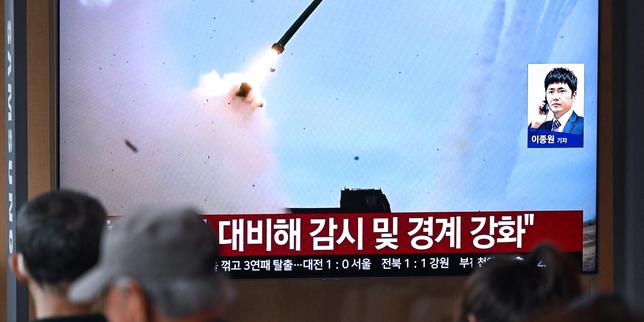
The coffee in Seoul is always hot, but the news is often cold. At 7:30 AM, the commuters in Gangnam barely look up from their smartphones as the alerts vibrate against their palms. Another launch. Another series of short-range ballistic missiles tracing a familiar, terrifying geometry across the sky. To the rest of the world, these are data points in a geopolitical ledger. To the people living under the flight path, they are the background noise of a life lived in the shadow of a volcano that never stops smoking.
South Korea’s Joint Chiefs of Staff reported the activity with the sterile precision of an actuary. Multiple missiles. Launched from the Sariwon area. Trajectories ending in the East Sea.
Numbers. Coordinates. Speed.
But numbers don't capture the sound of a nervous intake of breath in a classroom in Gyeonggi-do when the television screen switches to that grainy, purple-hued footage of a rocket defying gravity. They don't capture the way a grandfather, who remembers the hunger of the 1950s, looks at his grandson and wonders if the cycle of history is a circle or a spiral.
The missiles fired this morning weren't just tests of propulsion and guidance; they were messages written in fire and steel, sent just days before a global audience would turn its eyes toward a monumental election across the Pacific.
The Calculus of Silence
Imagine a technician in a reinforced concrete bunker north of the 38th parallel. Let’s call him Pak. He doesn't see the global headlines. He sees a pressure gauge. He sees the condensation on a fuel line. For Pak, the success of a launch is the difference between a quiet dinner and a specialized interrogation. The stakes for the individual are as high as the stakes for the nation.
When the world talks about "tensions," it treats nations like monolithic chess pieces. We forget that these pieces are made of millions of Paks—people whose daily existence is intertwined with the reliability of a solid-fuel engine.
The recent launches represent a shift in the internal logic of the region. This isn't the old pattern of "provoke and negotiate." The cadence has changed. The frequency of these tests suggests a transition from development to deployment. It is no longer about proving the technology works; it is about proving that the technology is ready.
Consider the timing. The United States is currently preoccupied with its own internal soul-searching, a democratic fever dream that consumes the oxygen of global discourse. Pyongyang knows this. By launching now, they aren't just testing missiles. They are testing the threshold of international attention. They are asking: "How much can we move the needle while you are looking the other way?"
The Invisible Stakes of the East Sea
The East Sea, or the Sea of Japan, is a graveyard for expensive machinery. Each splashdown represents millions of dollars in resources—resources that could, in another reality, be converted into grain, medicine, or infrastructure.
But in the theater of power, the "cost" is viewed differently. The cost of not firing is perceived as higher than the cost of the fuel. For the North, each launch is a shield. For the South, each launch is a reminder of the fragility of the "K-Culture" miracle. You can have the fastest internet and the most polished pop stars in the world, but you cannot change your geography. You are still a peninsula tied to a neighbor who views your prosperity as an existential threat.
The technology itself has evolved into something more sinister than the Scud missiles of the past. We are talking about maneuverable reentry vehicles. We are talking about solid-fuel systems that can be rolled out of a hidden tunnel and fired before a satellite can even blink.
In a hypothetical scenario—let's call it "Red Dawn 2.0"—the warning time for a resident of Seoul would be less than the time it takes to boil an egg.
Six minutes.
That is the reality of the short-range ballistic missile (SRBM). It isn't a weapon of global conquest; it is a weapon of local terror. It turns the sky into a ceiling that could collapse at any moment.
The Digital Shield and the Human Eye
Japan, too, watches with a specialized kind of exhaustion. The Japanese Coast Guard issues its warnings to mariners, telling fishing boats to watch for falling debris. It is a strange, modern hazard—like worrying about a lightning strike that was intentionally aimed.
The defense systems, the Aegis destroyers and the THAAD batteries, represent the pinnacle of human engineering. They are designed to hit a bullet with another bullet in the dark. It is a triumph of mathematics ($v = d/t$ is the easy part; the variables of atmospheric drag and mid-flight course correction are the nightmares).
Yet, for all the trillions spent on interceptors, the real defense remains psychological.
The goal of the missile is not always to explode. Often, the goal is to create a sense of inevitability. To make the world accept that a nuclear-armed North is not a problem to be solved, but a fact of life to be endured. It is the strategy of the slow boil. If you fire one missile, the world screams. If you fire a hundred over a year, the world sighs and changes the channel.
The Weight of the Morning News
Behind the technical specs of the Sariwon launch lies a deeper question about the value of peace. In the West, we often view peace as the absence of war. In East Asia, peace is a precarious equilibrium, a heavy boulder being held up by the collective exhaustion of all parties involved.
The missiles are a reminder that the Korean War never truly ended. It just went into a long, icy hibernation. The 1953 Armistice was a pause button, not a stop button. Every launch is a finger hovering over the "play" icon.
When we read about "several ballistic missiles," we should try to hear the sound they make when they break the sound barrier. We should try to imagine the vibration in the windows of a farmhouse near the border.
The real story isn't the metal. It’s the wait. It’s the way a mother in Incheon looks at her sleeping daughter after reading the news, wondering if the world her child inherits will be defined by the things we build or the things we destroy.
The missiles rise, they arch, and they fall. They leave behind a trail of white smoke that eventually dissipates into the blue, leaving the sky looking exactly as it did before. But the air feels heavier. The silence that follows a launch is never quite the same as the silence that preceded it. It is a silence filled with the knowledge that the next one is already being moved into position, somewhere in the dark, waiting for the next command to pierce the morning.
The arc is complete, the data is recorded, and the coffee in Seoul is finally cold.