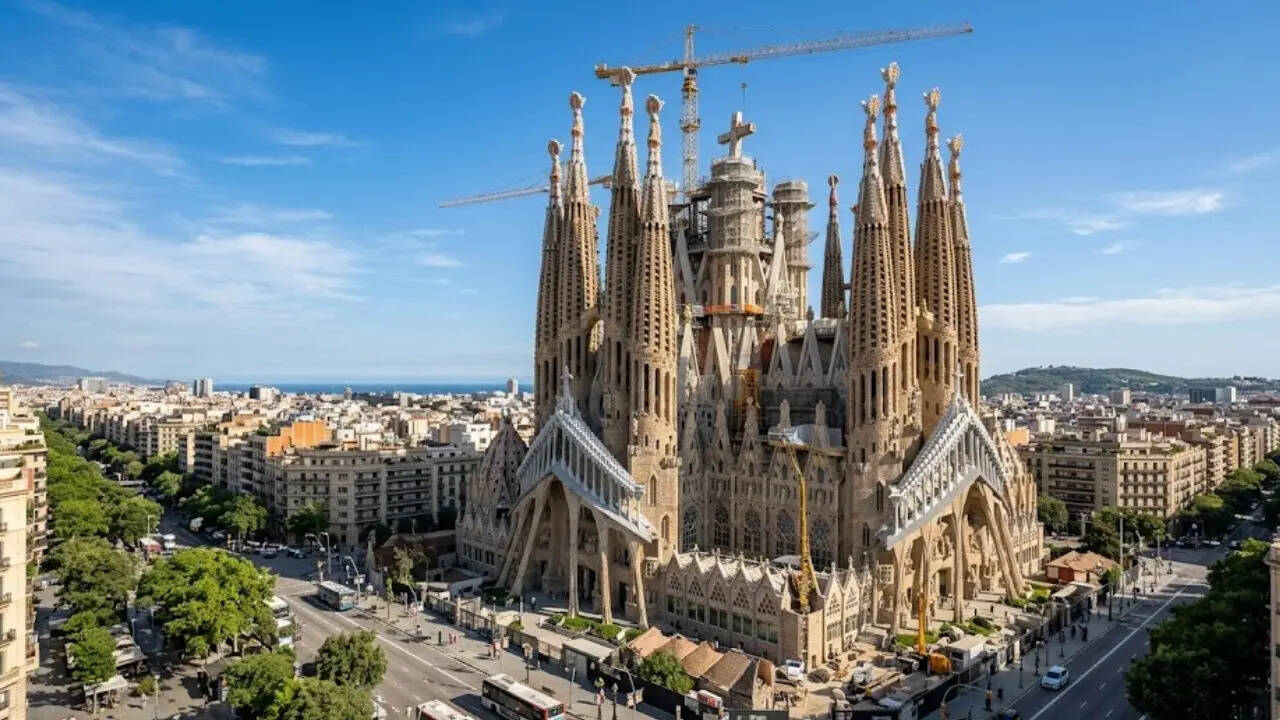
The Sagrada Familia isn't just a church. It’s a 144-year-old construction site that happens to be the most famous landmark in Spain. Most people think it’ll never be finished. They’ve heard the "under construction" joke for decades. But the reality is different now. The scaffolding is actually coming down. The finish line is visible.
Antoni Gaudí knew he wouldn't see the end of his masterpiece. He died in 1926 after being struck by a tram, leaving behind a project that was barely 15 percent complete. Since then, the basilica has survived a civil war, the destruction of Gaudí’s original plaster models, and the sheer technical nightmare of building stone structures that look like they grew out of the ground rather than being stacked by humans.
The 2026 deadline and what it actually means
You might have seen the headlines claiming the entire thing will be done by 2026. That’s a bit of a half-truth. 2026 marks the centenary of Gaudí’s death, and the goal is to finish the Tower of Jesus Christ by then. This tower is the big one. Once it's topped with its massive cross, the Sagrada Familia will officially become the tallest church in the world at 172.5 meters.
Gaudí was specific about that height. He didn't want his work to surpass Montjuïc hill. He felt it was improper for the work of man to rise higher than the work of God.
While the main towers will likely be done in 2026, the decorative details and the controversial Glory Facade will take longer. We're probably looking at 2034 for the absolute final touches. If you're planning a trip to see it "finished," don't wait. The transition from a construction zone to a completed monument is happening right now, and the contrast is incredible.
Why this took over a century to build
Speed was never the point. Gaudí famously said his client—God—wasn't in a hurry. But there were more practical hurdles. For a long time, the project relied entirely on private donations. No government funding. No church coffers. It was literally built cent by cent by the people of Barcelona and curious tourists.
Then there was the 1936 problem. During the Spanish Civil War, anarchists set fire to Gaudí’s workshop. They smashed his models and burned his plans. Architects spent years like detectives, piecing together fragments of plaster to figure out how Gaudí intended to support the massive weight of the roof.
They realized Gaudí wasn't using standard geometry. He was using ruled surfaces—hyperboloids, paraboloids, and helicoids. These shapes are common in nature but were a massive headache for builders in the early 20th century. Modern computers changed everything. Aeronautical software now does in minutes what used to take years of manual stone-cutting.
The controversy of the Glory Facade
Not everyone in Barcelona is cheering for the completion. The Glory Facade is the main entrance, and to build it according to Gaudí's grand vision, the city might have to demolish an entire block of apartments.
This isn't a small neighborhood spat. We're talking about roughly 1,000 families and businesses that could be displaced to make room for a giant staircase. The local residents' association has been fighting this in court for years. They argue the staircase wasn't even in Gaudí’s original plans but was an interpretation by his successors.
It’s a messy situation. You have a UNESCO World Heritage site on one side and the property rights of actual citizens on the other. The city council is stuck in the middle. This is why the "completion" date is so slippery. Building a tower is easy compared to winning a legal battle against your neighbors.
What you see inside today
If you haven't stepped inside recently, forget everything you know about dark, gothic cathedrals. The Sagrada Familia is bright. It’s a forest. Gaudí designed the interior columns to branch out like trees, creating a canopy that holds up the ceiling.
The light is the real star. The stained glass is arranged by color temperature. On the side where the sun rises, the windows are cool blues and greens. On the sunset side, they’re fiery reds and oranges. At about 4:00 PM on a sunny day, the entire nave looks like it's on fire. It’s breathtaking. It’s also a feat of engineering that ensures the weight of the stone doesn't crush the delicate glass.
Modern tech meets ancient stone
The builders aren't using hammers and chisels much these days. They use 3D printing and CNC milling. Large sections of the towers are now "pre-fabricated" off-site in a massive workshop in Galera.
These stone panels are reinforced with steel and then trucked into the center of Barcelona. They’re lifted by cranes and slotted into place like a giant LEGO set. This is the only reason the project has accelerated so much in the last ten years. Without this tech, we'd still be waiting another century.
How to visit without hating the crowds
The Sagrada Familia gets millions of visitors a year. It's crowded. It’s loud. If you just show up, you won't get in. Tickets sell out weeks in advance.
Book the earliest slot possible. 9:00 AM is your best bet to see the light hitting the Nativity Facade. If you can, book a tower tour. You’ll get to take a tiny elevator up and walk down the narrow spiral stairs. You see the fruit-shaped pinnacles up close. You see the gaps in the stone where the wind whistles through. It’s a perspective you can't get from the ground.
Don't just look at the church. Look at the surrounding streets. Notice how the Eixample district was built in a perfect grid, and then this organic, melting stone structure just erupts in the middle of it.
Next steps for your Barcelona trip
Start by checking the official Sagrada Familia website for ticket availability right now. If you're going in the next three months, they're probably already moving fast.
Avoid the "Skip the Line" tours sold by third parties on the street. They're often overpriced and don't offer anything you can't get by just buying a standard ticket with an audio guide. Wear comfortable shoes. You'll be looking up so much your neck will hurt, so take breaks in the small park across the street to get the full-scale view. Check the local news for any updates on the Glory Facade legal rulings if you want to see the "unfinished" parts before they potentially change the city's map forever.