The woman at the jewelry counter in Chicago doesn’t see the mud. She sees the 18-karat glow reflecting off the halogen bulbs. She sees a promise of forever. When the jeweler slides the ring onto her finger, he talks about "purity" and "investment." He mentions the "fine quality" of the metal, sourced from reputable North American suppliers.
He is telling the truth as he knows it. But his truth stops at the refinery door.
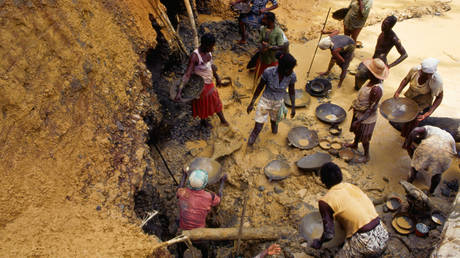
Thousands of miles south, in the dense, humid jungles of Colombia and the rugged highlands of Mexico, the "purity" looks different. It looks like mercury poisoning. It looks like a shallow grave. It looks like a local farmer being told at gunpoint that his land now belongs to the Sinaloa Cartel or the Clan del Golfo.
Gold has a unique property: it is a master of disguise. Once melted down, a bar of gold sourced from a legal Canadian mine looks identical to a bar of gold extracted by a teenager working for a drug lord. This is the alchemy of modern crime. Criminal organizations have discovered that gold is a far more efficient vehicle for moving wealth than cocaine. It doesn't rot. It doesn't lose value in the rain. And, most importantly, it can be "laundered" into the legitimate global economy with a simple stamp of a refinery’s seal.
The United States and Canada are the primary destinations for this tainted wealth. We aren't just bystanders to the cartel wars; we are the end-users.
The Invisible Pipeline
Consider a hypothetical, but statistically grounded, path of a single ounce of gold.
It begins in an illegal "hole" in the Antioquia region of Colombia. There are no safety harnesses here. No environmental regulations. The miners—often locals forced into labor or desperate migrants—use high-pressure hoses to blast away riverbanks, dumping tons of sediment and toxic mercury into the water supply. The mercury binds to the gold, making it easier to collect, but it also enters the fish, the soil, and the bloodstreams of the children living downstream.
This gold is "dirty" in every sense.
To make it "clean," the cartel moves it to a front company. Maybe it’s a local jewelry shop or a shell corporation registered as an export business. They mix the illegal gold with a small amount of legally mined metal. They forge the paperwork. By the time that gold reaches a refinery in Miami or a processing plant in Ontario, it has a paper trail that looks pristine.
Refineries in North America are required to perform "due diligence." They are supposed to ask questions. But when the paperwork matches the shipment, and the demand for gold is at an all-time high, those questions often become a whisper. The gold is melted. The atoms of the cartel’s profit are fused with the atoms of legitimate commerce.
The blood is washed off in the furnace.
Why Gold Is the New Cocaine
For decades, the primary headache for a drug cartel was the "cash problem." If you sell $50 million worth of fentanyl, you end up with a mountain of physical currency that is heavy, smells like drugs, and is incredibly difficult to move across borders without attracting the DEA.
Gold solves this.
A single suitcase can hold millions of dollars worth of gold. Even better, while drug trafficking carries massive prison sentences and international stigma, "illegal mining" is often treated as a regulatory hiccup. In many jurisdictions, the penalties for environmental crimes or smuggling minerals are a fraction of those for narcotics.
The cartels have realized that they can control the entire vertical. They control the land, they control the labor, they control the transport, and they control the export. By the time the U.S. Treasury Department realizes a specific refinery is processing cartel gold, that gold has already been sold to a tech giant for circuit boards or a bank for bullion.
It is estimated that in some South American countries, the value of illegal gold exports now exceeds the value of cocaine. We are witnessing a fundamental shift in the economics of organized crime. The "war on drugs" has evolved into a "war on resources," and the cartels are winning because they have found a way to make us their unwitting business partners.
The Human Cost of the Shine
We often talk about these issues in terms of "supply chain transparency" or "regulatory gaps." Those are sterile words. They hide the screams.
In the mining towns controlled by these groups, the "law" is whatever the man with the rifle says it is. If a local community protests the poisoning of their river, their leaders disappear. If a small-scale miner refuses to pay the "vacuna"—the protection tax—his equipment is blown up, or worse.
Women and girls are trafficked into these mining camps to serve as "entertainment" for the laborers. The camps are lawless zones where the sovereign state has no footprint. The only authority is the profit margin.
When we buy a gold necklace or a new smartphone in a sleek mall in Toronto, we are connected to that lawlessness by an invisible thread. The complexity of the global trade allows us to maintain a comfortable distance. We tell ourselves that because we bought it from a reputable brand, it must be "ethical."
But the reality is that the gold market is a giant, churning pot. Once the metal is refined to 99.9% purity, its history is deleted. It becomes a blank slate.
The Failure of the Gatekeepers
Why can’t we stop this?
The problem lies in the sheer volume of trade and the ease of deception. A refinery might process gold from hundreds of different sources. They rely on "local auditors" in South America to verify that the mines are legitimate. But who audits the auditors? In regions where the cartel’s influence reaches into the highest levels of government and police, a "clean" certification can be bought for the right price.
Furthermore, North American laws have struggled to keep pace. While the U.S. has the Dodd-Frank Act, which targets "conflict minerals" like tin and tungsten from the Democratic Republic of Congo, gold is more elusive. It is sourced from everywhere.
In Canada, home to some of the world's largest mining companies and most sophisticated refineries, the oversight has been criticized for being too reliant on self-reporting. We are essentially asking the industry to police itself while it is under immense pressure to meet the soaring global demand for gold.
Every time the price of gold hits a new record, the incentive for the cartels to destroy another acre of rainforest grows. Every time the geopolitical climate gets shaky and investors flee to the "safety" of gold, the shadow economy expands.
The Mirror in the Metal
We like to think of ourselves as the "good guys" in this narrative—the consumers who just want a nice watch or a secure retirement fund. But the cartels don't see us as consumers. They see us as the ultimate "washers."
Every dollar we spend on gold that hasn't been rigorously, independently traced from a specific, legal pit to the finished product is a dollar that could be funding a cartel's next shipment of weapons or its next bribe to a local official.
The difficulty is that "rigorous tracing" is expensive. It slows down the "seamless" flow of global trade. It requires companies to admit that they don't always know where their raw materials come from. It requires us, the public, to demand more than just a "recycled gold" label—which is often just another way to hide the origin of newly mined cartel metal.
The next time you hold a piece of gold, look past the shine.
Try to see the mercury in the water. Try to see the trees cleared from the Amazon. Try to see the faceless men in the jungle who are getting rich off our desire for something eternal. Gold is supposed to be the ultimate store of value, a symbol of everything that lasts.
But if that value is built on the destruction of lives and the empowerment of the world's most violent organizations, what exactly are we storing?
The metal is heavy. It is cold. And if you look closely enough, you might realize that the "purity" we’ve been sold is the greatest fiction of all. Our wealth is their weapon, and the refinery is the place where we agree to forget that.