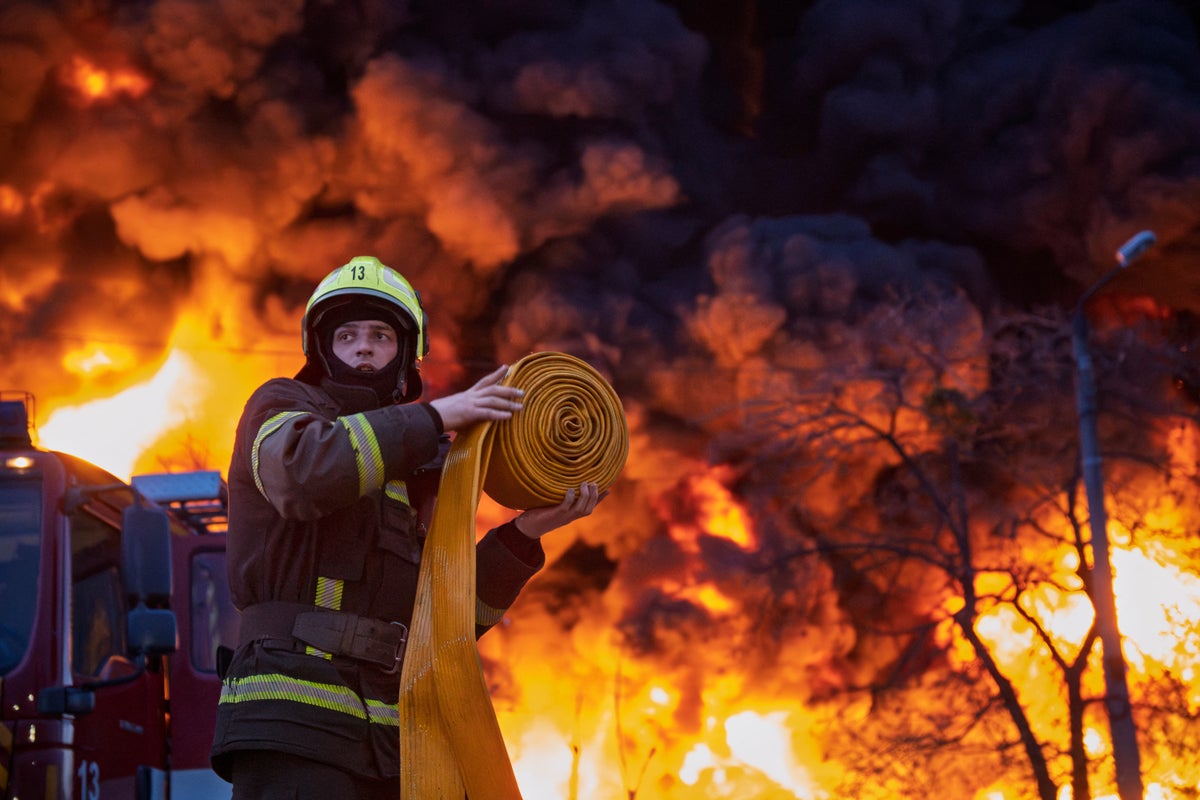
Western media has fallen into a predictable, rhythmic trap. Every time a Russian missile strike hits a civilian center in Kyiv or Kharkiv, the headlines follow a scripted choreography. They lead with the visceral horror of a child’s death, pivot to "Putin’s desperation," and finish with a vague call for more Western resolve. This isn't journalism; it’s emotional maintenance.
By focusing on the tragedy of the moment, the press misses the cold, industrial reality of what is actually happening. These strikes aren't "accidents" born of incompetence, nor are they purely "terror" tactics intended to break morale. They are calculated moves in a long-form game of logistics and air defense depletion.
If you want to understand the war, stop looking at the wreckage and start looking at the intercept rates.
The Myth of the Desperate Aggressor
The "Russia is running out of missiles" narrative has been the most durable piece of misinformation since 2022. We’ve heard it from British intelligence, American think tanks, and Ukrainian officials. Yet, three years in, the salvos are getting larger and more sophisticated.
The harsh truth? Russia has moved to a full-scale war footing that the West refuses to acknowledge. While the U.S. and Europe bicker over budget cycles and election optics, the Russian military-industrial complex has tripled its production of long-range precision munitions. They aren't "desperate." They are scaled.
When we focus on the civilian casualties, we ignore the strategic intent. These strikes serve a dual purpose:
- Air Defense Cannibalization: Russia forces Ukraine to choose between protecting front-line troops or protecting children in Kyiv. Every Patriot missile used to intercept a Kh-101 over a residential block is one less missile available to stop a Su-34 from dropping a glide bomb on a trench.
- Economic Exhaustion: It costs Russia roughly $1 million to $5 million to build a cruise missile. It costs Ukraine’s allies significantly more to maintain the sophisticated defense systems required to shoot them down. This is an asymmetrical math problem that Ukraine is currently losing.
The Cost of Moral Superiority
The West treats the war as a moral play. It’s a battle of good versus evil, democracy versus autocracy. While that might be true in a philosophical sense, wars are won by the side that can produce 155mm shells and ballistic missiles faster than the other side can consume them.
By prioritizing "outrage" over "output," the NATO alliance has failed to mobilize its own industrial base. We are sending Ukraine just enough to not lose, but never enough to win. This middle-ground policy is the most expensive and lethal option available. It guarantees a slow, grinding war of attrition where the side with the larger population and the more robust (and brutal) supply chain eventually wins.
I have watched defense contractors in the U.S. and Europe wait months for "clear signals" from governments before expanding production lines. In a war of this scale, that hesitation is a death sentence. While we "discuss" the ethics of long-range strikes, the other side is simply building more rockets.
Why High Intercept Rates are a Trap
Ukraine frequently reports intercept rates of 80% or 90%. The media presents this as a victory. It isn't.
In a war of attrition, an 80% intercept rate is a failure for the defender. If Russia fires 100 missiles and 10 hit their targets, they have likely damaged a power plant, a command center, or a logistics hub. More importantly, they have forced Ukraine to expend 100+ highly expensive interceptors.
The Russians are using "decoy math." They mix cheap, Iranian-designed Shahed drones with high-end hypersonic Kinzhals. They want the Ukrainian defenses to light up, revealing their positions and burning through their inventory.
- The Decoy: Costs $20,000.
- The Interceptor: Costs $2,000,000.
You don't need to be a math genius to see where this leads. If the West doesn't radically shift its strategy from "intercepting everything" to "destroying the launchers on the ground," Ukraine will eventually run dry.
The Fallacy of the Red Line
Every time a strike hits Kyiv, the debate about "red lines" resurfaces. "Can we allow Ukraine to strike back into Russian territory with ATACMS or Storm Shadow?"
This is the wrong question. The "red line" is a psychological construct designed by the Kremlin to paralyze Western decision-makers. It has worked spectacularly. By restricting Ukraine’s ability to strike the airfields and factories where these missiles originate, the West has effectively granted Russia a "safe zone" from which to commit mass murder.
Imagine a boxing match where one fighter is allowed to hit his opponent, but the opponent is only allowed to block. No matter how good the blocks are, the defender will eventually get tired, take a hit to the chin, and go down.
Stop Crying and Start Welding
The tragedy of a child killed in an overnight raid is undeniable. But crying about it on Twitter (or X) does nothing to stop the next one.
The only way to end these attacks is to make them physically impossible to carry out. That requires:
- Lifting all geographic restrictions on Western weaponry. If a missile is fired from an airfield in Russia, that airfield should cease to exist forty minutes later.
- Pre-emptive Industrial Sabotage: The West has the capability to disrupt the global supply chains Russia uses for microchips and high-end components. We aren't doing it aggressively enough because we fear the "economic blowback."
- Massive Scale: We need to stop treating 31 Abrams tanks or a handful of F-16s as "game-changers." They are drops in a bucket.
The current trajectory leads to a frozen conflict where Russia keeps its gains and continues to lob missiles into Ukrainian cities for the next decade. If that’s the "success" the West is aiming for, we should be honest about it.
If we actually want to protect civilians in Kyiv, we need to stop focusing on the victim and start focusing on the factory. The moral high ground is a lonely place when you’re standing on it while your house is being burned down.
Buy the ammo. Deliver the long-range systems. Let the Ukrainians hit back. Or admit that you’ve already decided that Ukrainian lives are a price you’re willing to pay for "stability" with Moscow.
Pick one. The middle ground is just a graveyard with better PR.