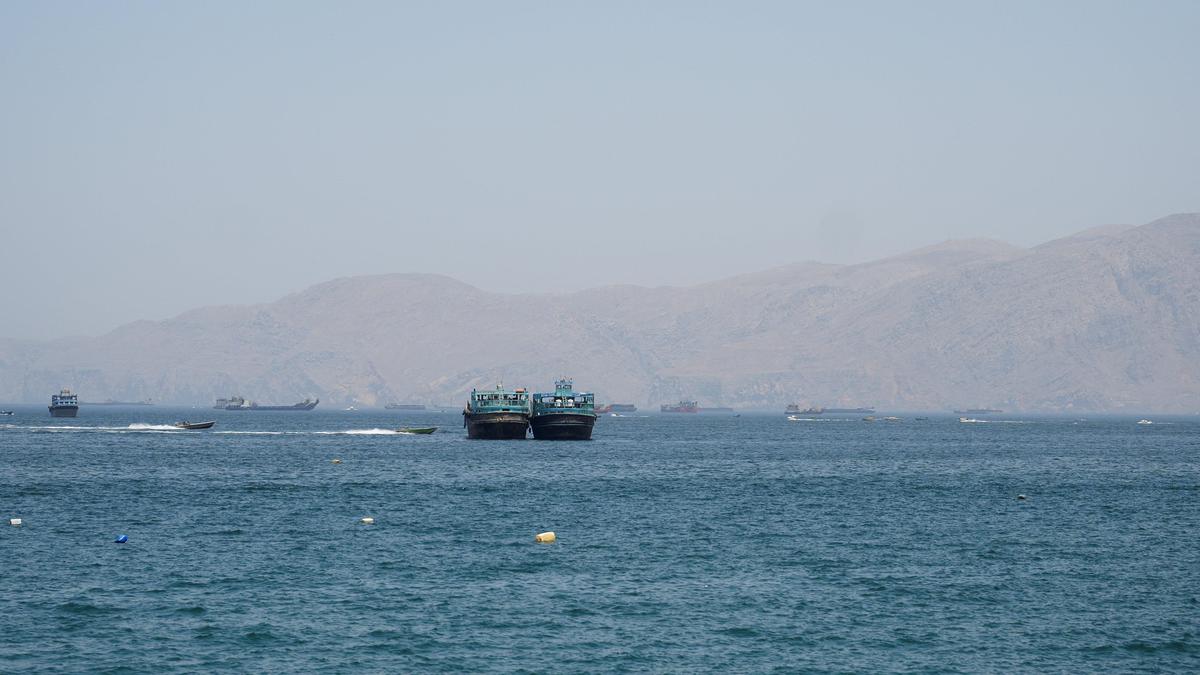
The attack on an Indian-flagged vessel off the coast of Oman is not an isolated incident of maritime misfortune. It is a loud, violent confirmation that the Indian merchant fleet has become a prime target in a geopolitical chess match it is not equipped to play. While the Ministry of External Affairs (MEA) maintains that all crew members are safe and has labeled the strike "unacceptable," these diplomatic condemnations do little to shield the sailors currently navigating the volatile waters of the Arabian Sea. The reality is that the security architecture protecting one of the world's most vital trade arteries is failing.
The Mirage of Maritime Security
For years, the international community relied on a predictable set of rules for transit through the Gulf of Oman and the Red Sea. Those rules are gone. The recent strike against an Indian-flagged ship underscores a terrifying shift in asymmetric warfare. We are no longer dealing with ragtag pirates looking for a ransom payout. Instead, we are seeing the deployment of sophisticated suicide drones and anti-ship missiles provided by regional powers to proxy groups.
The MEA statement focused on the safety of the crew, which is the immediate priority. However, the industry is looking at the long-term viability of these routes. If an Indian flag no longer provides a layer of neutrality or protection, the insurance premiums for these vessels will skyrocket. This isn't just about a hole in a hull. It is about the cost of every barrel of oil and every container of grain entering Indian ports. When risk rises, the consumer pays the bill.
A Targeted Campaign Against Global Interconnectedness
Why India? Why now? To understand the "why," we have to look past the immediate splash of the explosion. India has spent the last decade positioning itself as a bridge between the West and the Global South. It is a founding member of the IMEC (India-Middle East-Europe Economic Corridor), a project designed to bypass traditional bottlenecks. For those interested in disrupting global trade or challenging the influence of New Delhi, hitting an Indian-flagged ship is the most direct way to send a message.
The attackers are exploiting a specific vulnerability. While the Indian Navy has increased its presence in the Arabian Sea, it cannot be everywhere at once. The "Golden Hour" for a maritime strike is often minutes long—too short for a destroyer hundreds of miles away to intervene. This creates a vacuum of power that non-state actors are more than happy to fill. They aren't just attacking a ship; they are attacking the idea that the seas are a global common.
The Failure of Standard Defense Protocols
Merchant ships are notoriously "soft" targets. They are large, slow, and constrained by predictable shipping lanes. Current defense protocols for Indian vessels involve a mix of private security details and Navy escorts. But there is a glaring problem.
- Private Security Limitations: Most onboard security teams are armed with small arms. These are effective against boarders in skiffs, but they are utterly useless against a drone diving from 2,000 feet at 150 miles per hour.
- Electronic Warfare Gaps: Most merchant vessels lack the electronic jamming suites necessary to disrupt the GPS or radio links of an incoming loitering munition.
- The Escort Dilemma: The Indian Navy’s mission has expanded from anti-piracy to high-intensity regional policing. This stretches resources thin, leaving many ships to run the gauntlet alone.
We are seeing a massive technological mismatch. The cost of the drone used in the Oman attack was likely less than the cost of the fuel the ship burned that day. This is the definition of "unacceptable" in a way the MEA didn't mention: the cost of defense is becoming exponentially higher than the cost of offense.
The Economic Shrapnel
When a ship is hit, the damage extends far beyond the engine room. The maritime industry operates on razor-thin margins and ironclad schedules. A single "unacceptable" incident triggers a cascade of economic reactions.
First, the War Risk Surcharge. Underwriters are already re-evaluating the "safe" zones off the Omani coast. Once a region is flagged, every ship passing through—regardless of nationality—sees its insurance costs double or triple. For an Indian fleet that is already struggling to compete with lower-cost carriers, this is a body blow.
Second, the Crewing Crisis. Indian seafarers make up a massive percentage of the global maritime workforce. When news of an Indian-flagged ship being hit reaches the training academies in Chennai or Mumbai, it isn't just a news headline. It's a deterrent. If the flag of their own nation cannot protect them, why would they serve under it? We are risking a "brain drain" at sea that could take a generation to fix.
Beyond the Diplomatic Protest
The MEA's rhetoric is standard fare for the international stage, but veteran observers know that words carry no weight in the Strait of Hormuz. India is at a crossroads. It can continue to issue "firm" statements while its ships are used as target practice, or it can fundamentally change its maritime doctrine.
This requires more than just more patrol boats. It requires a hard-nosed look at why these attacks are succeeding. Is the intelligence sharing with regional partners like Oman and the UAE sufficient? Clearly not. Is the integration between the merchant navy and the military navy seamless? Hardly.
We are watching a transition from "maritime crime" to "maritime insurgency." In an insurgency, the goal isn't to win a battle; it's to make the cost of doing business so high that the other side gives up. For India, giving up isn't an option. Its energy security depends on these lanes. Its export-led growth depends on these lanes.
The Hardware Gap
The industry needs to stop pretending that "vigilance" is a strategy. Vigilance doesn't stop a drone. If the government wants to protect the Indian flag, it must facilitate the installation of active defense systems on civilian ships. This is a legal and logistical nightmare, but the alternative is to watch the Indian merchant marine wither away.
We should be talking about automated point-defense systems and localized jamming bubbles for high-value convoys. We should be discussing the legal frameworks that allow merchant captains to take more aggressive defensive measures. Instead, we are discussing the "safety of the crew" as if a lack of casualties makes the attack any less of a strategic defeat.
The strike off the Oman coast was a test. It was a test of India's resolve and its ability to protect its assets far from home. By responding with nothing but a press release, the message sent back is clear: the lanes are open for anyone with a drone and a grudge. The next attack won't be a surprise; it will be a consequence.
India must decide if it wants to be a maritime power or just a nation with a lot of coastline. Being a power requires the willingness to project force and the technical capability to render these "unacceptable" attacks impossible. Until the cost for the attackers exceeds the cost for the shipping companies, the drones will keep flying.
The smoke from the Oman attack has cleared, but the fire is still burning in the world’s most dangerous waterway. It’s time to stop talking about the safety of the crew and start talking about the survival of the flag.
Invest in shipboard electronic countermeasures immediately or prepare to pay the ransom of increased insurance and lost trade for the next decade.