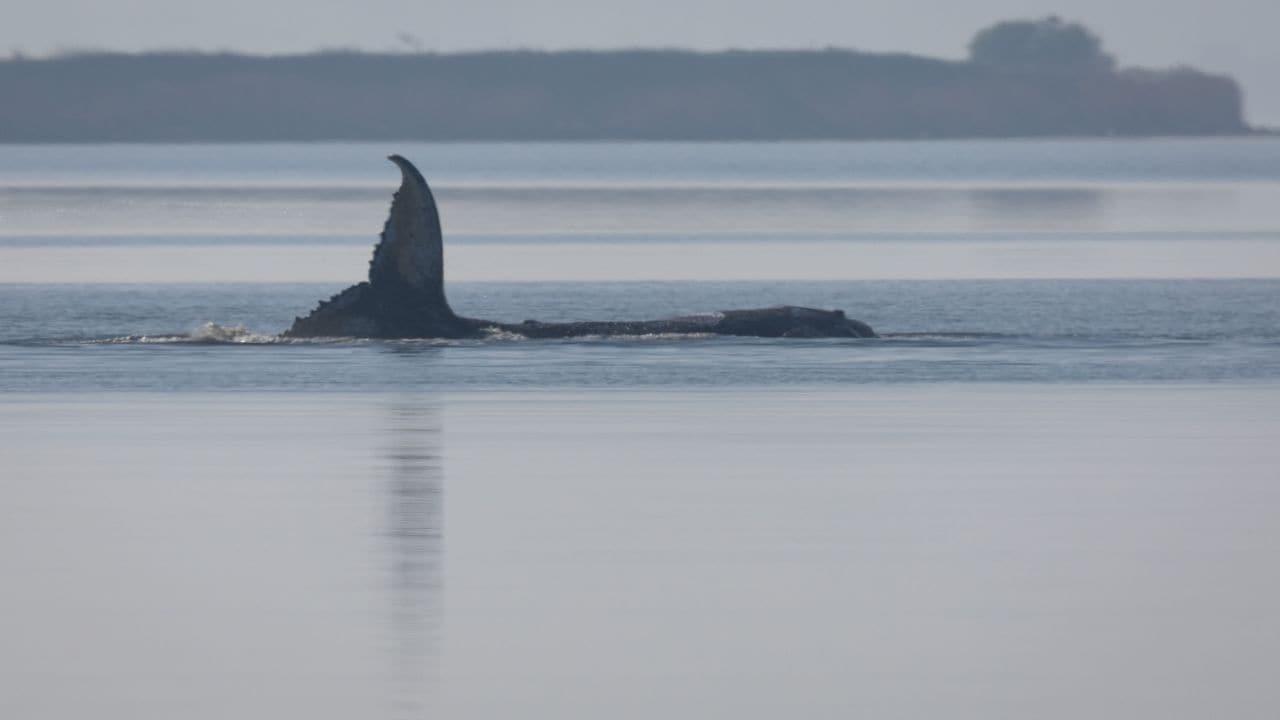
The Baltic Sea is a death trap for a humpback whale. It is too shallow, too fresh, and too loud. For the past seven weeks, a fifteen-meter humpback nicknamed Timmy has been dying in slow motion in front of a global audience. Despite a late-night escape from a sandbank near the island of Poel on April 20, 2026, the animal remains a prisoner of geography and biology. The reality of the situation is grimmer than the hopeful headlines suggest.
While the world watches livestreams of the mammal's heavy breathing, the ecological and physiological facts point to a tragic conclusion. This is not a rescue mission anymore; it is a public relations battle between human sentiment and the cold physics of the ocean. Expanding on this idea, you can also read: The Iranian Ship Seizure and Why Dual Use Cargo Is a Global Security Nightmare.
The Physiological Breaking Point
A humpback whale in the Baltic is a biological anomaly. These animals are built for the high salinity and immense depths of the Atlantic. The Baltic Sea, particularly around the coast of Mecklenburg-Western Pomerania, is essentially a brackish lake.
The low salt content is the first silent killer. Timmy is currently suffering from severe skin sloughing and lesions because his body cannot maintain osmotic balance in water this fresh. Rescuers have resorted to applying kilos of zinc ointment to his back—a desperate, almost symbolic gesture for an animal the size of a city bus. Observers at The New York Times have also weighed in on this situation.
Nutrition is the second hurdle. Humpbacks require massive quantities of krill or fatty fish like herring to maintain their blubber layers. While Timmy may have entered the Baltic chasing a shoal of herring, the energy he has expended struggling against sandbanks for fifty days far outweighs any caloric intake. He is effectively starving while his own body weight crushes his internal organs every time the tide recedes and leaves him pinned to the seabed.
The Logistics of a Failed Intervention
The public outcry in Germany has forced the government into a corner. Early in April, state officials tried to end the rescue operation, citing the animal’s deteriorating health and the "maximum rest" principle. They were met with fierce protests.
Now, we see the rise of private-sector heroics. A group of entrepreneurs, funded by the deep pockets of a retail electronics tycoon, has proposed a radical plan involving industrial air cushions and a pontoon transport system. The idea is to lift the whale, secure him to a tarp, and tow him hundreds of kilometers back to the North Sea.
The technical hurdles are nearly insurmountable.
- Weight Distribution: Lifting a forty-ton animal without snapping its ribs or causing a fatal drop in blood pressure is a feat of engineering rarely successful in the wild.
- Navigation: The journey out of the Baltic requires navigating narrow, high-traffic straits between Danish islands.
- Sedation: You cannot easily sedate a whale for a multi-day tow. If he panics while strapped to a pontoon, the result will be catastrophic for both the whale and the crew.
The Sound of Disorientation
Why did Timmy end up here? The investigative trail leads to the increasing noise floor of the North and Baltic Seas. Whales navigate using a complex acoustic map. Between the constant thrum of commercial shipping, the construction of offshore wind farms, and military sonar, the "acoustic fog" in these waters is denser than ever.
Historical data suggests that strandings in the Baltic are increasing as migration routes are pushed closer to the coast by industrial noise. Timmy likely didn't just "lose his way." He was likely driven into a corner by a wall of sound he couldn't escape. Once a whale enters the Skagerrak and moves south into the Kattegat, the path back to the Atlantic becomes a labyrinth of shallow channels and islands. For a disoriented, acoustic-reliant predator, it is a maze with no exit.
The Ethics of the Livestream
There is a voyeuristic cruelty to the current media coverage. Local outlets have maintained 24-hour feeds of the whale’s distress. We are watching a wild animal succumb to organ failure and skin infections in real-time.
While influencers debate whether to "let him die in peace" or "fight to the end," the actual experts—the biologists who have spent decades studying cetacean health—are being drowned out by the noise of the crowd. Euthanasia has been discussed but is politically radioactive. No politician wants to be the one who signed the order to put down "Timmy," especially when the public still believes in a cinematic rescue.
The Inevitable End
As of this morning, the water levels in Wismar Bay are dropping again. Timmy’s brief moment of freedom during the high tide was short-lived; he has already come to a halt on a secondary sandbank. He is not "resting," as some officials claim. He is failing.
The hard truth is that the Baltic Sea is not a home for humpbacks, and our attempts to "fix" a biological error with air cushions and zinc ointment may be doing more to soothe our collective conscience than to save the animal. If Timmy does not reach the deep waters of the Skagerrak within the next forty-eight hours, the rescue ships will become recovery vessels.
We are witnessing the limits of human intervention in the natural world. Sometimes, the most "human" thing to do is to acknowledge that the ocean has already made its decision.