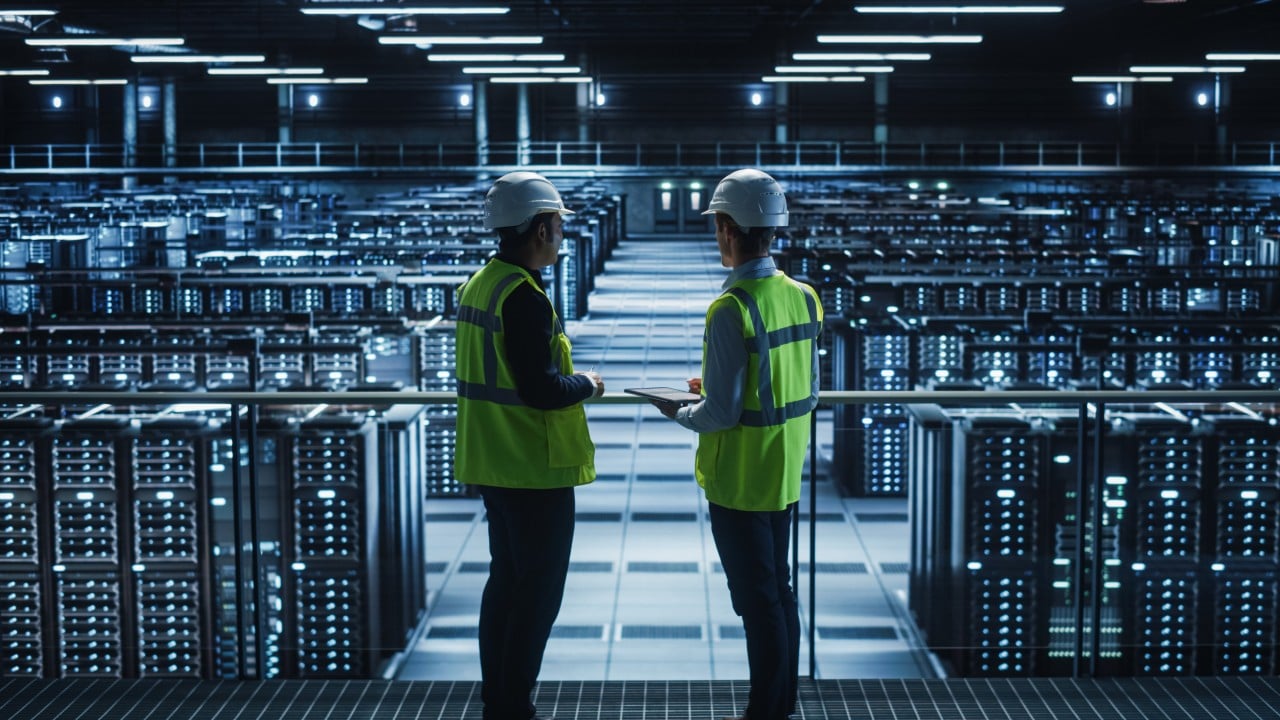
You have probably been told that the generative artificial intelligence race is won by whoever hoards the most advanced graphic processing units. That is only half the story. The real bottleneck isn't just silicon anymore. It is the raw electricity required to spin those chips and the networks that move the resulting data.
While Western tech giants scramble to build hyper-scale data centers next to strained municipal power grids, China is executing a radically different playbook. They are treating computing capacity like physical water or electricity, building a massive, interconnected domestic network designed to turn cheap, remote energy into high-value digital exports.
If you want to understand how massive this shift is, look at the numbers released by the National Data Administration. In March 2026, Chinas average daily token calls shattered records, surpassing 140 trillion. That is a staggering 1,400-fold increase from the 100 billion daily tokens logged at the start of 2024. This explosion in demand is the driving force behind Beijing formalizing its computing power network into the nations core planning frameworks, with investments expected to cross 7 trillion yuan this year alone.
It is a structural transformation that changes how we think about tech infrastructure. China isn't just building data centers. It is building an industrial pipeline that converts stranded western green energy into global AI services.
The Token Export Strategy Changing the Value Chain
Most people look at electricity as something you can't easily export across oceans. Power lines lose juice over long distances, and shipping batteries is expensive. But Chinese AI firms realized they could package their massive reserves of cheap domestic electricity and computing power to process tokens, which are then delivered globally via simple API calls.
This friction-free trade is basically a massive value upgrade. Selling raw electricity in northwestern China brings in pennies. But when you convert that same electricity into AI computing power to output tokens, the value jumps by an estimated 22-fold.
This economic engine showed its teeth when Chinese models outperformed US rivals in weekly token usage on OpenRouter, a global API aggregator. Models like MiniMax M2.5, Kimi K2.5, Zhipu GLM-5, and DeepSeek V3.2 took over four of the top five spots on the platform. Western developers accounted for nearly half of that user base, meaning American apps are quietly running on infrastructure fueled by Chinese power plants.
Power costs make up 60% to 70% of large-model operating costs. By using efficient Mixture of Experts architectures, which activate only a fraction of a model for simpler tasks, Chinese engineers dramatically cut the compute needed per token. Combine that software efficiency with rock-bottom power rates, and you get a price-to-performance ratio that foreign competitors are finding incredibly hard to match.
Balancing the Grid Through East Data West Computing
The physical backbone of this strategy rests on solving a major geographic mismatch. Chinas economic engines and data creators sit in densely populated eastern coastal hubs like Shanghai, Shenzhen, and Beijing. But these megacities don't have the spare land, cooling resources, or cheap electricity to feed thousands of hungry server racks.
The west, however, has plenty of space and an abundance of wind, solar, and hydro energy. The "East Data, West Computing" initiative serves as the national blueprint to bridge this gap.
Take the remote city of Qingyang in Gansu province. It is rapidly transforming into a major computing hub. Amidst the loess hills, massive wind turbines and solar fields provide green power directly to an industrial park that has already built over 102,000 standard racks, hitting a capacity of 142,000 PFlops.
Regional Asymmetry in Computing Infrastructure
┌──────────────────────────────────┐      ┌──────────────────────────────────┐
│          EASTERN HUBS            │      │           WESTERN HUBS           │
│  (Beijing, Shanghai, Guangdong)  │      │   (Gansu, Guizhou, Inner Mong.)  │
├──────────────────────────────────┤      ├──────────────────────────────────┤
│ • High concentration of users    │      │ • Abundant land & cool climates  │
│ • Generates "hot", real-time data│      │ • Cheap, surplus green energy    │
│ • Severe power & space limits    │      │ • High-latency tolerant workloads│
└─────────────────┬────────────────┘      └─────────────────▲────────────────┘
                  │                                         │
                  └─────────────── High-Speed ──────────────┘
                                   Data Highway
By aggregating green energy, the park guarantees that companies pay no more than 0.4 yuan per kilowatt-hour. That is roughly 6 US cents. It allows eastern platforms to offload heavy, non-real-time training workloads and deep data analysis to the west, while keeping immediate, low-latency tasks closer to coastal users.
Network Bottlenecks and the Reality of Overcapacity
It isn't all smooth sailing, though. If you talk to engineers on the ground, they will tell you that building rows of servers near wind farms sounds great in theory, but running real-time AI workloads across thousands of miles introduces massive logistical headaches.
The biggest hurdle is network latency and packet loss. On standard high-performance networks, even a tiny 0.1% packet loss rate can slash total computing efficiency by 50% because processors waste time waiting for retransmissions. When eastern data hits western hubs, traditional internet routing just can't guarantee the steady, predictable performance required for complex AI workloads.
This technical bottleneck has created a noticeable rift:
- Eastern data centers remain heavily overcrowded because developers want their models physically close to users to avoid latency.
- Some western facilities suffer from low utilization rates, leading to localized overinvestment and bidding wars between provinces.
To tackle this, the central government activated the Future Network Test Facility, an ultra-high-speed optical network connecting data centers across 40 cities. By enforcing deterministic data paths, the system aims to make geographically separated data centers run like a single, unified supercomputer. Early tests claim the network hits 98% of the efficiency of a single, centralized data center. If these figures hold up under sustained commercial pressure, it will solve the latency penalty that has plagued distributed computing for years.
Your Next Infrastructure Moves
Whether you are building models or managing enterprise tech architecture, Chinas infrastructure pivot offers a few clear lessons you can act on immediately.
First, stop treating compute as a static resource. If you are running heavy AI training or batch-processing workloads, look for cloud providers that tap into geographically distributed, energy-optimized regions. You don't need to pay premium rates for real-time coastal data centers if your workloads can handle a few milliseconds of latency.
Second, prioritize token efficiency over raw model size. The market is shifting from sheer computing scale to token output efficiency per watt. Optimize your applications by utilizing Mixture of Experts architectures or fine-tuned, smaller models that reduce the computational load per API call.
Finally, track your operational energy costs. As power grids around the world face unprecedented strain from AI adoption, the cost of intelligence will track closer and closer to the cost of electricity. Securing access to platforms backed by stable, low-cost green energy networks is no longer just an environmental goal. It is a core competitive necessity.