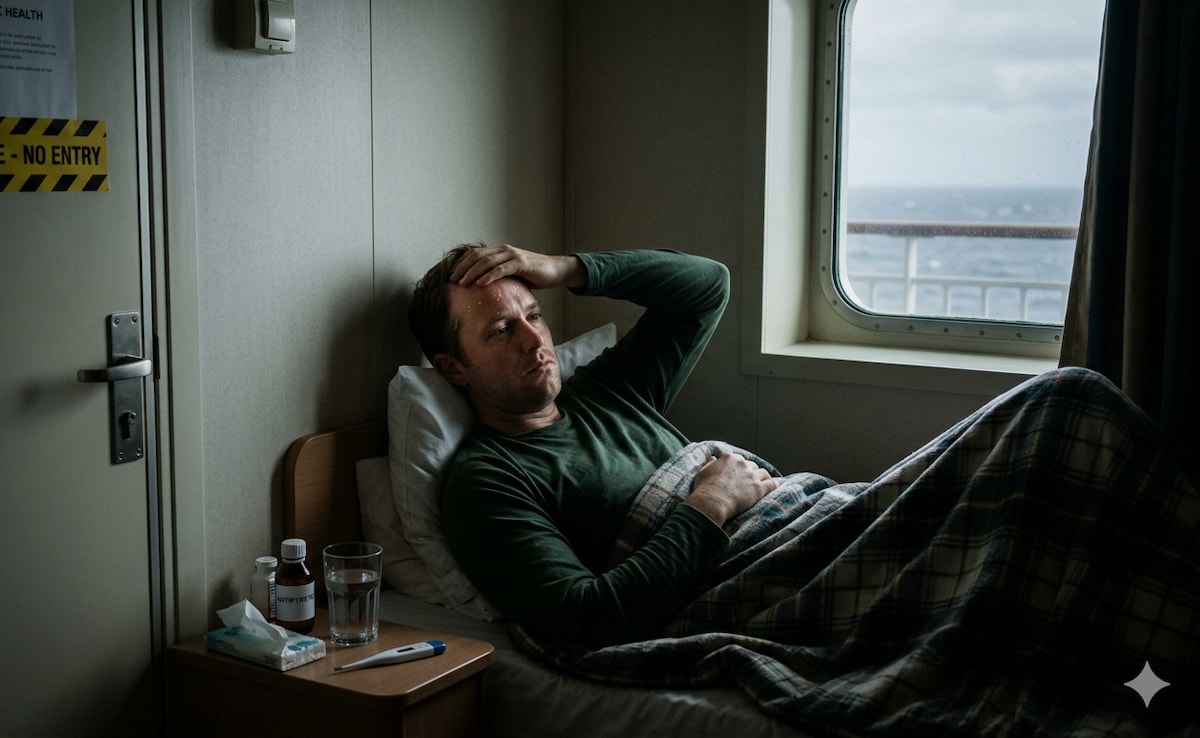
The maritime industry relies on a singular, ancient reflex when faced with an outbreak: drop the anchor and lock the cabin doors. When rumors of Hantavirus shadow a luxury vessel, the immediate call for a ship-wide quarantine sounds like common sense. It is actually a fundamental misunderstanding of biology. Quarantine on a cruise ship does not stop Hantavirus because the virus does not behave like the flu or Norovirus. Locking three thousand passengers in a steel hull with a respiratory pathogen is often less about public health and more about a desperate attempt to manage optics while the underlying risk remains untouched in the ventilation shafts.
Hantavirus is a severe respiratory disease, but it is not a contagious wildfire jumping from person to person in the buffet line. To understand why a cruise ship quarantine is often a theatrical failure, one must look at the vector. This is a rodent-borne pathogen. It is transmitted through the aerosolization of dried droppings, urine, or saliva from infected mice and rats. If a ship has a Hantavirus problem, it has a pest problem. Locking humans in their rooms does nothing to address the microscopic dust being pushed through the HVAC system by a hidden nesting site in the cargo hold. In related developments, read about: Hantavirus on the High Seas The Hidden Danger in the Cruise Industry.
The Viral Ghost in the Ventilation
The primary threat of Hantavirus on a ship is the "invisible breath" of the machinery. Most terrestrial outbreaks occur in cabins or sheds where deer mice have lived undisturbed. On a ship, the environment is a pressurized, recycled ecosystem. If a rodent infestation takes hold in the bowels of the vessel, the forced-air systems become the delivery mechanism.
http://googleusercontent.com/image_content/180 National Institutes of Health has provided coverage on this critical topic in extensive detail.
When a passenger breathes in these particles, the virus targets the endothelium—the lining of the blood vessels. This leads to Hantavirus Pulmonary Syndrome (HPS). The lungs fill with fluid. The heart begins to fail. Unlike the common cold, the mortality rate for HPS can hover near 40 percent. This high stakes reality creates a panic-driven response from port authorities, who often demand the ship stay at sea. However, keeping a vessel in isolation essentially turns the ship into a giant petri dish for whatever environmental contaminant is already present.
If the virus is coming from the structure of the ship itself, quarantine is not a shield. It is a sentence. It forces the healthy to stay in the exact environment that sickened the first victim, while the medical staff on board—usually equipped for minor injuries and seasickness—struggle to manage a specialized pulmonary crisis.
Why Maritime Quarantine Logic Fails
Standard protocols for ships are built on the Norovirus model. Norovirus is the king of cruise ship illness because it is hardy and moves through contact. You touch a railing, you eat a shrimp, you get sick. In that scenario, isolation and deep cleaning of surfaces work. Hantavirus operates on a different plane of existence.
The Vector Problem
A quarantine assumes the passengers are the danger. With Hantavirus, the passengers are the victims of a localized environmental failure. To stop the spread, you don't need to lock people in their cabins; you need to find the nest.
- Aerosolization: The virus becomes airborne when dust is stirred up.
- Stability: Outside of a host, the virus remains infectious for several days depending on humidity and temperature.
- Host Specificity: Not every rat carries it, but once the virus enters a population of ship-board rodents, it persists.
The False Security of the Cabin
Cabin doors are not airtight. The air flowing into a luxury suite is pulled from the same internal arteries as the rest of the ship. If the source of the Hantavirus is a contaminated storehouse near the air intake, a passenger is no safer in their bed than they are in the theater. In fact, by restricting movement, crew members may inadvertently prevent passengers from reaching fresher, open-deck air where the concentration of viral particles is diluted by the ocean breeze.
The Economic Pressure of a Sick Ship
Port authorities are notoriously ruthless. When a ship reports a potential Hantavirus case, the vessel becomes a pariah. No country wants to risk the introduction of a high-mortality pathogen into their own rodent populations. This leads to "The Flying Dutchman" scenario, where a ship is refused docking rights and forced to manage a medical emergency at sea.
This is where the investigative trail gets dark. Ship owners are incentivized to downplay symptoms to avoid the catastrophic costs of a diverted voyage or a forced quarantine. A quarantine is expensive. It destroys the brand. It leads to massive litigation. But the alternative—allowing a suspected Hantavirus case to disembark and potentially contaminate a port city—is a regulatory nightmare.
We have seen this play out with other pathogens. The instinct is to hide the problem until the ship reaches a flag-state or a friendly port. By the time the world hears about an "outbreak," the window for effective environmental remediation has usually closed. The focus shifts entirely to the passengers, while the actual cause—the rodents in the drywall—is ignored in the rush to get the ship back into service.
Reengineering the Response
If we want to actually minimize disease spread on a ship, the industry must move away from the 14th-century "stay in your room" mentality.
Modern Detection vs. Ancient Isolation
The use of rapid environmental DNA (eDNA) testing could revolutionize maritime safety. Instead of waiting for a passenger to develop a fever, ships could routinely test their air filtration units for rodent genetic markers or viral signatures. This is proactive engineering. It identifies the threat before it reaches a human lung.
The High-Efficiency Particulate Air (HEPA) Mandate
The most effective way to stop Hantavirus spread is not a lock on a door, but a filter in the wall. Standard ship ventilation often fails to meet the HEPA requirements needed to trap viral-sized particles. Upgrading these systems is a significant capital expense, which is why cruise lines resist it. They would rather pay for a few days of extra food during a quarantine than overhaul the mechanical guts of a ten-year-old vessel.
The Myth of Human-to-Human Transmission
A critical point of confusion often cited in media reports is the Andes virus—a specific strain of Hantavirus found in South America that has shown a limited ability to spread from person to person. While this is a scientific reality, it is the exception, not the rule. The vast majority of Hantavirus strains found globally require the rodent middleman.
By treating every Hantavirus scare as a contagious human-to-human event, authorities waste precious time. They focus on masks and gloves for the passengers when they should be deploying industrial vacuum systems with HEPA filters and professional exterminators. You cannot "quarantine" your way out of a pest infestation.
The Brutal Truth of the Cruise Industry
The cruise industry is a series of floating cities governed by the laws of the sea, which are often more concerned with commerce than clinical precision. When a health crisis hits, the priority is containment of the news, then containment of the passengers.
True safety on the water requires a shift in how we view the ship itself. It is not just a hotel; it is a closed-loop biological environment. If a pathogen like Hantavirus enters that loop, the solution is a radical transparency that the industry currently lacks. We need to stop asking if quarantine works and start asking why we are allowing ships with substandard pest control and archaic ventilation to carry thousands of lives into the middle of the ocean.
The next time a headline screams about a ship in lockdown, don't look at the passengers waving from their balconies. Look at the vents. Look at the docks. The danger isn't the person in the next cabin; it's the air being pumped into yours from a basement no one has checked in months.
The only way to win this fight is to stop pretending that a wooden door can stop a microscopic particle carried by the very air we need to survive. Stop the rodents, fix the filters, or stay on the shore.