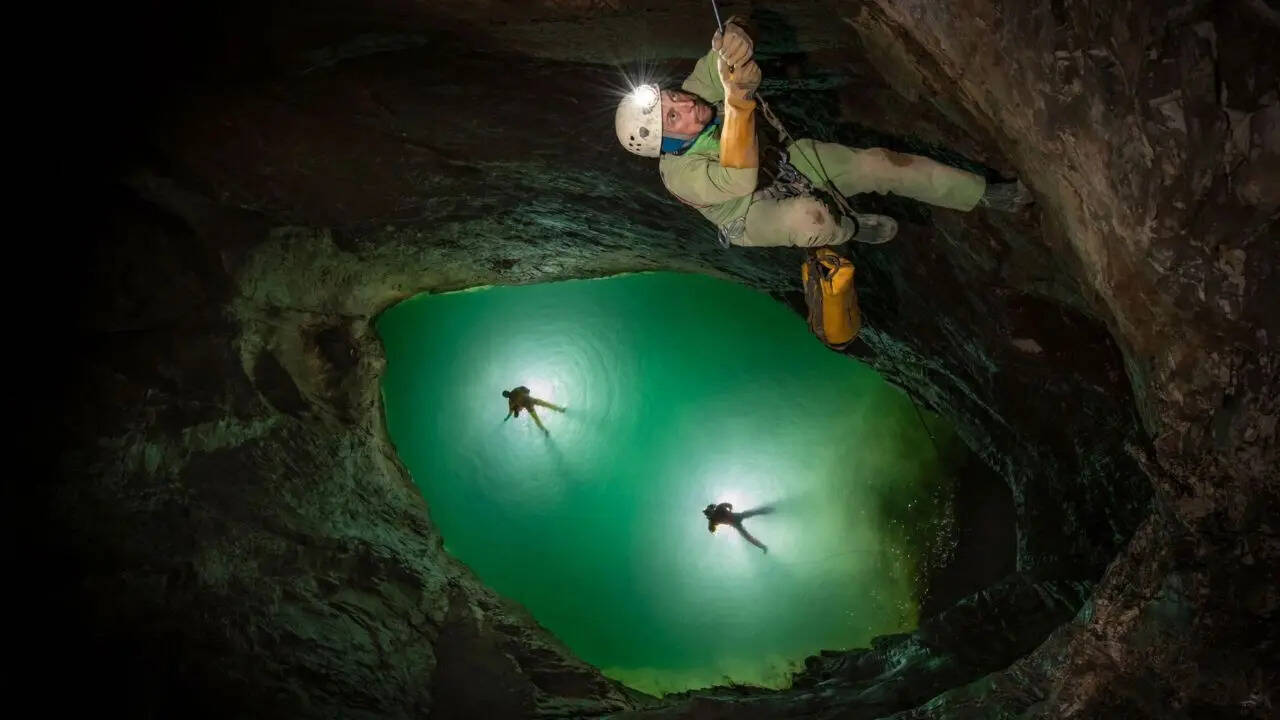
You're probably used to looking up at mountains and feeling small. But there's a whole different kind of "small" that hits when you're two kilometers vertically underground, squeezed between millions of tons of limestone with a freezing subterranean river rushing past your boots. We aren't talking about your local tourist cavern with paved paths and colored lights. We're talking about the abyss.
The hunt for the deepest cave in the world is a relentless, dangerous race. It’s been called "mountaineering in reverse," but that doesn't quite capture the claustrophobia or the sheer physical toll of hauling gear through mud-slicked vertical shafts for weeks at a time. Explorers don't just hike into these places. They live in them, setting up underground camps where the sun hasn't shone for millions of years.
As of 2026, the rankings for these subterranean giants are dominated by the Western Caucasus region, specifically in Georgia. The geology there is perfect for creating deep pits. Massive limestone blocks, heavy rainfall, and specific tectonic activity have carved out vertical labyrinths that seem to go on forever.
Veryovkina Cave is the Uncontested King
If you want to reach the bottom of Veryovkina, you’re looking at a journey that takes most professional expeditions about a week. It sits in the Arabika Massif in Abkhazia, Georgia. At its currently measured depth of 2,212 meters, it's the only cave known to exceed the two-kilometer mark along with its neighbor, Krubera.
It wasn't always the record holder. For decades, it was just another hole in the ground until a breakthrough in 2017. Speleologists found a series of vertical pitches that dropped deeper than anyone expected. The bottom isn't a dry room. It’s a place called "The Last Nemo Station," a sump area that’s partially flooded.
What makes Veryovkina terrifying isn't just the depth. It's the flash floods. In 2018, a team was nearly wiped out when a sudden storm on the surface sent a wall of water down the shafts. They spent days huddled in a high camp, listening to the roar of the water below them. That's the reality. You’re at the mercy of the weather thousands of feet above your head.
Krubera Cave and the Legend of Voronya
Before Veryovkina took the crown, Krubera was the gold standard for depth. Also located in the Arabika Massif, it reaches 2,197 meters. For years, it was the "Everest of Caves."
Krubera is a brutal, vertical system. It’s famous for its narrow squeezes and massive pits. One of the biggest challenges here is the "sumps"—sections of the cave completely filled with water. To find the true bottom, divers have to haul tanks and heavy equipment through miles of dry cave just to submerge themselves in freezing, pitch-black water at the very end.
It's named after Russian geographer Alexander Kruber, but many locals and explorers call it Voronya, which means "Crows' Cave." Hundreds of crows used to nest in the entrance pit. Imagine dropping into a dark hole while a cloud of birds circles your head. It’s like something out of a gothic horror novel.
Sarma and Snezhnaya Round Out the Caucasus Giants
Georgia really has a monopoly on deep caves. Sarma Cave, currently sitting at 1,830 meters, is still being explored. Many experts believe it might eventually connect to other systems and challenge the top two. It’s known for high-velocity winds that howl through the narrow passages, a phenomenon caused by pressure differences between the surface and the deep interior.
Snezhnaya, or "Snowy" cave, is a monster in its own right at 1,760 meters. It’s arguably one of the most complex systems on the list. It’s not just a straight drop. It’s a mess of huge halls, underground rivers, and massive ice deposits near the entrance that stay frozen all year long. Navigating it requires a masterclass in rope work and route finding.
Moving Beyond Georgia to the Austrian Alps
If you head over to Austria, you find the Lamprechtsofen system. For a brief moment in the late 90s, it was the deepest cave in the world. It currently measures about 1,735 meters deep.
What's unique about Lamprechtsofen is that it’s a "through-trip" potential. Explorers often enter from a high-altitude entrance and work their way down to the valley floor. It’s technically an "ascent" from the bottom entrance for many researchers. The cave serves as a massive drain for the Leogang Mountains. If you’re in the lower sections during a heavy snowmelt, you’re in serious trouble. The water levels can rise meters in a matter of hours.
Jean Bernard and the French Connection
France has a legendary history in speleology. Pierre Saint-Martin was a long-time record holder, but Gouffre Jean-Bernard is the current French heavyweight at 1,602 meters. Located in the French Alps, it was discovered by the Groupe de Spéléologie Vulcain in 1963.
Jean-Bernard is a technical nightmare. It’s notoriously tight in places, requiring explorers to exhale just to squeeze their ribcages through cracks. It has at least 13 known entrances, but reaching the lowest point is a grueling task that requires high-level alpine cave experience. Don't even think about it if you aren't comfortable with "rebelays"—the process of switching your rappelling gear between different anchors while hanging over a several-hundred-foot drop.
Sistema Huautla and the Deepest in the West
Mexico is home to Sistema Huautla, the deepest cave in the Western Hemisphere at 1,570 meters. It’s a massive, sprawling labyrinth beneath the Sierra Mazateca mountains in Oaxaca.
Huautla is different from the Georgian caves. It’s warmer, but it’s incredibly wet. It’s a hydrological masterpiece, draining a huge plateau. Bill Stone, a legendary cave explorer, has spent decades leading expeditions here. They’ve used state-of-the-art rebreather technology to dive into the sumps at the bottom. The Huautla expeditions are massive undertakings, involving dozens of people, miles of rope, and months of preparation. It’s basically a NASA-level operation but with more mud and less oxygen.
Why These Rankings Keep Changing
You might check this list in six months and see a new name at the top. Why? Because "bottoming out" a cave is rarely final.
Most caves end in a "sump" (a water-filled tunnel) or a "choke" (a pile of boulders and debris). If a diver can squeeze through that sump or a team can spend a week digging through a choke, they might find another kilometer of passage on the other side.
There's also the "connection" factor. Often, two separate caves are discovered and explored. If a team finds a passage that connects them, the total depth is recalculated from the highest entrance to the lowest point. That’s how systems like Lamprechtsofen and Huautla suddenly "grow" by hundreds of meters.
Chevé and the Hunt for 2.5 Kilometers
While Veryovkina holds the record now, many eyes are on Sistema Chevé in Mexico. It’s currently around 1,536 meters deep, but dye tracing tests have proven something incredible. Scientists dumped dye into the water at the top, and it emerged miles away at a much lower elevation.
This suggests that Chevé could technically be over 2,500 meters deep. The problem is finding a way through the middle. There’s a massive gap that no human has squeezed through yet. If they find that link, the world record won't just be broken; it'll be shattered.
The Physical Toll of Deep Caving
Don't mistake this for a casual hobby. Pushing these depths is one of the most physically demanding things a human can do.
- Hypothermia: Most of these caves are around 2°C to 5°C. You're constantly wet, and the air is humid.
- Physical Exhaustion: You’re hauling 20kg bags up and down ropes for 12 hours a day.
- Mental Strain: Being in total darkness for 14 days straight messes with your internal clock. You start to hallucinate. You lose track of whether it's Tuesday or Sunday.
Most people who do this aren't doing it for fame. There's no prize money. They do it because they want to see a part of the planet that literally no other human has ever seen. It’s true exploration in its purest, grit-filled form.
If you’re interested in this world, don't just grab a rope and head to Georgia. Join a local grotto or caving club. Learn the ropes—literally. Vertical caving is a high-stakes skill set that takes years to master. Start with the "beginner" pits in places like TAG (Tennessee, Alabama, Georgia in the US) or the Yorkshire Dales in the UK. Get comfortable with the dark, the cold, and the mud. Only then should you look toward the two-kilometer abyss.
Check the latest expedition reports from the Speleological Union of Ireland or the National Speleological Society. They track these depth updates in real-time. The map of the world isn't finished yet. It’s just waiting for someone to crawl into the next hole.