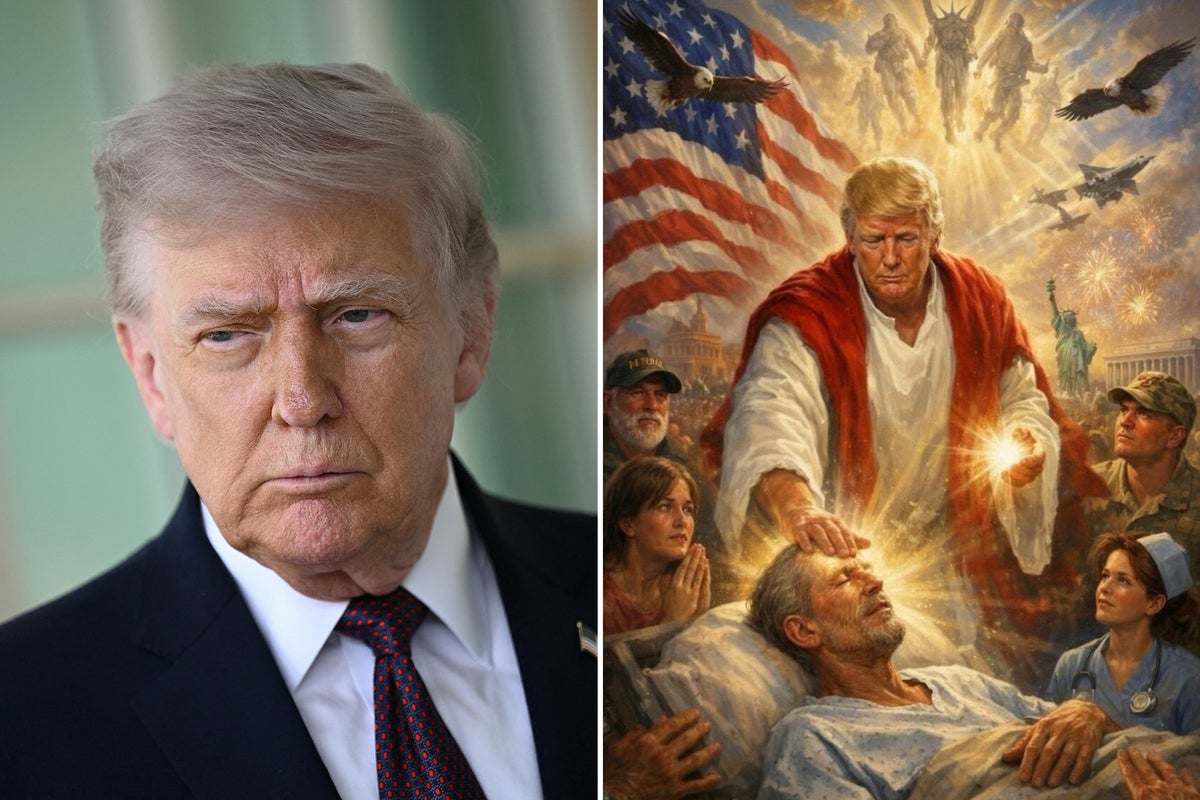
The viral spread of AI-generated imagery depicting Donald Trump in divine or Christ-like contexts represents a fundamental shift in how political identity is forged and maintained. These images do not function as literal claims of divinity. Instead, they serve as high-speed visual shorthand for a specific brand of populist martyrdom. For the core of Trump’s base, the "AI Jesus" trope is a tool of defiance against a secular media and a legal system they perceive as hostile. It is not a test of theological purity; it is a tactical deployment of cultural symbols.
Understanding the endurance of these images requires moving past the initial shock of the aesthetic. Critics often ask where the "red line" is for Christian supporters, assuming that a perceived blasphemy should trigger an immediate mass exodus. This assumption misses the mechanics of modern political tribalism. In this environment, the medium—the artificial, often hyper-realistic or surreal AI render—is actually more important than the specific theological implications.
The Architecture of Online Martyrdom
Political movements have always leaned on religious imagery. What has changed is the speed and accessibility of the tools used to create it. In the past, creating a sophisticated piece of propaganda required a studio and a budget. Today, a prompt and a few seconds of processing power can generate a scene of a former president being comforted by a celestial figure.
These images bypass the rational mind and go straight for the emotional jugular. When a supporter sees an image of Trump surrounded by light, they aren't checking it against the Nicene Creed. They are seeing a reflection of their own feeling of being under siege. The image validates their internal narrative: that their leader is undergoing a transformative, almost supernatural struggle on their behalf.
This is the "why" behind the lack of a red line. The supporters aren't looking for a pastor; they are looking for a champion. If that champion is depicted using the visual grammar of the New Testament, it merely reinforces the stakes of the fight. The legal battles in New York, Florida, and D.C. are reframed not as courtroom procedures, but as a path to Calvary.
Why The Blasphemy Argument Fails to Land
The secular critique of these images usually centers on the idea of the "Golden Calf." Commentators point to the biblical prohibition against idols and wonder why evangelical voters aren't more offended. This line of questioning fails because it treats the images as a replacement for faith rather than an extension of political expression.
The Irony Defense
A significant portion of the audience engaging with these images does so with a layer of digital irony. They know the images are "fake" in the sense that they are AI-generated. They might even find them slightly kitschy. However, they share them because they know it upsets the "right" people. The outrage from the left and from traditionalist theologians becomes the proof of the image's efficacy. In this loop, the more the media decries the imagery as sacrilegious, the more valuable the imagery becomes as a badge of tribal membership.
Cultural Christianity vs. Doctrinal Rigor
There is a massive distinction between the Christianity of the pews and the Christianity of the political rally. The latter is a cultural identity, a set of shared values and grievances. For the cultural Christian, the AI depiction of Jesus standing over Trump’s shoulder is a "vibes-based" endorsement. It signals that Trump is on the side of the "godly" against the "godless." In this context, the specifics of the depiction are secondary to the side the depiction chooses.
The Algorithmic Feedback Loop
Generative AI does not exist in a vacuum. It is fed by the data of our collective desires and fears. When users prompt AI models to create these images, they are often leaning into the tropes that the algorithms have already identified as high-engagement.
The platforms themselves play a silent but definitive role. Images that evoke strong emotional reactions—whether it’s awe from a supporter or horror from an opponent—are prioritized by recommendation engines. This creates a self-reinforcing cycle where the most extreme visual metaphors are the ones that reach the most eyes.
The technology has made it possible to "flood the zone" with hyper-specific iconography. If a certain demographic responds well to images of Trump in a lion’s den, the AI can produce infinite variations of that theme in minutes. This is not just a change in how we see politics; it is a change in how politics is manufactured. We are moving away from the era of the "big tent" and into the era of the "personalized icon."
The Legal and Ethical Gray Zone
As these images become more prevalent, they raise questions about the ownership of the divine and the limits of political satire. AI models are trained on centuries of religious art—Renaissance paintings, stained glass, and Sunday school illustrations. By stripping these styles of their original context and applying them to a 21st-century politician, the technology performs a kind of cultural strip-mining.
There is also the matter of the "deepfake" evolution. While many of these AI Jesus images are stylized and obviously "artistic," the line between a symbolic illustration and a deceptive deepfake is thinning. If an AI can show Jesus endorsing a candidate, it won't be long before it shows a candidate performing miracles—or committing crimes—in a way that is indistinguishable from reality to the untrained eye.
The Burden on the Institutional Church
The real crisis isn't found in the images themselves, but in the silence or complicity of religious institutions. When the visual language of a faith is co-opted for a partisan agenda, the faith itself risks becoming a subsidiary of a political brand.
For traditional leaders, the AI Jesus phenomenon is a nightmare of brand dilution. It suggests that the iconography of the church is now public domain for any political consultant or bored internet troll with a Midjourney subscription. The "red line" hasn't been crossed because, in the eyes of the digital populist, the line no longer exists. The sacred and the profane have been mashed together in a high-resolution render, and the resulting image is exactly what a polarized public wants to see.
The power of these images lies in their ability to simplify. Politics is messy, legal cases are boring, and policy is complicated. An image of a divine hand on a suit-clad shoulder is simple. It provides an immediate answer to the question of "Who is the good guy?" In a world of infinite information, simplicity is the ultimate currency.
The mistake is thinking that these images are about Donald Trump or even about Jesus. They are about the people who create and share them. They are a visual scream for relevance in a world that feels increasingly complex and indifferent to their values. Until the underlying anxieties of the electorate are addressed, the digital prophets will continue to churn out icons that blur the line between the ballot box and the altar.
If you are looking for a breaking point, you are looking in the wrong direction. The supporters aren't waiting for a reason to stop; they are actively building a visual universe where stopping is no longer an option. The AI is simply providing the bricks.
Stop waiting for the "red line" to appear in a viral post. The crossing happened the moment we decided that a generated image was more truthful than a documented fact.