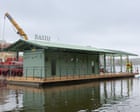
The introduction of Stockholm’s first municipally funded and operated floating sauna in Hornstull, Södermalm, marks a structural shift in urban wellness infrastructure. While the 5.5 million Swedish kronor (£436,573) facility is framed in public discourse as a cultural victory for universal access, its deployment acts as a strategic intervention into a highly distorted local market. By evaluating this municipal pilot through the lens of supply constraints, asset-utilization metrics, and the optimization of urban public spaces, we can decode the true operational dynamics of civic infrastructure.
The Structural Deficit: The Anatomy of Stockholm's Sauna Monopoly
The Stockholm waterfront sauna ecosystem operates under a conditions of extreme demand inelasticity paired with an artificially constrained supply. To understand why a municipal intervention was required, one must analyze the market distortion via three operational metrics: If you enjoyed this piece, you might want to look at: this related article.
- The Membership Queue Bottleneck: Private and club-managed saunas across the capital maintain structural backlogs that outstrip active capacity by several orders of magnitude. The operator Sthlm Sauna reports a aggregate waiting list of 20,000 applicants across its portfolio, with 13,000 individuals queued for a single location in Vinterviken.
- The Allocation Failure: Under the legacy private-club model, booking slots function as scarce economic goods. When open access slots are made available to non-members, secondary market dynamics or immediate inventory depletion occurs within minutes, pricing out or structurally excluding non-networked citizens.
- The Infrastructure Gap: The demolition of Liljeholmsbadet—a historic 1930s floating public bathhouse—left a geographic and functional void on the Södermalm waterfront. The new Hornstull pontoon is a direct asset replacement strategy designed to recapture that lost public utility.
This structural imbalance creates a stark division: wellness resources become concentrated among incumbent members, while the broader populace faces high barriers to entry. The municipal pilot functions as an regulatory supply-shock intended to break this compounding exclusivity.
The Cost Function and Operational Architecture of the Hornstull Pilot
The physical asset, designed by architect Dinell Johansson and manufactured by specialized marine builder Marinbastun, optimizes municipal capital expenditure through modular engineering. For another look on this story, refer to the recent update from Vogue.
The project's viability depends on specific operational choices that minimize long-term liabilities while maximizing civic throughput:
1. Spatial Efficiency and Historical Integration
The green exterior architecture references Stockholm’s traditional painted wooden water pavilions, satisfying strict municipal aesthetic guidelines. However, the true innovation lies in its dual-purpose zoning. The installation features a dedicated sauna structure alongside an open-access public jetty. This ensures the asset generates public utility even from citizens who do not utilize the thermal facilities, maximizing the return on occupied public waterfront space.
2. The Variable Pricing Mechanism
Initial operations will employ a flat-rate pricing structure to establish a baseline demand curve. The transport office has indicated that subsequent operational phases will introduce segmented pricing tiers targeting students and pensioners. This price discrimination strategy is mathematically necessary to smooth out peak-demand inefficiencies—preventing capacity exhaustion during weekends while filling underutilized daytime mid-week slots.
3. The Decoupling of Membership and Access
By legally mandating a 100% membership-free booking architecture, the City of Stockholm removes the artificial premium associated with existing private clubs. The operational mandate shifts from maximizing member lifetime value (LTV) to maximizing daily throughput and equitable turn utilization.
Comparative Nordic Benchmarks: The Oslo and Gothenburg Precedents
Stockholm's strategy is not an isolated experiment; it is a fast-follow adaptation of proven regional models. The municipal transport office openly acknowledges leveraging design and operational insights from Denmark and Finland, but the closest technical parallels lie in Norway and Western Sweden:
+-----------------------------------+-----------------------------------+-----------------------------------+
| Metric                            | Gothenburg (Jubileumsparken)      | Oslo (Sauna Association Model)    |
+-----------------------------------+-----------------------------------+-----------------------------------+
| Funding Structure                 | 100% Municipal / Free Open Access | Hybrid Public-Private/Civic Trust |
| Core Material Blueprint           | Recycled Industrial Steel & Glass | Modular Wooden Floating Pontoons  |
| Primary Strategic Objective       | Industrial Waterfront Reclamation | Mass Scale Civic Thermal Access   |
+-----------------------------------+-----------------------------------+-----------------------------------+
The Oslo Sauna Association proved that low-barrier waterfront structures stimulate exponential increases in year-round urban water usage. Gothenburg's award-winning Jubileumsparken structure demonstrated that high-design public architecture built on public land could revitalize underutilized post-industrial quysides. Stockholm’s execution merges these approaches: utilizing Oslo's structural manufacturer (Marinbastun) while adopting Gothenburg's strict civic integration mandate.
Limitations and Systemic Friction Points
A precise analysis requires acknowledging the operational constraints inherent in the municipal model. The strategy faces three distinct structural vulnerabilities:
- The Capacity-Demand Disconnect: A single 5.5m SEK facility cannot structurally absorb a displaced market demand represented by 20,000-person waiting lists. Without rapid capital scaling to build secondary and tertiary locations, the booking platform for the Hornstull site will inevitably experience the same digital inventory exhaustion that plagues private operators.
- Maintenance Depreciation of Public Goods: Thermal facilities subjected to high-throughput, unvetted public use face accelerated physical depreciation compared to private, member-policed spaces. The operational budget must account for aggressive HVAC, structural wood, and sanitation maintenance cycles to prevent the premature decay that claimed Liljeholmsbadet.
- Regulatory Friction on Waterfront Zoning: The expansion of this pilot is bound by strict environmental and maritime transit laws. As Sthlm Sauna noted, securing municipal clearances for private waterfront projects can take over a year. While the city's transport office can bypass certain bureaucratic bottlenecks, competing demands for quay space—including commercial shipping, public walkways, and environmental preservation zones—will limit the velocity of a city-wide rollout.
The Waterfront Quay Strategy
The Hornstull pilot is the anchor asset of a comprehensive municipal masterplan: the Stockholm Waterfront Quay Strategy. This overarching framework seeks to convert static, industrial, or under-monetized maritime edges into high-density civic spaces. The macro-strategy dictates that all future urban core sauna developments must comply with new municipal guidelines requiring 100% open-booking availability.
The long-term trajectory will be defined by a regulatory shift. By using its zoning authority as leverage, the municipality will gradually compel private operators to dedicate a fixed percentage of their operational slots to the public network, effectively transforming the private sauna ecosystem into a public utility network.
The success of the Hornstull facility will not be measured by its financial profitability, but by its capacity to lower the friction of civic entry, proving that public health infrastructure can be integrated directly into prime urban real estate.