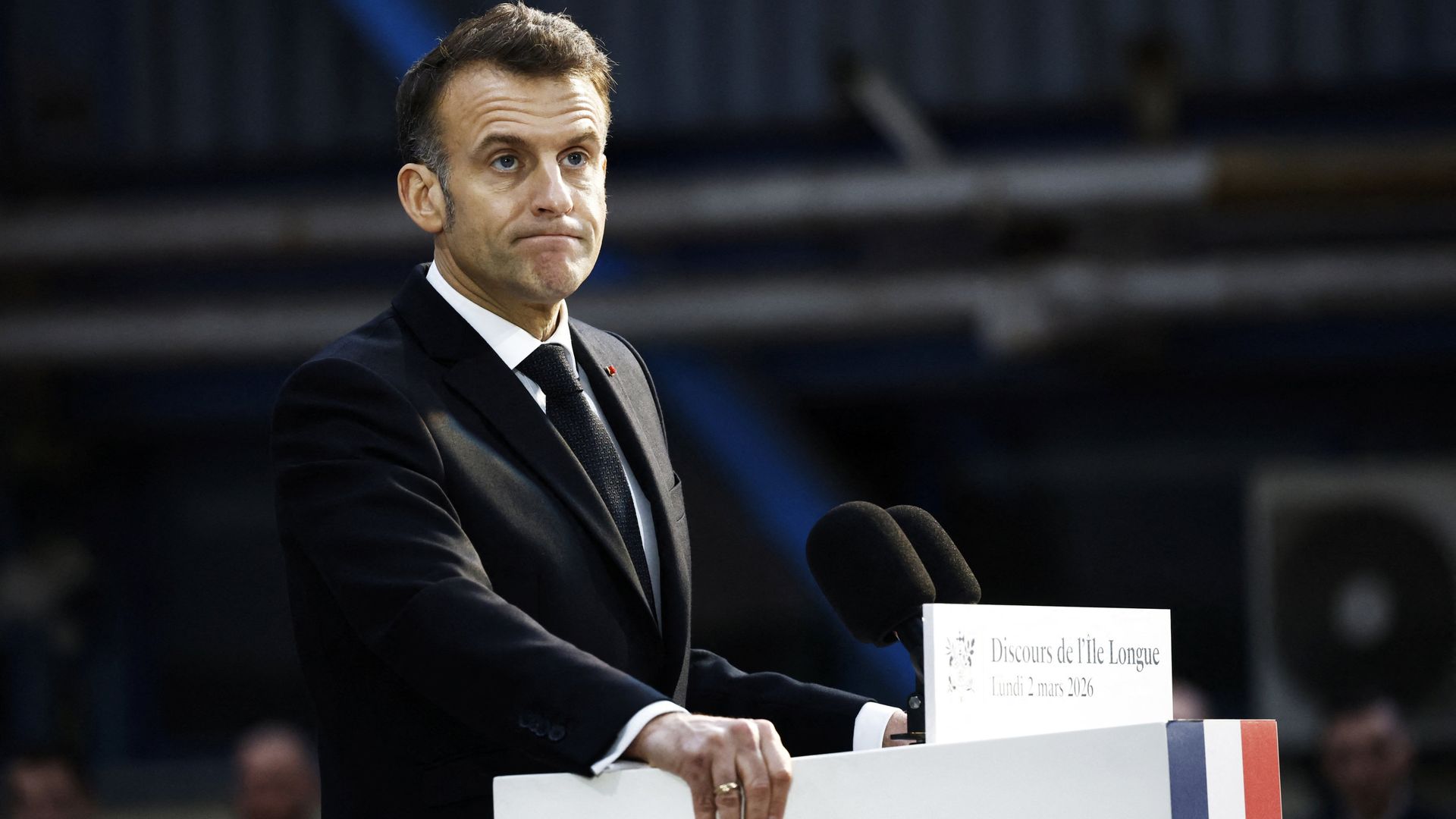
Standing on the windswept concrete of the Île Longue submarine base on March 2, 2026, Emmanuel Macron effectively ended the post-Cold War era for European security. By announcing an expansion of France’s nuclear warhead stockpile and the "temporary deployment" of atomic-capable assets to allied soil, the French President signaled that the days of relying solely on the American security umbrella are over. This is not merely a policy shift; it is a fundamental reordering of how Europe intends to survive a decade defined by what Macron called "ambient animosity."
For thirty years, the French nuclear posture was defined by "strict sufficiency," a polite way of saying they kept just enough warheads to make an aggressor think twice, but not enough to trigger a regional arms race. That ceiling of roughly 290 warheads has been shattered. While the Élysée refuses to name the new target number, the message to Moscow and a volatile Washington is unmistakable: France is now the primary guarantor of European survival.
The Forward Deterrence Doctrine
The most radical element of this announcement is the birth of "Forward Deterrence." Historically, French nuclear weapons were a "sanctuary" tool—meant only to protect French territory and its "vital interests," a term kept intentionally vague to keep adversaries guessing. Under the new framework, that sanctuary is expanding to encompass the "depth of the European continent."
Macron’s plan involves dispersing the Strategic Air Forces (FAS) across a network of allied bases. By rotating nuclear-capable Rafale fighter jets through countries like Poland, Germany, and the Netherlands, France is creating what it calls an "archipelago of forces." This move is designed to complicate the targeting math for any adversary. If French nuclear assets are stationed in Poznań or Kleine Brogel, a strike against those assets becomes an existential gamble involving the only nuclear power remaining in the European Union.
Eight nations have already signed on to this "Advanced Deterrence" plan:
- The United Kingdom: Continuing the coordination established in the 2025 Northwood Declaration.
- Germany: Establishing a "high-ranking nuclear steering group" to integrate conventional forces into nuclear exercises.
- Poland: Actively seeking a "program of advanced nuclear deterrence" to counter Russian proximity.
- Northern and Benelux Allies: Including Sweden, Denmark, the Netherlands, Belgium, and Greece.
The Hardware Behind the Threat
This doctrine would be toothless without the massive industrial reinvestment currently hidden within the French defense budget. The centerpiece of this modernization is the M51.3 submarine-launched ballistic missile (SLBM).
The M51.3, which entered service in late 2025, represents a significant leap over previous iterations. It features a three-stage solid-propellant design capable of delivering multiple independently targetable reentry vehicles (MIRVs) over distances exceeding 9,500 kilometers. More importantly, the new TNO-2 warheads are designed specifically to penetrate increasingly sophisticated anti-ballistic missile (ABM) shields.
On the aerial side, the focus has shifted to the ASN4G, a hypersonic air-launched cruise missile. By moving from supersonic to hypersonic delivery, France is betting that speed and maneuverability will render current European air defenses obsolete, ensuring that even a limited "warning strike"—a core tenet of French doctrine—cannot be intercepted.
The Cost of Autonomy
Critics, including the International Campaign to Abolish Nuclear Weapons (ICAN), have been quick to point out the staggering financial and diplomatic costs. France already spends roughly €6 billion annually on its nuclear forces. Increasing the warhead count while simultaneously funding the SNLE 3G (third-generation nuclear submarine) program and the FCAS (Future Combat Air System) will place an immense strain on a French economy already grappling with energy transition costs.
There is also the matter of the "button." Macron was explicit: there will be no sharing of the ultimate decision. While German or Polish pilots might fly escort for French Rafales, and their generals might sit in on planning sessions, the French President remains the sole authority. This creates a psychological friction point. Will Berlin or Warsaw truly feel protected by a shield for which they have no key?
| Component | Current Asset | Future Upgrade | Strategic Goal |
|---|---|---|---|
| Sea-Based | M51.2 SLBM | M51.3 / TNO-2 | Penetrate modern ABM systems |
| Air-Based | ASMPA Missile | ASN4G Hypersonic | Unstoppable "Warning Strike" capability |
| Submarines | Le Triomphant-class | SNLE 3G | Acoustic invisibility and 50-year lifespan |
The Trump Factor and the End of Ambiguity
The timing of this "toughening" of the French model is not accidental. The return of transactional diplomacy in Washington and the ongoing war in Ukraine have convinced Paris that the U.S. "nuclear umbrella" is now a matter of political whim rather than a structural certainty.
By refusing to disclose the size of its new arsenal, France is adopting a "Cold War 2.0" posture—transparency is out; strategic opacity is back in. This is a deliberate attempt to restore the "fear" Macron believes is necessary for freedom. The French leader is betting that by making the European continent a single, integrated nuclear theater, he can deter a Russian state that has become increasingly comfortable with "grey-zone" provocations.
The risk, of course, is that this "Forward Deterrence" invites the very escalation it seeks to prevent. If a French nuclear-capable jet is involved in a skirmish over the Baltics, the line between a conventional border dispute and a global cataclysm becomes dangerously thin.
France has chosen its path: a heavily armed, sovereign Europe that no longer asks for permission to defend itself. The success of this gamble depends on whether "fear" can truly buy the peace that decades of diplomacy could not.
Would you like me to analyze the specific budgetary impact of the SNLE 3G submarine program on France's 2024-2030 Military Programming Law?