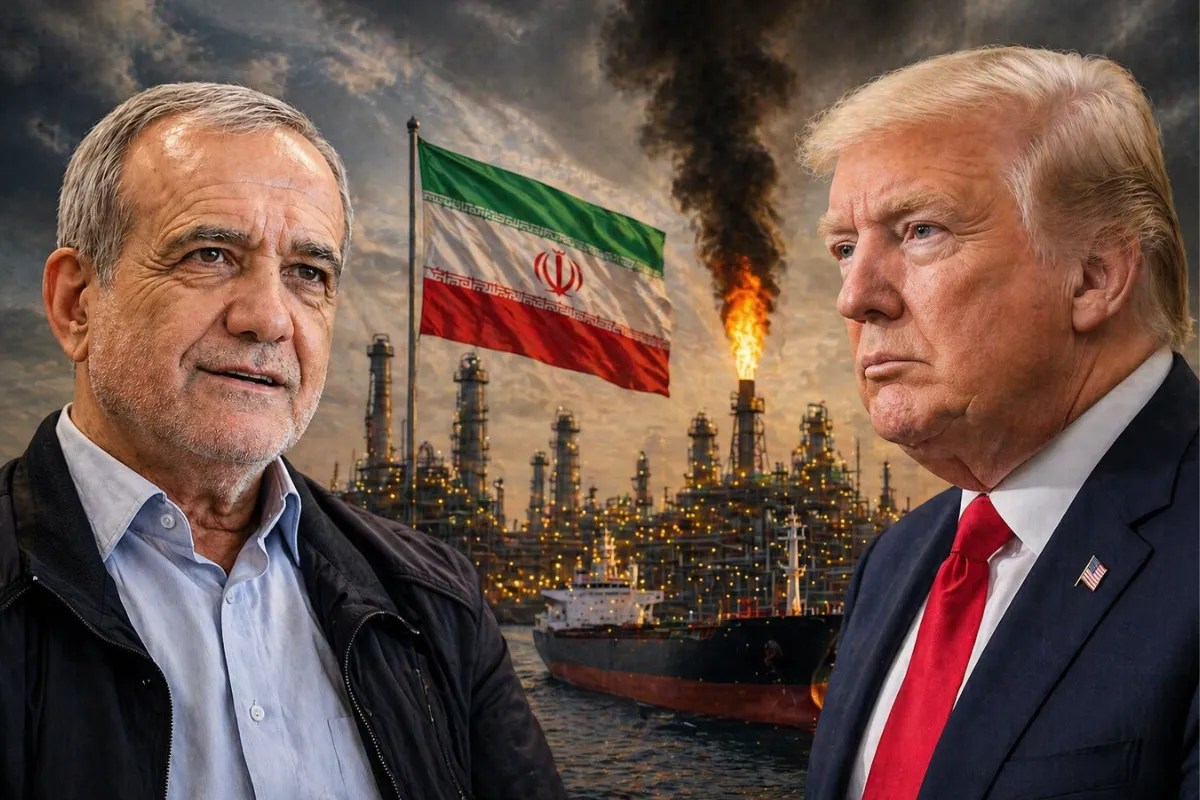
The global energy market is currently staring at a ticking clock that counts down to a potential total blackout of Iranian crude exports. While political pundits focus on rhetoric, the hard data suggests a systematic dismantling of Tehran's primary revenue stream is no longer a matter of "if" but "when." The return of maximum pressure policies under a shifting American administration aims directly at the Kharg Island terminal, the juggernaut facility responsible for over 90 percent of Iran's oil exports. If this single point of failure is neutralized, either through kinetic action or an airtight secondary sanction regime, the Iranian rial faces a terminal tailspin.
This isn't just about a spike in gasoline prices at the pump. It is about a fundamental shift in how the West intends to handle the geopolitical stalemate in the Middle East. For years, Iran has relied on a "ghost fleet" of tankers and small, independent Chinese refineries to keep its economy afloat. Those days are ending. If you liked this post, you might want to read: this related article.
The Fragility of the Kharg Island Bottleneck
Iran's oil infrastructure is impressively centralized, which is its greatest weakness. Almost every drop of crude destined for international waters passes through Kharg Island in the Persian Gulf. For an investigative eye, the vulnerability is staggering. Unlike Saudi Arabia, which has developed extensive pipelines to the Red Sea to bypass the Strait of Hormuz, Iran is boxed in.
Military analysts and energy experts have long pointed out that you don't need a full-scale invasion to cripple a nation's economy. You just need to make its primary export terminal unusable. Whether through physical damage or a naval blockade that makes insurance for tankers impossible to obtain, the result remains the same. The "three-day" window often cited in high-level warnings refers to the immediate shock period where the global market would have to price in the permanent loss of roughly 1.5 million barrels of oil per day. For another look on this development, check out the recent coverage from The Washington Post.
The Ghost Fleet and the Chinese Connection
To understand how Iran has survived this long, one must look at the "dark fleet"—a collection of aging tankers that turn off their transponders and engage in ship-to-ship transfers in the middle of the ocean. These vessels are the lifeblood of the Iranian resistance economy. They operate in a gray zone, often using flags of convenience and shifting ownership through shell companies in places like Panama or the Marshall Islands.
The primary destination for this oil is China's "teapot" refineries. These are small, independent operators that don't have significant exposure to the U.S. financial system, making them largely immune to traditional sanctions. However, the incoming American strategy focuses on the banks that facilitate these transactions. By targeting the clearinghouses and the regional Chinese banks, the U.S. can effectively cut the payment cords. Without a way to get paid in a usable currency, the physical oil becomes a liability rather than an asset.
The Ripple Effect on Global Supply Chains
Critics of a total oil embargo argue that removing Iranian crude will cause a global recession. This is a common counter-argument, but it ignores the current state of global spare capacity. Saudi Arabia and the United Arab Emirates are currently sitting on millions of barrels of idle production capacity. They have the taps ready.
Historically, the fear of $150-a-barrel oil has kept Washington from pulling the trigger on Iran's energy sector. But the math has changed. The U.S. is now the world’s largest oil producer. Its domestic production acts as a buffer that didn't exist during the oil shocks of the 1970s or even the early 2000s. The leverage has shifted from the producer to the enforcer.
Technical Decay and the Cost of Isolation
Beyond the immediate threat of sanctions or strikes, the Iranian oil industry is rotting from the inside. Oil fields are not like faucets; they require constant investment, high-tech pressure management, and advanced recovery techniques to remain productive. Most of Iran's major fields are middle-aged or elderly. They need Western technology—specifically from firms like SLB or Halliburton—to maintain flow rates.
Because of the isolation, Iran has been forced to use inferior parts and "MacGyvered" solutions to keep the pumps moving. This has led to a steady decline in reservoir pressure. Even if all sanctions were lifted tomorrow, it would take years and hundreds of billions of dollars to bring their infrastructure up to modern standards. The current crisis is simply accelerating a collapse that was already written in the geological and financial ledgers.
The Domestic Fallout and the Rial’s Death Spiral
When the oil revenue stops, the Iranian government loses its ability to subsidize basic goods. Bread, fuel, and electricity prices are all pegged to the state's ability to inject hard currency into the market. We have already seen the "meat protests" and the "water protests" across various provinces. A total loss of oil income would likely trigger hyperinflation that makes the current 40-50 percent rate look stable.
The Iranian leadership knows this. Their current strategy is a mix of brinkmanship and a desperate search for new partners in the Global South. But Russia, also under heavy sanctions, is now a competitor for the same Chinese market. Moscow and Tehran are effectively cannibalizing each other's market share by offering steeper and steeper discounts to Beijing. It is a race to the bottom where the only winner is the Chinese buyer.
Miscalculating the American Resolve
The greatest risk for Tehran lies in misjudging the political appetite in Washington. For a long time, the prevailing wisdom was that the U.S. was "pivoting" away from the Middle East to focus on the Pacific. This led to a sense of security in the Iranian corridors of power. That assumption was a mistake.
The new policy framework isn't about nation-building or boots on the ground. It is about financial and logistical strangulation. It is a "clean" war fought with bank codes and satellite tracking of tankers. By the time the impact is fully felt at the pump in Tehran, the options for recourse will have vanished.
The Strategic Failure of Diversification
For two decades, Iran has talked about moving away from an oil-dependent economy. They have tried to bolster their mining, automotive, and agricultural sectors. However, all these industries still require foreign exchange to import raw materials and machinery. Without oil, there is no foreign exchange.
The failure to diversify means that the entire weight of the state sits on a single, aging, and highly vulnerable pillar of crude. When that pillar is kicked, the roof comes down. The coming months will likely see a dramatic increase in "maritime incidents" and aggressive enforcement of the "No Oil for Terror" acts. The noose is tightening around the Kharg Island terminals, and the time for diplomatic maneuvering has largely expired.
The era of managed decline for Iranian oil is over; the era of forced cessation has begun.