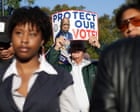
Ruby’s hands don’t move like they used to. The skin is translucent, mapped with veins that look like rivers on a faded atlas, and her knuckles are swollen from eighty years of labor. But when she holds a ballpoint pen, her grip tightens. She remembers a time when that pen was a weapon. She remembers standing in a line that stretched around a brick courthouse in the sweltering heat of a Georgia July, waiting for the right to mark a piece of paper.
Back then, the barrier was a "literacy test" designed to make even a scholar stumble. Today, the barrier isn't a physical wall or a trick question. It is a quiet, rhythmic sound. It is the sound of a gavel striking wood in a marble building six hundred miles away in Washington, D.C. It is the sound of a legal eraser moving across the lines of the Voting Rights Act of 1965, thinning the ink until the words are barely legible.
For decades, the Voting Rights Act served as a federal sentry. It was the "preclearance" requirement—Section 5—that acted as a digital gatekeeper before the digital age existed. If a state with a history of discrimination wanted to change a single polling location or redraw a district line, they had to prove to the Department of Justice that the change wouldn't hurt minority voters. It was a proactive shield. It stopped the fire before the house started burning.
Then came 2013. In Shelby County v. Holder, the Supreme Court effectively gutted that shield. They argued that the "test" used to decide which states needed oversight was outdated. They said the country had changed. They were right about the change, but perhaps wrong about the direction.
Consider the immediate aftermath. Within hours—not days, not weeks, but hours—of the Shelby decision, several states moved to implement restrictive voting laws that had previously been blocked or stalled. It was as if a dam had breached. Since then, the court has continued this methodical deconstruction, most notably in cases like Brnovich v. DNC, which made it significantly harder to challenge laws that have a disparate impact on different races.
What does that look like on the ground? It looks like a closed polling station in a neighborhood where most people don't own cars. It looks like a new law that bans handing out water to people waiting in four-hour lines. It looks like a "purged" voter roll that removes a grandmother’s name because she didn't see a specific piece of mail.
These aren't just administrative hiccups. They are the invisible stakes of a democracy that is being redesigned in real-time.
The legal argument often centers on "states' rights" and the idea that the federal government should stop babysitting local elections. It sounds logical in a textbook. It feels different when you are the person standing in the rain, watching a "Polling Place Closed" sign being taped to a schoolhouse door.
The Supreme Court’s recent trajectory suggests a shift toward a "colorblind" interpretation of the law. This sounds noble in theory. If we ignore race in the law, race ceases to be an issue, right? But history isn't a whiteboard you can just spray with cleaner. When you remove a protection designed to counter a specific, documented bias, you aren't creating a level playing field. You are simply allowing the existing tilt to take over.
Imagine a race where one runner has been forced to wear lead weights for miles. If, at the halfway point, the referee decides the weights are "outdated" and removes them, the runner is still miles behind. They are still exhausted. They still have to run the rest of the race on a track that was built to favor the person in the lead. Removing the weights doesn't make the race fair; it just stops making it worse while ignoring the ground already lost.
The court's logic often rests on the idea that Section 2 of the Voting Rights Act—which allows people to sue after a discriminatory law is passed—is enough. But lawsuits are expensive. They take years. By the time a court decides a district was illegally drawn, three or four elections have already passed. The winners have been seated. The laws have been signed. You cannot un-ring a bell, and you cannot un-cast an election.
This is the "demolition" the headlines talk about. It isn't a wrecking ball hitting a building all at once. It is a slow, professional disassembly. A bolt removed here. A support beam weakened there. Until one day, the structure that Ruby risked her life for is no longer a shelter. It is just a monument to a promise we no longer intend to keep.
The impact is most felt in the "Black Belt" of the South and in Indigenous communities in the West. In some counties, the distance to the nearest ballot drop-box has tripled. In others, the window for early voting has been squeezed until it only fits those with flexible office jobs. The working poor, the elderly, and the marginalized are being filtered out of the process by the friction of bureaucracy.
It is a death by a thousand papercuts. Or, more accurately, a death by a thousand missing pens.
We often talk about democracy as a fragile thing, like a glass vase. But it’s more like a garden. It requires constant weeding. It requires a realization that the soil itself carries the seeds of past seasons. If you stop tending to it because you think the "weeds of the past" are gone, you find out very quickly how fast the thorns return.
The Supreme Court’s recent rulings haven't just changed the rules of the game; they have changed who gets to play. By narrowing the scope of the Voting Rights Act, they have shifted the burden of proof. It is no longer the state’s job to prove their laws are fair. It is the citizen’s job to prove, through exhaustive and costly litigation, that they are being wronged.
This shift ignores the reality of power. Power does not concede gracefully. It adapts. It finds new ways to define "security" and "integrity" that conveniently result in fewer voices from the "wrong" side of the tracks.
Ruby still has her pen. She still has her resolve. But she shouldn't have to be a hero just to be a voter. The law was supposed to be the thing that made heroism unnecessary. It was supposed to be the floor that no one could fall through.
Now, the floor is being pulled up, plank by plank, to be used as firewood for a house that only some are invited to enter. The ink is drying. The eraser is still moving. And the silence from the bench is the loudest sound in the room.
The sun sets over the courthouse where Ruby once stood. The building is still there, white and imposing. The laws are still there, bound in heavy volumes. But the spirit of the thing—the radical, simple idea that every voice carries the same weight—is flickering like a candle in a drafty hallway. We are living in the age of the Great Undo.
The question isn't whether the law has changed. The question is whether we will even recognize the country that remains once the editing is finished.



