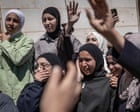
The images coming out of the West Bank aren't just heartbreaking. They're a window into a systematic breakdown of law and order that most global news cycles choose to ignore until the body count includes a child. This week, the tragedy hit a 14-year-old Palestinian boy. He was one of two people killed during a settler attack near a school in the occupied West Bank. It wasn't a crossfire incident. It wasn't a "clash" in the way some headlines like to sanitize it. It was a direct assault.
When a teenager goes to school, the biggest worry should be an exam or a social slight. In the West Bank, the worry is now whether armed groups from nearby settlements will descend on the village before the final bell rings. This latest attack marks a terrifying peak in a trend that's been climbing for months. We need to talk about why this is happening and what the actual data says about the lack of accountability.
Understanding the Surge in Settler Violence
To understand why a 14-year-old ends up dead near his classroom, you have to look at the environment of total impunity. Since October 2023, the frequency and intensity of settler attacks have spiked to levels we haven't seen in decades. This isn't just about land. It's about intimidation. According to reports from the United Nations Office for the Coordination of Humanitarian Affairs (OCHA), there's been an average of four attacks per day against Palestinians since the current conflict intensified.
The attack that claimed the life of this young boy followed a familiar, grim pattern. Armed individuals entered Palestinian space, often under the watchful eye or with the active participation of security forces. Stones are thrown. Then come the bullets. In this specific case, witnesses and local officials described a chaotic scene where settlers opened fire near an educational facility.
Think about that. A school. A place that's supposed to be a protected sanctuary under international law. Instead, it became a kill zone. This isn't an isolated "bad apple" scenario. It’s a structural reality where one group of people feels entitled to use lethal force against another with almost zero fear of legal consequence.
The Myth of Two Equal Sides
Media outlets often fall into the trap of "both-sides-ism." They frame these deaths as part of a cycle of violence. That framing is lazy and wrong. There is a massive power imbalance here. You have a civilian population living under military occupation, and you have a settler population that is frequently armed by the state and protected by the military.
The Israeli human rights organization B’Tselem has documented hundreds of these incidents. Their findings show that in the vast majority of cases, even when there's video evidence, the perpetrators are never charged. When the law only applies to one group, it isn't law anymore. It's just a tool for control.
- The statistics are staggering. Out of over 1,000 cases of settler violence tracked by the organization Yesh Din, only about 3% lead to a conviction.
- The targets are consistent. Olive groves, livestock, and increasingly, children and schools.
- The goal is clear. Forcing Palestinian communities to leave their land by making daily life unbearable.
Why Schools Have Become the New Front Line
You might wonder why attackers would target a school. It’s a calculated move. Attacking a school strikes at the very heart of a community’s future. If parents don't feel safe sending their kids to learn, the fabric of the village begins to tear.
In the village of Khirbet Tana and surrounding areas, schools have been demolished or attacked repeatedly. This latest killing near a school isn't just about the tragic loss of a 14-year-old boy. It’s about the message it sends to every other child in that district. It says: "You aren't safe anywhere."
Education is a form of resilience. For Palestinians, staying on their land and keeping their schools open is an act of defiance. When settlers target these institutions, they're trying to break that spirit. They’re trying to ensure that the next generation is too traumatized or too afraid to stay.
The Role of the International Community
Let's get real about the "condemnations" we hear from Washington or Brussels. They're empty. Every time a Palestinian child is killed, a spokesperson stands behind a podium and expresses "deep concern." They call for a "thorough investigation."
We already know how those investigations end. They end with a file being closed due to "lack of evidence," even when the shooters are known to the local community. The international community’s refusal to move beyond words into actual sanctions or legal pressure is what allows this to continue.
If this happened anywhere else, the outcry would be deafening. But because it happens in the West Bank, it gets buried under the weight of geopolitical interests. We've seen some small moves lately. The U.S. and the UK have started imposing sanctions on specific violent settlers. It’s a start, but it’s like trying to put out a forest fire with a water pistol. The issue isn't just a few individuals; it’s a system that encourages them.
Life Under the Shadow of the Settlement
Imagine living in a village like Masafer Yatta or the areas around Nablus. You wake up and see a new outpost on the hill above you. You know that within weeks, your water lines might be cut. Your sheep might be poisoned. And your son might not come home from school.
This is the daily reality that the "peace process" talk ignores. There is no peace process for a family burying a 14-year-old. There is only survival. The boy killed this week didn't have a political agenda. He had a backpack and a life ahead of him.
The radicalization isn't just happening on one side. When children witness their friends being shot by neighbors who face no punishment, what do we expect the result to be? We're witnessing the systematic creation of a cycle that will haunt the region for another fifty years.
What Needs to Change Immediately
The cycle won't break itself. Waiting for "calm" is a fantasy because the status quo isn't calm for Palestinians—it's a slow-motion catastrophe.
- Dismantle the culture of impunity. Security forces must be held accountable when they stand by and watch these attacks happen.
- International monitoring. We need more than just journalists on the ground. We need actual international protection for vulnerable communities.
- End the expansion. Every new settlement unit is a fresh spark for violence. You can't talk about a two-state solution while the ground for the second state is being swallowed up daily.
Don't let the news cycle bury this boy's name. Don't let the complexity of the "conflict" obscure the simple, brutal fact that a child was killed while trying to get an education. Stay informed by following local sources like the Palestinian Center for Human Rights or Israeli groups like Breaking the Silence. They provide the ground-level truth that often gets polished away by mainstream media. Demand that your representatives move past "concern" and into action. The time for talking has long since passed.