Stop worshiping at the altar of "passive" energy.
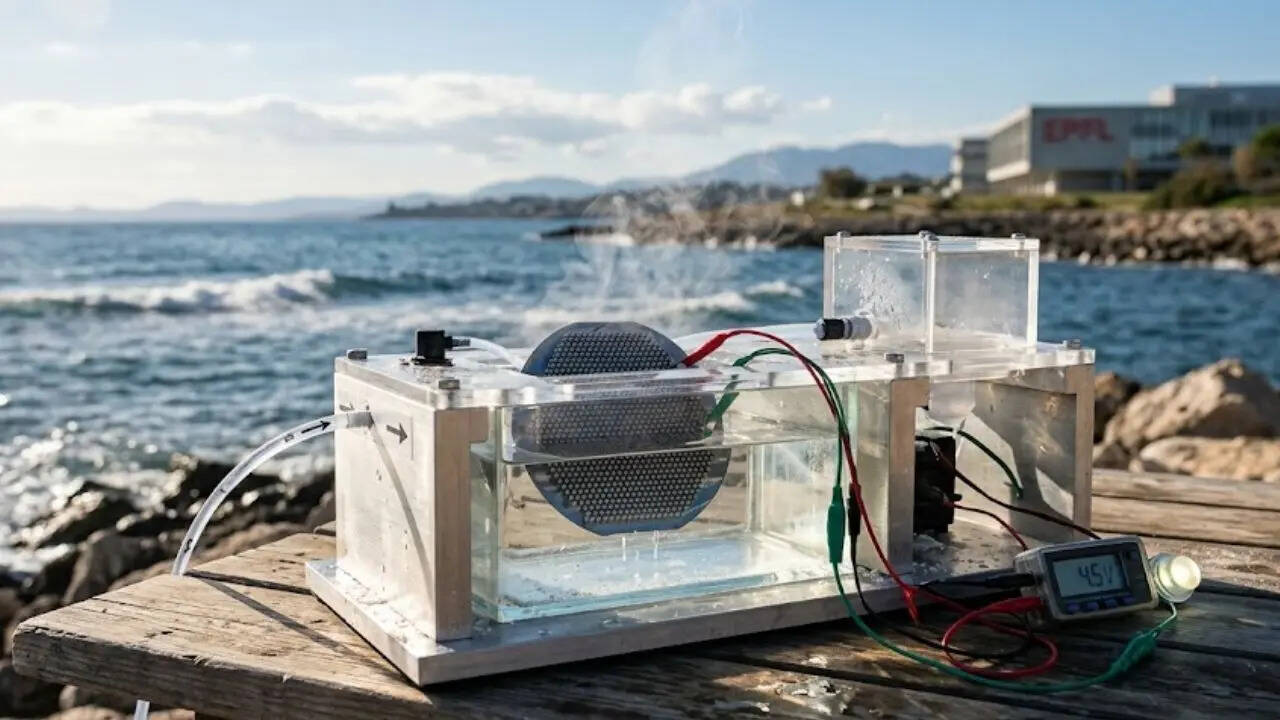
The tech press is currently vibrating over a specific nanogenerator that supposedly turns seawater evaporation into an infinite power source. The narrative is seductive: salt water, a bit of carbon-coated fabric, and the sun’s heat creating a "perpetual" flow of electricity. It sounds like magic because, from a practical engineering standpoint, it is. Expanding on this topic, you can also read: The Ghost in the Jungle Fog.
I have spent years watching venture capital burn in the furnace of "miracle" materials that fail to scale. These devices, often utilizing the hydrovoltaic effect, are the latest in a long line of lab-bench trophies that will never power a single city block. The problem isn’t the science; it’s the math. Specifically, the math of energy density and the brutal reality of salt.
The Power Density Delusion
Most reports on these nanogenerators highlight the voltage—perhaps a respectable 1 volt. What they bury in the footnotes is the current. We are talking about nanoamps or microamps. Analysts at Mashable have shared their thoughts on this trend.
To understand why this is a catastrophic failure of scale, we have to look at the power equation:
$$P = V \times I$$
If your voltage ($V$) is high but your current ($I$) is microscopic, your power ($P$) is functionally zero. To charge a standard smartphone using the current evaporation-driven tech, you wouldn't need a patch of material the size of a postage stamp. You would need a surface area roughly equivalent to a small parking lot.
Imagine a scenario where a maritime sensor needs to transmit a signal. To do so using an evaporation-driven nanogenerator, you’d have to cover the entire hull of the vessel in delicate, carbon-doped membranes. The cost of the material alone would exceed the value of the ship, all to produce the same wattage as a single AA battery you could buy for fifty cents.
The industry is obsessed with the mechanism of energy harvesting while ignoring the magnitude of the harvest. We are picking up pennies in front of a steamroller and calling it a financial strategy.
The Salt Problem Nobody Wants to Talk About
The "seawater" part of this equation is the biggest lie of all.
Seawater is not just water. It is a dense soup of sodium, magnesium, calcium, and biological matter. These nanogenerators rely on capillary action—water moving through tiny pores in a material.
What happens when you evaporate salt water in a porous material? The water leaves. The salt stays.
Within hours of operation, these "eternal" generators suffer from massive salt crystallization. The pores clog. The flow stops. The generator dies. Researchers claim they have "self-healing" or "anti-fouling" geometries, but these are academic sticking plasters. In a real-world ocean environment, biofouling—algae and barnacles—will treat your carbon-coated nanogenerator like a five-star hotel.
We’ve seen this before in the desalination industry. Keeping membranes clean is the single most expensive part of the process. If you have to spend more energy cleaning the device than the device generates, you haven't built a power plant; you’ve built a high-maintenance filter.
Thermodynamics Doesn't Give Participation Trophies
The competitor’s article suggests this energy is "free." It isn't. It is a derivative of solar energy, harvested at an incredibly low efficiency.
Standard photovoltaic (PV) panels convert sunlight to electricity at roughly 20% efficiency.
Evaporation-driven generators rely on the sun to heat water, which then creates a pressure gradient, which then moves ions through a material. Every one of those steps is a "tax" on the original energy input.
By the time you get to the electric terminal, the efficiency is often less than 1%.
Why would any rational engineer deploy a system that is 20 times less efficient and 100 times more fragile than a standard solar panel? The answer is "academic novelty." It makes for a great paper in Nature or Science, but it’s a non-starter for the energy grid. We are prioritizing "cool" science over "functional" physics.
The Real Potential Is Not Where You Think
If we want to actually use the hydrovoltaic effect, we have to stop looking at seawater and start looking at industrial waste heat.
The only way these nanogenerators make sense is if they are integrated into systems where evaporation is already a required, high-volume byproduct—like cooling towers in nuclear plants or massive data center chillers. In those environments, we can control the water quality to prevent clogging and utilize the massive, concentrated heat gradients that nature doesn't provide on a standard beach.
Even then, it’s a niche play.
PAA: Can we power a house with seawater evaporation?
The honest answer is: Not unless your house is the size of a dollhouse and your "generator" covers a football field.
The energy density of evaporation is simply too low. To get the 10kWh a day a typical US home uses, you would need to manage a massive, wet, salt-encrusted infrastructure that would degrade faster than you could repair it. The maintenance costs alone would be a nightmare.
Stop asking if we can do it and start asking if we should.
The False Promise of "Passive"
"Passive" is a marketing term used to hide low output.
True energy independence requires density and reliability. Wind and solar are criticized for being intermittent, but compared to evaporation generators, they are the bedrock of stability.
I’ve watched startups chase these "ambient energy" dreams for a decade. They always hit the same wall: the Square-Cube Law. As you scale the device up to get meaningful power, the structural and maintenance challenges grow exponentially, while the power output only grows linearly.
We are being sold a dream of "energy from thin air" by people who haven't accounted for the cost of the carbon cloth, the replacement cycles of the membranes, or the simple fact that a gust of wind or a splash of dirty water ruins the entire chemistry.
Stop Subsidizing the Impossible
Government grants and private equity are being poured into these "miracle" materials because they sound sustainable. They aren't.
Manufacturing high-surface-area carbon nanomaterials is an energy-intensive, chemically "dirty" process. If the device only lasts six months before it’s choked with salt and calcium, the "embodied energy"—the energy it took to make the thing—will be higher than the energy it produces in its lifetime.
That is the definition of a "black hole" technology. It consumes more than it gives.
If you want to solve the energy crisis, look at high-efficiency heat exchangers or next-generation geothermal. Leave the salt-water rags in the lab where they belong. We don't need more "breakthroughs" that look good in a press release but fail in the rain.
Stop waiting for the ocean to power your lightbulbs. It’s not happening.