The lock on a flat door in Nottingham is a simple mechanism. It consists of a series of pins, a spring, and a bolt. It represents the thin, metallic line between the sanctuary of a home and the chaos of the street. On a Tuesday in 2023, that line didn’t just fail; it vanished.
Valdo Calocane walked out of a police station. He had been in custody for less than an hour. He had no money, no phone, and no plan. What he did have was a history of severe psychosis that had been documented, filed, and ultimately ignored by the systems designed to contain it. Within minutes of his release, he was standing in the hallway of a residential building, leaning his weight against a door that didn't belong to him.
We talk about "public safety" as if it is a solid, architectural feature of our cities. It isn’t. It is a fragile agreement, a web of handoffs between doctors, police officers, and social workers. When one person lets go of the thread before the next has grabbed it, people die.
The Hour of Total Neglect
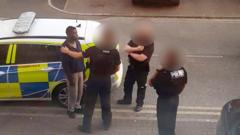
Consider the timeline. It is the most damning piece of the puzzle. At 9:10 AM, Calocane was arrested after a report of a disturbance. By 10:15 AM, he was back on the pavement.
There was no mental health assessment. There was no check to see if he had taken the medication that kept his paranoid delusions at bay. There was only the administrative ticking of boxes. He wasn't a "threat" in the immediate, legal sense of the word at that specific moment, so the gates opened.
Imagine, for a second, being the resident inside that flat. You are making toast. Perhaps you are checking your emails or wondering if it will rain later. You hear a rattle at the handle. Then a thud. Then the sound of wood splintering. This isn't a hypothetical horror story for the people of Nottingham; it was the prologue to a massacre.
Calocane didn't just break into a home. He broke into the collective trust of a community. He spent those minutes after his release wandering, a ticking bomb that the state had just decided to stop monitoring. The inquiry into these events has revealed a truth that is harder to swallow than simple incompetence. It wasn't that the system broke. It was that the system worked exactly as it was designed—prioritizing the clearing of a holding cell over the preservation of human life.
The Ghost in the Machine
Schizophrenia is not a choice, but the management of it is a social responsibility. For years, Calocane had been a ghost in the psychiatric system. He was known to the NHS. He was known to the police. He was a man who had been sectioned multiple times, yet he was allowed to drift into the shadows of non-compliance.
The tragedy of the Nottingham attacks—the deaths of Barnaby Webber, Grace O’Malley-Kumar, and Ian Coates—didn't begin on the street where they were killed. It began in the consultation rooms where red flags were treated as footnotes. It began in the police stations where a man with a history of violence and a shattered mind was treated as a routine trespasser.
When we look at the data, the failure becomes even more systemic. The inquiry heard that the "risk" was consistently underestimated. Why? Because the metrics used to judge risk are often backward-looking. They ask: What has he done today? They rarely ask: What is he capable of when the voices return?
The disconnect is a chasm. On one side, you have the clinical reality of a man who believes he is being controlled by external forces. On the other, you have the bureaucratic reality of a police sergeant who has a quota of cells to clear and a pile of paperwork to finish. Between those two worlds, the victims are lost.
The Weight of a Broken Handoff
There is a specific kind of anger that comes with preventable grief. It is heavy and cold. It is the anger felt by the families of the victims as they sit in the inquiry rooms, listening to officials explain why they let a killer walk free minutes before he chose his targets.
The inquiry has peeled back the layers of a "revolving door" policy that has become the standard in modern mental healthcare. We have moved away from long-term institutionalization—which had its own horrors—toward a model of community care. But community care only works if there is an actual community of professionals watching. In Calocane’s case, there was only a vacuum.
He was a man who had stopped taking his anti-psychotic medication. To a doctor, that is a clinical crisis. To a police officer, it's often a "civil matter." This linguistic gap is where the blood pools. We have created a society where the most dangerous individuals are often the ones who fall through the widest cracks, simply because their behavior doesn't fit neatly into a single department’s jurisdiction.
A City Under the Shadow of "What If"
Nottingham is a city of hills and history, but for those who lived through that June day, it is now a map of missed opportunities. Every street corner where the van sped, every doorway where Calocane lingered, serves as a reminder of the 65 minutes of freedom he was granted by a system that was tired of dealing with him.
The inquiry doesn't just seek to assign blame. It seeks to understand how a man can be so visible to the state and yet so completely ignored. It asks why the "minutes after release" were spent in a residential block instead of a secure facility.
The answer is uncomfortable. It’s about resources. It’s about the fact that there are more people in crisis than there are beds to hold them, and more "incidents" than there are officers to investigate. But when you distill the politics and the budgets down to their essence, you are left with the image of a broken door frame and the terrifying realization that the person who broke it should never have been there in the first place.
The stakes aren't abstract. They are found in the empty chairs at three different dinner tables. They are found in the silence of a student's bedroom that will never be lived in again.
We tend to look for monsters in the darkness, but the Nottingham tragedy shows us that the real danger often walks out of the front door of a police station in broad daylight, wearing a neon sign of warning that no one bothers to read. The failure wasn't just in the lock on the flat door. The failure was in every door that opened for Valdo Calocane when they should have remained firmly shut.
The bolt was slid back. The spring stayed coiled. And a city began to bleed.