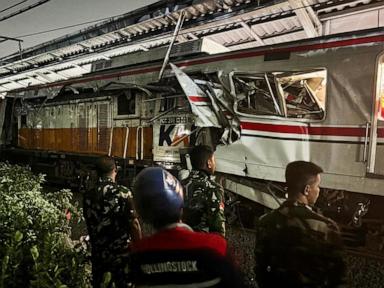
On a clear morning near Bandung, the metal-on-metal scream of a head-on collision shattered more than just the silence of the West Java highlands. When an inner-city commuter train slammed into the Turangga long-distance express, the immediate toll was measured in wreckage and lives lost. However, the true tragedy lies in the systemic failure of a signaling infrastructure that was supposed to be foolproof. This wasn't a freak accident. It was the predictable outcome of a high-speed modernization push that left its basic safety protocols in the dust.
Indonesia is currently obsessed with "fast." From the Whoosh high-speed rail to the sprawling expansion of the Greater Jakarta LRT, the nation is desperate to leapfrog decades of underinvestment. But as the investigation into the Cicalengka-Haurpugur collision reveals, you cannot run a 21st-century rail network on a patchwork of manual overrides and aging electrical relays.
The Digital Ghost in the Analog Machine
The stretch of track where the collision occurred is a single-line bottleneck. In railway operations, this is the most dangerous configuration possible. To prevent two trains from occupying the same space, engineers use a system called "block signaling." Essentially, the track is divided into sections, and only one train is permitted in a section at a time.
In the Cicalengka incident, the automated signaling system reportedly malfunctioned. When the digital "handshake" between stations fails, crews often revert to manual communication. This is where the human element becomes a liability rather than a failsafe.
The Problem with Manual Overrides
- Communication Lag: In a high-stress environment, verbal confirmation is prone to phonetic errors.
- Pressure to Perform: Drivers and station masters are under intense pressure to maintain schedules, often leading to "shortcut" decisions when technology fails.
- Inconsistent Hardware: The Indonesian rail network is a Frankenstein’s monster of European, Japanese, and domestic technology. Getting these systems to talk to each other reliably is a constant struggle for maintenance crews.
When the signaling at Haurpugur Station failed to "see" the incoming Turangga express, the system effectively became blind. The decision to allow the local commuter train to proceed into the same block was not just an individual error; it was a failure of a protocol that allowed a train to move without absolute, hard-coded digital verification.
The Funding Gap Beneath the Shiny Exterior
It is easy to cut a ribbon on a billion-dollar high-speed rail project. It is much harder to secure the political will to fund the mundane, invisible maintenance of the "legacy" lines that carry the vast majority of Indonesia’s working class.
The state-owned operator, PT Kereta Api Indonesia (KAI), faces a brutal balancing act. On one hand, they must support the government's prestige projects. On the other, they are managing thousands of kilometers of track that still rely on colonial-era logic. We are seeing a widening gap between the "showpiece" rail and the "workhorse" rail.
This isn't just about money; it's about the allocation of technical expertise. The best engineers and the newest monitoring software are being funneled into the high-profile corridors. Meanwhile, secondary lines—which are often more complex due to their single-track nature—are left to make do with refurbished equipment and overstretched personnel.
Human Factors in a Half-Automated System
Safety experts often talk about the "Swiss Cheese Model." Every layer of safety has holes. An accident happens when the holes in every layer line up perfectly.
In the Java highlands, the holes lined up. The first hole was the technical glitch in the signaling interface. The second hole was the lack of an Automatic Train Protection (ATP) system on the older rolling stock. ATP is a technology that automatically applies the brakes if a train passes a red signal or enters a blocked section. While common in Europe and parts of East Asia, many of Indonesia's regional trains lack this basic intervention layer.
If the Turangga or the commuter train had been equipped with modern ATP, the computers would have overriden the drivers the moment the distance between the two locomotives reached a critical threshold. Instead, the safety of hundreds of passengers rested entirely on the eyes of the drivers and the radio sets of the station masters.
Why ATP is Often Sidelined
Implementing ATP across an entire national fleet is an expensive, logistical nightmare. It requires:
- Transponders (balises) to be installed every few hundred meters along the track.
- On-board computers to be retrofitted into aging locomotives.
- Unified software that can handle various train speeds and braking weights.
For a developing economy, the cost-benefit analysis often tilts toward "more trains" rather than "safer trains." It is a cold calculus that works until it doesn't.
The Myth of the Human Error Escape Hatch
In the aftermath of these disasters, the narrative almost always shifts toward "human error." It is a convenient way to close a file. By blaming a driver or a signalman, the institution avoids a reckoning with its own structural deficiencies.
But true investigative rigor demands we ask: Why was the human allowed to make the error in the first place? A robust system is designed to absorb human mistakes. If a single misunderstood radio call can result in a fatal collision, the system is fundamentally broken.
The workers on the ground are often operating in a state of "cognitive tunneling." When the signaling goes dark, they are forced to process an overwhelming amount of information to keep the line moving. They are trying to solve a 3D puzzle with 2D tools.
Moving Beyond the Wreckage
If Indonesia wants to be a global leader in transport, it must stop treating safety as a secondary feature of modernization. The focus needs to shift from the speed of the journey to the integrity of the infrastructure.
This means a mandatory, nation-wide audit of all single-track signaling interfaces. It means prioritizing the installation of GPS-based tracking systems that act as a secondary layer of "eyes" when the primary signals fail. These are not glamorous projects. They don't make for great campaign photos. But they are the only way to ensure that the next time a digital handshake fails, the result is a delayed train rather than a body count.
The metal can be replaced. The trust of the public is much harder to weld back together. Every time a collision occurs on the legacy lines, it undermines the credibility of the entire transport revolution. You cannot build a high-speed future on a low-security foundation.
The tracks are waiting for more than just new trains; they are waiting for a commitment to the invisible mechanics of survival.


