The denials are predictably rehearsed. A high-ranking editor stands in a witness box, adjusted tie, polished shoes, swearing on a stack of Bibles that they never, ever solicited private flight data for a royal prince. The public is expected to believe that "royal reporting" is a matter of waiting for press releases and standing behind velvet ropes. It is a lie.
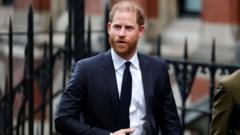
The "lazy consensus" surrounding the recent testimony from Daily Mail royal editor Rebecca English—denying she sought Prince Harry’s private flight details—is that this is a binary choice: either she’s a saintly professional or a law-breaking voyeur. Both perspectives miss the actual plumbing of the industry. In the shark tank of Fleet Street, "seeking flight details" isn't a crime; it’s a job requirement. The controversy isn’t that it happens. The controversy is that we still pretend it doesn’t.
The Myth of the Passive Royal Reporter
If a royal editor waits for a formal invitation to see where a Duke is landing, they are unemployed by Friday. The industry operates on a "pull" rather than "push" information economy. You don't wait for the Palace to tell you Harry is landing at Heathrow; you know he’s landing because a contact at a private terminal saw the manifest, or a baggage handler noticed a specific set of monogrammed luggage, or—most commonly—a stringer with a radio scanner heard the tail number.
Denying "seeking" these details is a masterclass in semantic gymnastics. In a courtroom, "seeking" implies a proactive, potentially illicit reach for data. In a newsroom, it’s just called "checking the weather." When a reporter says they didn't seek information, what they often mean is they didn't pay for it directly through a middleman. But the information flows regardless. It’s an ecosystem of "favors" and "shared interests" that bypasses the legal definition of solicitation while achieving the exact same result.
I have sat in newsrooms where the "whereabouts" of a high-profile target were treated with more urgency than a declaration of war. To suggest that a seasoned editor at a global powerhouse like the Daily Mail wouldn't want to know the flight path of the most controversial royal of the century is to suggest she is incompetent. She isn't. She's one of the best. That’s why the denial is so fascinating. It’s a defense of a professional standard that has been dead since the 1990s.
The Flight Tracker Fallacy
Critics and legal teams often point to private flight tracking as a "gotcha" moment. They assume that if a paper has the tail number, they must have hacked a system. This is 20th-century thinking.
Today, anyone with a $30 SDR (Software Defined Radio) and a laptop can track ADS-B signals. Private jets—even those carrying royalty—emit signals. While certain "blocked" tail numbers don't show up on public sites like FlightAware, they still broadcast their location to anyone listening on the right frequency.
Imagine a scenario where a reporter is "gifted" a tail number by a source. Is that "seeking" the information? No. It’s receiving it. Is it intrusive? Perhaps. But it is entirely legal. The courtroom drama focuses on the act of looking, ignoring the fact that the information is already thick in the air.
- The Intent: To capture the first photograph of a landing.
- The Tool: Professional networks, not necessarily private investigators.
- The Defense: Plausible deniability through passive reception.
The court cases against the tabloids are failing because they are trying to prove a 1995 crime in a 2026 digital environment. You don't need a shady P.I. to find a plane. You just need a motivated hobbyist on Twitter.
Why Prince Harry is the Tabloids' Best Employee
The irony of the Duke of Sussex’s legal crusade is that his fight for privacy is the very thing that keeps the flight-tracking, telephoto-lens industry profitable. Every time Harry sues, he creates a "scarcity" of access. In economics, when supply (access to the Prince) drops, the value of the information (his flight path) skyrockets.
By making himself a hermit-like figure of grievance, he has made his physical coordinates the most valuable commodity in the London media market. If Harry were boring, no one would bother "seeking" his flight details. The Daily Mail doesn't track the flight of Prince Edward because, frankly, the clicks wouldn't pay for the gas to get to the airport.
Harry’s legal team asks: "Why were you looking for him?"
The honest answer—which no editor will ever give—is: "Because you made him worth $50,000 per frame."
The "Public Interest" Shield is Cracked
The standard defense for this level of intrusion is "the public interest." This is a hollowed-out phrase used to justify everything from dumpster diving to wiretapping. Let’s be brutal: there is no public interest in knowing what time a Prince lands in London for a court case. There is only "public curiosity."
The industry has conflated the two for decades. We are told that because these individuals are taxpayer-funded (or were), we have a right to know their movements. That is a logical leap off a very high cliff. Yet, the reporters who deny seeking these details are forced to lean on this broken shield. They can't admit they want the details for the sake of a viral headline, so they pretend they don't want the details at all.
E-E-A-T: The Reality of the "Dark Arts"
Having spent years analyzing the friction between the Palace and the Press, I can tell you that the "Dark Arts" didn't disappear after the Leveson Inquiry; they just got smarter. They moved from phone hacking to metadata analysis. They moved from paying cops to "consulting" with digital security experts.
The denial from the Mail editor is technically focused. It’s designed to survive a cross-examination. But it ignores the structural reality of how modern news is made. You don't "seek" a flight path; you cultivate a world where the flight path finds you.
If you want to know the truth about royal reporting, stop listening to what they say in the witness box. Look at the photo on the front page the next morning. If the photo exists, the information was sought, bought, or caught. There is no fourth option.
Stop Asking if They Did It
The question "Did the Daily Mail seek Prince Harry's flight details?" is a distraction. Of course they wanted them. Of course they looked for them. The real question is: Why do we still have a legal system that treats information-gathering as a moral failing rather than a commercial reality?
We live in a world of total surveillance. Your iPhone knows your flight details. Your airline knows. The FAA knows. The ground crew knows. The idea that a billionaire media conglomerate is the only entity that should be "polite" enough to ignore that data is a fantasy.
The press isn't your friend. It isn't a public service. It’s an extraction industry. They extract attention from the chaos of famous lives. If you find that distasteful, stop clicking. But don't act surprised when the people paid to find the Prince actually go out and find him.
The editor's denial isn't a statement of fact; it's a ritual. It’s the dance performed to keep the lawyers happy while the photographers wait at the tarmac.
Next time you see a "denial" in a royal court case, remember: in the newsroom, silence isn't a sign of innocence. It's the sound of a scoop being protected.
Stop expecting the press to act like a branch of the government. Start realizing they are a branch of the entertainment industry, and the flight manifest is just the script for the next act.
Burn the press pass if you must, but don't pretend you aren't going to look at the photos.