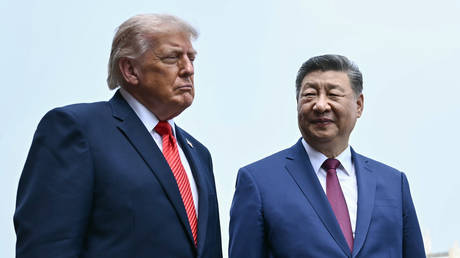
The recent understanding between Donald Trump and Xi Jinping regarding the Strait of Hormuz represents a rare alignment of interests between the world’s two largest economies, but it is built on a foundation of shifting sand. Both leaders have signaled that an Iranian blockade of this vital waterway is unacceptable. For Trump, it is about domestic energy prices and his "America First" promise to prevent global chaos from draining U.S. coffers. For Xi, it is a matter of survival; China is the world's largest importer of crude oil, much of which flows through that narrow chokepoint. While the agreement appears to be a win for global stability, the underlying tension between Washington’s desire for "maximum pressure" and Beijing’s need for "maximum flow" creates a paradox that could collapse at the first sign of a real kinetic conflict.
The Chokepoint Math
The Strait of Hormuz is the world's most important oil transit point. Roughly 20 percent of the world's total petroleum liquids consumption passes through this narrow stretch of water between Oman and Iran. If the flow stops, the global economy enters a tailspin.
Iran knows this. They have spent decades refining a "mosquito fleet" strategy, using fast-attack boats, sea mines, and shore-based anti-ship missiles to threaten the 21-mile-wide passage. It is the ultimate asymmetric lever. For years, the U.S. Fifth Fleet acted as the lone guarantor of the strait. Now, the geopolitical calculus has shifted. Trump is no longer willing to foot the bill for protecting oil that is largely destined for Asian ports. Xi, meanwhile, can no longer rely on the U.S. Navy to secure China's energy lifeline while simultaneously engaging in a trade war with Washington.
Trump’s Economic Isolationism Meets Xi’s Energy Hunger
Donald Trump views foreign policy through the lens of a balance sheet. He sees U.S. military presence in the Persian Gulf as a massive subsidy for Chinese manufacturing. By forcing a public "agreement" with Xi, Trump is effectively demanding that China take some of the skin in the game. He wants Beijing to use its significant economic influence over Tehran—China is Iran's largest trade partner—to keep the mullahs in check.
Xi Jinping is in a corner. China imports nearly 10 million barrels of oil per day. A significant portion of that comes from Saudi Arabia, Iraq, and the UAE, all of which must ship through Hormuz. If Iran closes the gate, Chinese factories go dark. This shared fear has created an unlikely partnership. Beijing has historically played both sides, buying Iranian oil under the table while maintaining ties with the Saudis. However, a total blockade would be a catastrophe China cannot ignore.
The Problem with Enforcement
The "catch" in this agreement lies in the execution. How do you stop a nation that feels it has nothing left to lose? Iran is currently under the weight of crushing sanctions. In their view, if they cannot export their oil, no one should.
The U.S. and China agree that the strait must stay open, but they disagree fundamentally on the method. Washington prefers the stick—more sanctions and military posturing. Beijing prefers the carrot—diplomatic engagement and economic integration. If the U.S. moves to further squeeze Iranian exports, Tehran may lash out. At that point, China would have to choose between backing its "partner" in Washington or protecting its "supplier" in Tehran.
The Asymmetric Threat and the Cost of Defense
Defending the Strait of Hormuz is not like a traditional naval battle. It is a grueling, high-risk game of minesweeping and escorting tankers through a gauntlet of coastal batteries.
The cost of insurance for tankers in the region has already seen massive spikes during periods of tension. A sustained conflict would make shipping commercially unviable, regardless of whether the strait is technically "open." Even if the U.S. and China agree on the goal, the actual mechanics of patrolling the waters together are fraught with peril. There is no shared command structure. There is no history of naval cooperation. Any Chinese military presence in the Gulf would be viewed with deep suspicion by U.S. regional allies like Israel and Saudi Arabia.
Beijing’s Strategic Hedging
While Xi agrees that the strait must remain open, he is simultaneously working to make the strait irrelevant. This is the part of the story often missed in mainstream reports. Through the Belt and Road Initiative, China is investing heavily in pipelines and ports that bypass Hormuz.
- Gwadar Port in Pakistan: Part of the China-Pakistan Economic Corridor (CPEC), aimed at linking the Arabian Sea directly to Western China.
- Pipelines through Myanmar: Reducing reliance on the Malacca Strait and the Indian Ocean.
- The Northern Sea Route: Exploring Arctic shipping lanes as a long-term alternative to the Suez Canal and Middle Eastern chokepoints.
These projects take decades. For now, the Strait of Hormuz remains the jugular vein of the Chinese economy. This vulnerability is exactly what Trump is trying to exploit. He knows that by threatening to step back from the region, he forces Xi to either step up—and spend billions on defense—or pressure Iran to fold.
The Proxy War Complication
The agreement between the two superpowers ignores the local players who have their own agendas. Saudi Arabia and Iran are engaged in a cold war for regional hegemony. Neither Riyadh nor Tehran will take orders from a joint U.S.-China communique if they believe their national survival or regional standing is at stake.
The Saudis, in particular, are wary of any deal that involves China. They see Beijing as too soft on Iran. If the U.S. pivots toward a shared security model with China, the Saudis may feel compelled to accelerate their own nuclear ambitions or seek new security guarantees elsewhere. This creates a more volatile environment, not a more stable one.
The Reality of Oil Markets
Markets hate uncertainty. Even the rumor of a deal between Trump and Xi caused a temporary dip in oil futures, as the "risk premium" associated with a Hormuz closure evaporated. But traders are cynical. They know that a single limpet mine on the hull of a Japanese or Norwegian tanker can undo months of diplomacy in an afternoon.
The "agreement" is a political signal, not a military reality. It tells Iran that if they choose to block the strait, they will face the combined wrath of their biggest customer and their biggest enemy. On paper, that is a powerful deterrent. In practice, a cornered regime in Tehran might see it as proof that their only remaining leverage is to actually pull the trigger and see if the U.S. and China really have the stomach for a protracted naval war.
The Limits of Superpower Influence
We often overestimate how much control Washington or Beijing has over local actors. The Houthi rebels in Yemen, backed by Iran, have already shown they can disrupt Red Sea shipping with relatively low-tech drones and missiles. The Strait of Hormuz is an even more compressed environment.
A "joint understanding" does not clear the mines. It does not silence the shore batteries. It certainly does not solve the underlying grievance of an Iranian government that sees itself as being strangled by a global financial system it can no longer access.
The Failure of the Maximum Pressure Campaign
The U.S. strategy has been to force Iran to the negotiating table by destroying its economy. While the economy is indeed in shambles, the "negotiation" has not happened. Instead, Iran has increased its uranium enrichment and expanded its regional influence through proxies.
China’s role in this is pivotal. By continuing to buy "teashed" or rebranded Iranian oil, Beijing provides a vital financial vent for the Iranian regime. Trump wants that vent closed. Xi wants the oil. The agreement to keep the strait open is effectively a agreement to disagree on everything else. It is a tactical truce, not a strategic alliance.
The Future of Gulf Security
If this pact holds, we might see the beginning of a multi-polar security arrangement in the Middle East. This would mark the end of the Carter Doctrine—the 1980 policy stating the U.S. would use military force to defend its interests in the Persian Gulf.
The transition would be messy. If the U.S. withdraws, a power vacuum is inevitable. If China fills it, the global balance of power shifts permanently. The "catch" mentioned in the headlines isn't just a diplomatic hurdle; it is the fundamental reality that both the U.S. and China are trying to protect the same water for entirely different reasons, using entirely different methods, while fundamentally distrusting one another.
The Risks of Cooperation
There is a significant risk that any joint naval effort could lead to accidental escalation. Imagine a scenario where a Chinese destroyer and a U.S. carrier strike group are both responding to an Iranian provocation. Without clear communication and shared protocols, the risk of a "friendly fire" incident or a navigational collision is high. In the high-tension environment of the Gulf, such an accident could spark a crisis between the two superpowers that dwarfs the original problem with Iran.
The Strategic Bottleneck
The Strait of Hormuz remains the world's most dangerous mile. The agreement between Trump and Xi is a recognition of mutual vulnerability, but it lacks any mechanism for enforcement. It is a verbal pact between two rivals who are currently in the middle of a systemic competition for global dominance.
China will continue to seek ways to bypass the strait to reduce its vulnerability to U.S. naval power. The U.S. will continue to seek ways to reduce its commitment to the region without handing the keys to the Middle East to Beijing. In the middle sits Iran, holding the matches and standing in a pool of gasoline.
The idea that the U.S. and China have "solved" the Hormuz problem is a dangerous fantasy. They have merely identified the problem as something they both fear. Fear can drive cooperation, but it is a poor substitute for a coherent regional security strategy. As long as the primary goal of the U.S. is to isolate Iran and the primary goal of China is to fuel its own growth, the Strait of Hormuz will remain a flashpoint that no amount of high-level handshaking can truly cool.
The next time a tanker is struck or a drone is downed, the world will see exactly how much this agreement is worth. If the U.S. expects China to take the lead in a military response, they will be disappointed. If China expects the U.S. to continue acting as the world’s unpaid security guard, they are mistaken.
The shipping lanes remain open for now, but the cost of keeping them that way is rising for everyone involved. The true test isn't whether Trump and Xi can agree on a goal, but whether they can survive the fallout when that goal is inevitably challenged by a regime with its back against the wall.