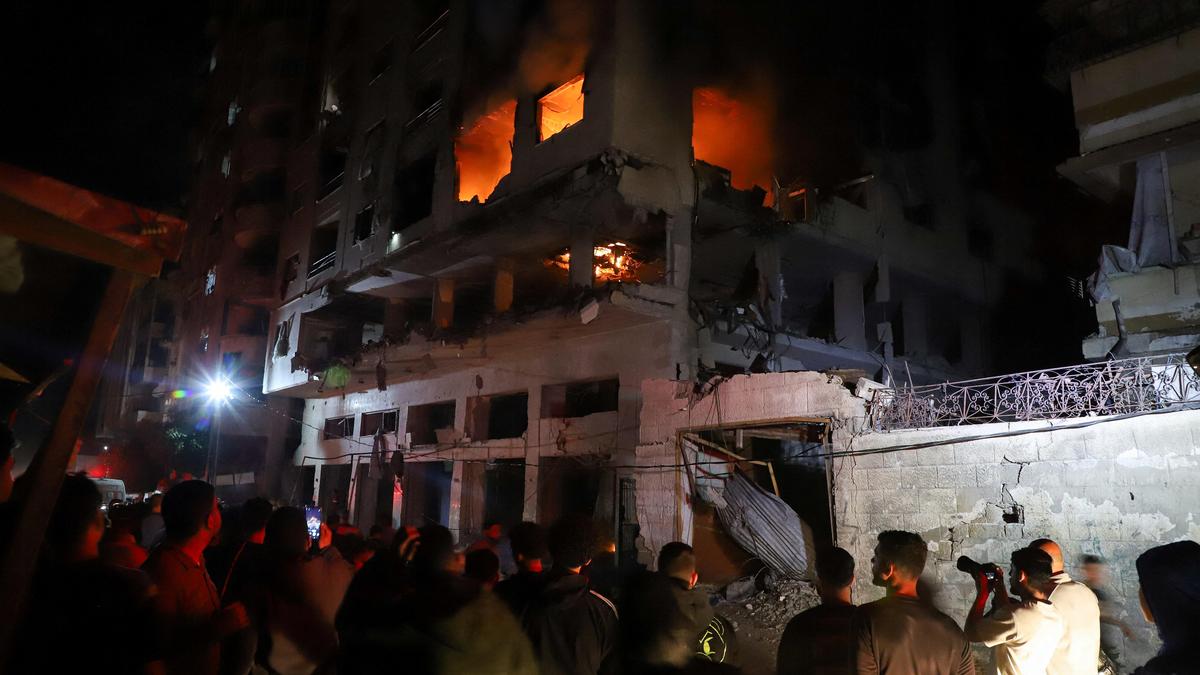
Israeli forces shot and killed 34-year-old Nour al-Din Kamal Hassan Fayyad on the outskirts of the Jenin refugee camp on Saturday, marking yet another casualty in an aggressive, months-long military campaign that has fundamentally reshaped the northern West Bank. While early wire reports frame the death as an isolated clash, the reality on the ground points to a systemic, highly coordinated encirclement of Palestinian urban centers under the banner of Operation Iron Wall. Fayyad, a resident of Wadi Burqin, was struck in the thigh by live ammunition while attempting to enter the sealed camp, bleeding out before emergency medical teams could resuscitate him.
The incident is not a mere footnote in a regional conflict. It is the predictable outcome of an intentional military strategy designed to permanently alter the geography of the occupied territories while global attention remains fixed elsewhere.
The Mechanized Isolation of Jenin
The killing of Nour al-Din Fayyad exposes the mechanics of a broader chokehold. Since mid-January, the Israeli military has maintained a strict cordon around the Jenin and Tulkarem refugee camps. This is not temporary crowd control. It is a structural siege.
The United Nations Relief and Works Agency (UNRWA) reports that Operation Iron Wall has already displaced nearly 40,000 Palestinians from these northern camps. The military apparatus has effectively transformed dense civilian neighborhoods into closed military zones. Displaced residents are granted only sporadic, highly monitored windows of access to inspect what remains of their homes. When Fayyad approached the perimeter of the camp, he was not entering an active battlefield; he was navigating a militarized border that did not exist in this configuration a year ago.
According to the Palestinian Red Crescent, Fayyad suffered a single live bullet wound to the thigh. By the time emergency responders evacuated him from the perimeter, his pulse had stopped. The Israeli army maintained its standard operational posture following the shooting, offering no immediate comment or specific justification for the lethal use of force against an unarmed resident attempting to access the camp.
The Arithmetic of Parallel Wars
The casualty figures emerging from the West Bank since October 2023 reveal an escalation that operates independently of the conflict in Gaza, yet thrives under its political cover. Palestinian Health Ministry data indicates that over 1,162 Palestinians have been killed by Israeli soldiers or settlers in the West Bank over the last two and a half years.
To view these numbers as collateral damage from simple counter-terrorism operations is to misunderstand the shifting rules of engagement. The frequency of lethal live-fire incidents has increased as the threshold for using deadly force has dropped. Just two weeks prior to Fayyad’s death, a similar raid in Nablus claimed the life of 26-year-old Naif Samaro, who was shot while traveling to visit his wife in labor at a local hospital.
The systemic nature of the violence is underscored by recent data from international oversight bodies.
| Metric (West Bank Escalation since Oct 2023) | Recorded Figure |
|---|---|
| Total Palestinian Fatalities | 1,162 |
| Total Palestinians Injured | ~12,245 |
| Total Palestinian Detentions | ~23,000 |
| Total Displaced by Operation Iron Wall | ~40,000 |
These statistics represent a structural dismantling of normal life. The everyday movement of logistics, workers, and families has been filtered through an unpredictable network of over 900 additional military barriers and checkpoints established over the last 30 months.
Institutionalized Lawlessness and the Settler Vanguard
The escalation cannot be attributed solely to uniform-wearing soldiers. A major factor driving the instability is the deepening integration between military operations and armed settler actions. Organizations like the Armed Conflict Location & Event Data Project (ACLED) have identified 2026 as the deadliest year for settler-driven violence since systematic monitoring began a decade ago.
In previous years, settler incursions into Palestinian villages were treated by authorities as rogue, extremist outbursts. Today, they function as a vanguard for territorial expansion. Backed by key ministers within the Israeli government, armed settlers routinely fence off Palestinian grazing lands, open private settlement roads, and establish mobile outposts with structural impunity. When local populations attempt to resist these land seizures, the military steps in to enforce order, almost exclusively penalizing the Palestinian residents.
This dual pressure—formal military operations like Iron Wall from the top, and informal settler expansion from the bottom—has created an unlivable environment in the rural and refugee sectors of the West Bank. UNICEF recently warned that the conditions required for basic childhood survival are being systematically erased through the deliberate destruction of water networks, schools, and residential shelters.
The Strategy of Permanent Friction
The classic counter-insurgency doctrine suggests that military operations have a defined end state, usually tied to the elimination of specific targets or the restoration of local governance. Operation Iron Wall rejects this template. It is an exercise in permanent friction.
By sealing off entire refugee camps and enforcing zero-tolerance perimeters with live ammunition, the military ensures that any civilian movement can be classified as a security threat. Fayyad’s attempt to cross into Jenin camp was treated as a hostile act not because he was carrying a weapon, but because the space he occupied had been redefined by military decree as off-limits to the people who live there.
This strategy achieves two things for the current Israeli political establishment. First, it fragments the West Bank into isolated pockets, preventing any cohesive political or social resistance from forming across the territory. Second, it establishes a new baseline of normalcy. A death in Jenin or Nablus no longer triggers massive international headlines or diplomatic crises; it is processed as routine maintenance of an occupation that has entered its late, most aggressive phase.
The international community remains trapped in a rhetorical loop, issuing statements of concern while the physical reality on the ground is rewritten day by day. Nour al-Din Fayyad did not die in a vacuum. He was killed because the perimeter around Jenin has become a hard, permanent border, and the policy governing that border is designed to shoot first and explain later.