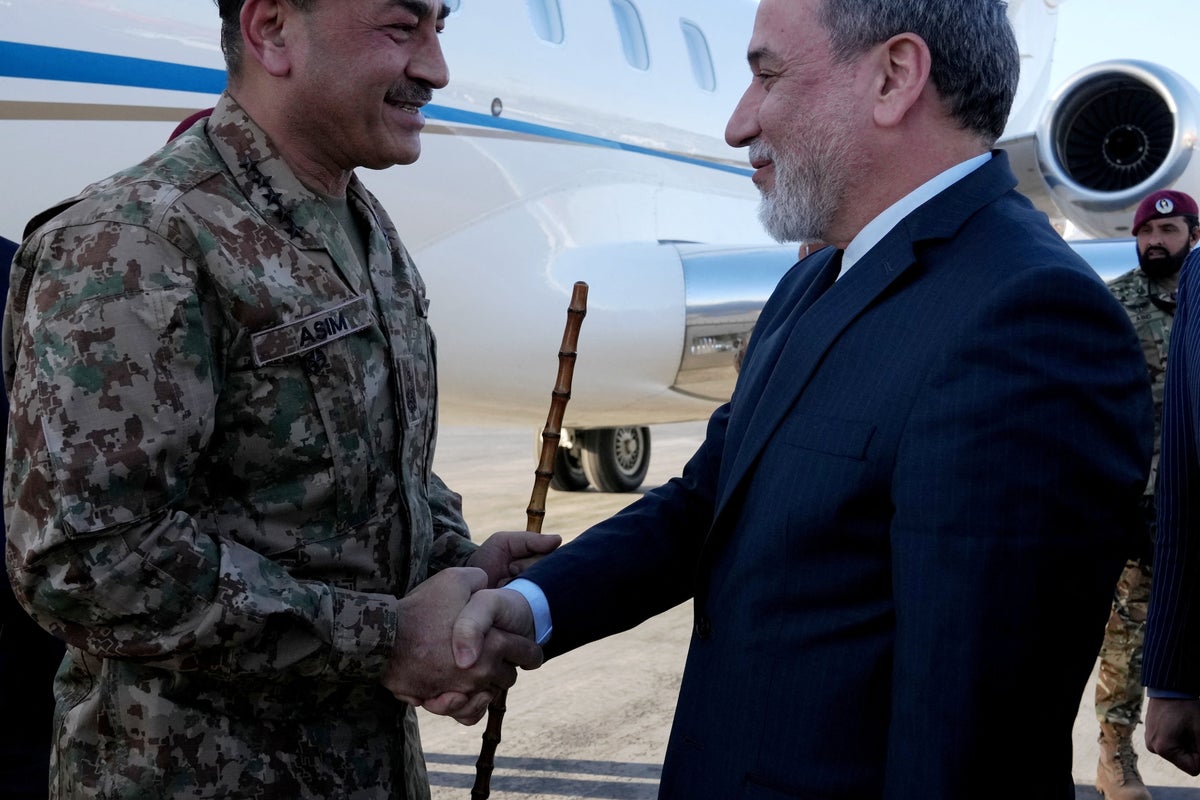
The air in Tehran during the transition from winter to spring carries a specific weight. It is the scent of diesel, jasmine, and the heavy, invisible pressure of a thousand sanctions. For decades, this city has been the focal point of a geopolitical standoff that feels like a permanent architectural feature of the Middle East. But when a white jet touches down at Mehrabad International Airport carrying General Asim Munir, the Chief of Army Staff of Pakistan, the atmosphere shifts. This is not just another diplomatic junket.
Munir arrives as a man with a singular, high-stakes mandate. He has been called Donald Trump’s "favorite field marshal," a moniker that carries the swagger of Mar-a-Lago and the lethal pragmatism of the Pakistani military establishment. He is in Tehran to do what decades of career diplomats have failed to achieve: bridge the chasm between Washington and Tehran.
The stakes are not found in the dry text of a memorandum of understanding. They are found in the flickering lights of a hospital in Shiraz that lacks Western-made medical parts, or in the bank accounts of a family in Islamabad watching inflation swallow their savings because regional trade remains frozen. This is about the pulse of 300 million people caught in the crossfire of a forty-year grudge.
The Architect of the Backchannel
To understand why Munir is the one stepping off that plane, you have to look at the map of the world not through political borders, but through the lens of survival. Pakistan occupies a sliver of land that is essentially a high-pressure valve. To the west lies an isolated Iran; to the east, a rising India; to the north, a chaotic Afghanistan. For Islamabad, peace between the United States and Iran isn’t a luxury. It is a biological necessity.
General Munir does not speak in the flowery, evasive language of the UN General Assembly. He speaks the language of security, logistics, and hard-nosed reality. It is a dialect that Donald Trump respects. During his first term, Trump showed a distinct preference for dealing with "strongmen" and military leaders over the bureaucratic layers of the State Department. He views the world as a series of transactional puzzles. Munir is the piece that finally fits the slot.
Imagine a room in the heart of Tehran. The walls are adorned with intricate Persian rugs, the air thick with the smell of bitter tea. On one side, Iranian officials who have spent their lives being told the Great Satan is immovable. On the other, a General who carries the quiet endorsement of a man who might soon be back in the Oval Office.
The conversation isn’t about ideology. It’s about the "What If." What if the oil flows? What if the borders soften? What if the threat of a regional firestorm is replaced by the hum of a trans-continental pipeline?
The Trump Factor and the Art of the Proxy
The timing is not accidental. As the American political engine roars toward another election, the shadow of a second Trump administration looms large over every foreign ministry on the planet. Tehran is pragmatic. They remember the "Maximum Pressure" campaign, but they also remember Trump’s stated desire to exit "forever wars."
Munir is effectively acting as a human bridge. He is providing Tehran with a roadmap to a version of Trump that isn't just about tweets and tariffs, but about the "Great Deal." For Trump, Munir represents a reliable interlocutor who can guarantee that if a deal is made, the security apparatus of the region will actually enforce it.
Consider the alternative. Without this backchannel, we are looking at a continued slide into a gray-zone conflict. We see it in the Red Sea. We see it in the drone strikes that pepper the news cycle. These aren't just "events." They are the sounds of a system breaking down because there is no one left to talk.
Munir’s presence in Tehran suggests that the silence has finally been broken. He is there to explain that the path to Washington might no longer run through Brussels or London, but through a direct, military-to-military understanding facilitated by Pakistan.
The Hidden Cost of the Status Quo
We often talk about "US-Iran relations" as if it’s a game of Risk played on a board. We forget the human geography.
There is a hypothetical merchant in the Grand Bazaar of Tehran—let's call him Abbas. For twenty years, Abbas has watched the value of the Rial plummet. He has seen his children graduate from top-tier universities only to find there are no jobs because the global economy has built a wall around his country. He doesn't care about the intricacies of uranium enrichment levels as much as he cares about the ability to buy a refrigerator that wasn't smuggled in through the mountains at a 300% markup.
Across the border in Balochistan, a truck driver named Tariq waits for days at a crossing that should take minutes. He is carrying goods that could feed families, but the bureaucratic friction of a sanctioned neighbor makes every mile a struggle.
General Munir carries the weight of Abbas and Tariq into those meetings. He understands that a stabilized Iran-US relationship would unlock the CPEC (China-Pakistan Economic Corridor) potential, turning a volatile border into a commercial artery.
The "peace" being discussed isn't a warm embrace. It is a cold, calculated cessation of hostilities that allows the gears of commerce to turn. It is the realization that the cost of the grudge has become higher than the cost of the compromise.
The Tightrope of the Field Marshal
The role of a mediator is inherently dangerous. In Pakistan, Munir must balance a domestic audience that is often skeptical of American intentions with a military that requires American hardware and Chinese investment. In Tehran, he must navigate a complex power structure where the Revolutionary Guard and the diplomatic corps don't always see eye to eye.
The skepticism is valid. We have seen "resets" before. We saw the JCPOA rise and fall. We saw the smoke over Baghdad. Why is this different?
The difference lies in the personality of the players. Munir is not a career politician looking for a legacy; he is a career soldier looking for stability. And Trump is not a traditional diplomat; he is a disruptor who loves nothing more than succeeding where his predecessors failed.
The General’s visit to Tehran is a signal that the "favourite field marshal" is ready to play the long game. He is betting that he can convince Iran that a transactional peace with a Trump-led America is better than a principled war with no end in sight.
But the real work happens in the silences between the meetings. It happens in the data shared about border security, the assurances given about proxy groups, and the quiet nods that signify a shift in posture.
Beyond the Headlines
While the world watches the grand gestures, the real story is in the details of the "revival." This isn't just about the nuclear program. It’s about the connectivity of a region that has been fractured for a generation.
If Munir succeeds, the map of the Middle East and South Asia changes. The "favoritism" Trump shows him isn't about personal friendship; it’s about the utility of a man who can deliver a message to a capital that usually hangs up the phone.
The jet will eventually take off from Mehrabad, leaving the smog of Tehran behind. The General will return to Rawalpindi to brief his commanders. The reports will be written in dry, technical prose. But the heartbeat of the mission will remain in the streets.
It will be in the eyes of the shopkeepers who wonder if the prices will finally stop climbing. It will be in the minds of the young entrepreneurs in Lahore who dream of a market that extends all the way to the Mediterranean.
We are witnessing a moment where the rigid structures of the old world are being tested by a new kind of personalized, high-stakes diplomacy. It is messy. It is uncertain. It is fraught with the potential for spectacular failure.
Yet, as the General moves through the halls of power in Tehran, there is a sense that the old ways of fighting have simply run out of steam. The field marshal has arrived, not to start a war, but to see if there is enough oxygen left in the room to finally sustain a flame of peace.
The shadow of the General on the tarmac is long, stretching across a landscape that has seen too much blood and not enough trade. Whether that shadow marks the beginning of a new era or just another fleeting eclipse depends entirely on whether the world is ready to trade its grievances for a future that actually functions.
The silence that follows his departure will be the most telling part of the journey.