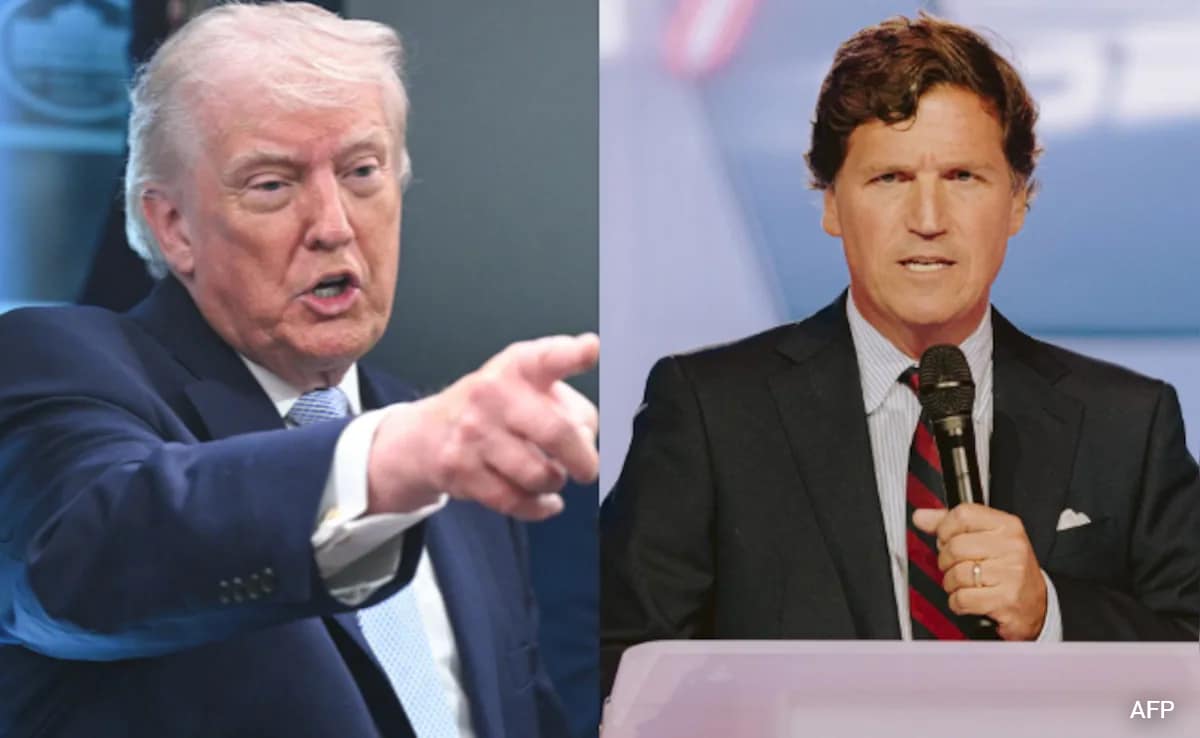
Donald Trump’s public disparagement of Tucker Carlson and other right-wing figures regarding their opposition to military engagement with Iran reveals a fundamental fracture in the modern Republican coalition. This is not merely a clash of personalities; it is a structural breakdown between two competing grand strategies: Transactional Realism versus Media-Driven Isolationism. By analyzing the friction between these factions, we can identify how foreign policy is being weaponized as a tool for internal party discipline and ideological gatekeeping.
The Logic of Transactional Belligerence
The core of the dispute rests on the definition of national strength. For the populist wing, represented by Carlson, strength is defined by domestic preservation and the avoidance of "forever wars" that drain the treasury. For Trump’s specific brand of realism, strength is a psychological currency used to extract concessions from adversaries. When Trump mocks the "low IQ" of those opposing a potential strike on Iran, he is signaling that their rigid adherence to non-interventionism limits his tactical flexibility. For an alternative view, see: this related article.
This friction operates within a Three-Pillar Framework of Escalation:
- Credible Threat Inflation: To maintain leverage in negotiations, a leader must project a willingness to use force. Absolute isolationism removes this tool from the kit, rendering "maximum pressure" campaigns toothless.
- Intellectual Hierarchy: By labeling opponents as "stupid," Trump attempts to move the debate from the moral plane (is war right?) to the operational plane (who is smart enough to win?). This shifts the burden of proof onto the isolationists to prove their strategy can achieve the same security outcomes.
- The Audience Cost Function: In political science, "audience costs" are the domestic penalties a leader pays for backing down. By preemptively insulting those who would call for restraint, Trump lowers his domestic audience costs for escalation, effectively giving himself more room to maneuver in the international arena.
Deconstructing the Isolationist Response
Tucker Carlson and the broader "New Right" have attempted to decouple the Republican base from its historical neoconservative moorings. Their logic follows a path of Internal Resource Prioritization. They argue that every dollar spent on a kinetic strike in the Middle East is a dollar not spent on border security or domestic infrastructure. This creates a zero-sum game between foreign intervention and domestic stability. Similar analysis on this matter has been provided by NPR.
However, the "low IQ" critique targets a specific weakness in this logic: the failure to account for global maritime stability and energy markets. An isolationist stance on Iran assumes that the United States can insulate its economy from a closed Strait of Hormuz. Trump’s criticism implies that a refusal to engage—even rhetorically—ignores the technical realities of global trade.
Structural Bottlenecks in Policy Alignment
The conflict highlights a significant bottleneck in the development of a coherent "America First" foreign policy. This bottleneck is caused by the lack of a middle ground between total withdrawal and total intervention.
- Information Asymmetry: The executive branch operates on classified intelligence that media figures like Carlson do not possess. Trump’s mocking of their "intelligence" is a direct reference to this gap, asserting that those outside the SCIF (Sensitive Compartmented Information Facility) are theorizing in a vacuum.
- The Signaling Loop: When media influencers push for restraint, they inadvertently signal to Iran that the American public will not support a strike. This reduces the efficacy of the "Madman Theory" of diplomacy, where an adversary is kept off-balance by a leader’s perceived unpredictability.
The Divergence of Rhetoric and Kinetic Action
We must distinguish between Rhetorical Posturing and Operational Intent. Trump has historically been reluctant to engage in new ground wars, preferring targeted strikes (such as the 2020 Soleimani operation) or economic warfare. His mockery of the isolationist right serves as a "re-centering" mechanism. It prevents the party from drifting so far toward non-interventionism that it loses its identity as the party of military strength.
The mechanism at play is Intra-Party Hegemony. By delegitimizing the "intellectual" leaders of the anti-war right, Trump ensures that he remains the sole arbiter of when and where American force is applied. He is not necessarily advocating for war with Iran; he is advocating for his right to threaten it without being undermined by his own media ecosystem.
Quantifying the Political Risk
The risk of this strategy is the alienation of the very base that Carlson speaks to. If the populist base perceives that the "America First" movement is being co-opted by traditional hawkish interests, the coalition fractures.
- Primary Vulnerability: Candidates running on a pure isolationist platform may find themselves at odds with a leader who demands total tactical flexibility.
- Donor Dynamics: The neoconservative donor class remains interested in Iranian containment. Trump’s rhetoric bridges the gap between these donors and the anti-war base, using the "low IQ" insult as a bridge to satisfy the former while maintaining his "tough guy" persona for the latter.
Strategic Recalibration for the GOP
The path forward for the Republican party requires a synthesis of these two poles. A "Smart Intervention" framework would focus on:
- Defined Exit Triggers: Moving away from nation-building toward specific, time-bound kinetic objectives.
- Economic Substitution: Using energy independence as a weapon to reduce the strategic importance of Iranian aggression.
- Psychological Deterrence: Maintaining the credible threat of force while avoiding the "sunk cost" of permanent deployments.
The "low IQ" comments are the opening salvo in a battle for the soul of 21st-century conservatism. This is a competition between those who view the world through the lens of a Closed System (isolationism) and those who see it as an Open Transactional Market (realism). The winner will dictate the defense budget, the structure of the State Department, and the future of American alliances for the next decade.
The immediate tactical move for any GOP operative is to align with the "unpredictable strength" model. This allows for the avoidance of war while retaining the power to threaten it—effectively neutralizing the isolationist critique by framing it as a lack of strategic imagination. Expect more public shaming of isolationist influencers as the 2024 and 2026 election cycles demand a unified, yet flexible, defense posture.