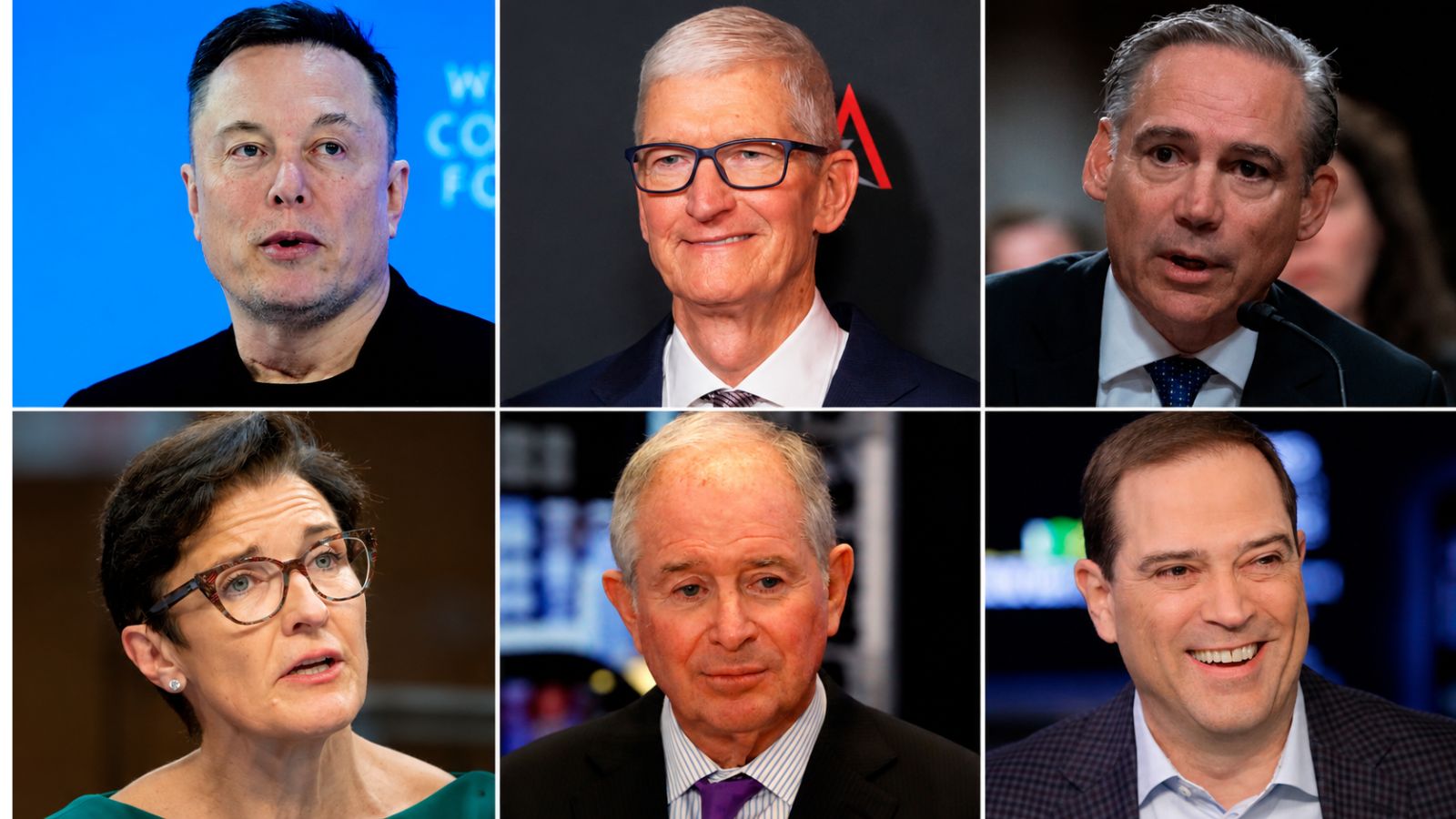
The air inside a private Gulfstream is different. It’s thinner, scrubbed of the common scents of city life, and carries the faint, metallic tang of pressurized ambition. Somewhere over the Pacific, Elon Musk likely looked out at the darkening horizon, the curvature of the Earth visible from his window, and saw not just a geography, but a balance sheet. He wasn't alone. Kelly Ortberg of Boeing, Tim Cook of Apple, and a phalanx of the world’s most powerful corporate titans were hurtling toward Beijing.
They weren't just passengers. They were the unofficial diplomats of a shadow state—the American Economy—and they were walking into a room where the stakes were higher than any quarterly earnings call could ever describe. Discover more on a related topic: this related article.
When Donald Trump landed in China for this high-stakes summit, he didn't just bring the State Department. He brought the architects of our modern lives. To understand why this specific group of CEOs matters, you have to look past the press releases. You have to look at the friction between a factory floor in Shenzhen and a retail shelf in Ohio.
The Architect of the Silicon Bridge
Tim Cook moves with a calculated grace that masks the sheer terror of his position. Think of Apple not as a phone company, but as a massive, intricate web. One end is anchored in the polished glass of Cupertino; the other is buried deep in the soil of Chinese manufacturing. Additional analysis by Forbes delves into similar perspectives on this issue.
For Cook, this trip isn't about politics. It’s about survival.
If a trade war turns into a cold war, the gears of the world’s most profitable machine don't just slow down. They grind to a halt. Cook sat at that table in Beijing knowing that every word he whispered into the President’s ear was a plea for stability. He represents the "Just-in-Time" era—a world where we expect our devices to appear as if by magic, ignoring the reality that they are born from a fragile peace between two superpowers that increasingly distrust one another.
He is the human personification of the compromise we all make: we want our privacy and our democratic values, but we also want our titanium-framed smartphones delivered by Friday.
Turbulence and the New Pilot
Then there is Kelly Ortberg. He hasn't been at the helm of Boeing long, but he has inherited a house on fire. For Boeing, China isn't just a market; it’s the only market that can save them from a decade of decline.
Every time a Chinese airline signs a contract for a fleet of 737 MAX jets, it’s a heartbeat for American manufacturing. But those signatures are often written in the disappearing ink of geopolitical favor. Ortberg walked into those meetings knowing that his planes are often treated as bargaining chips.
Imagine standing in a room where your company’s entire future—thousands of jobs in Washington and South Carolina—depends on whether two men at the head of the table can agree on the price of soybeans or the status of a distant island. That is the invisible weight Ortberg carries. He isn't just selling planes; he is selling the idea that American engineering is still the global gold standard, even as the sky grows crowded with state-subsidized competitors.
The Wildcard in the Room
Elon Musk occupies a space that defies traditional categorization. He is the bridge-burner and the bridge-builder all at once. In the United States, he is the government’s biggest contractor, launching satellites and molding the future of transport. In China, he is the rare foreign entity allowed to own his factory outright.
Musk’s presence on this trip serves as a reminder that the "America First" doctrine has a complicated relationship with globalism. He is there because Tesla needs China’s lithium and its voracious middle class. Yet, he is also there as a confidant to a President who views China as the primary antagonist of the American story.
It is a dizzying tightrope walk. One wrong move and he loses the grace of the CCP; another, and he loses the subsidies of the GOP. He represents the modern mogul—someone who operates above the level of nations, yet is constantly pulled back down by the gravity of their laws.
The Invisible Stakes of the Dinner Table
We often view these summits as dry exchanges of data. We see the photos of men in dark suits shaking hands under the glow of ornate chandeliers. We read the bullet points about tariffs and trade deficits.
But consider the human cost of a failed negotiation.
Behind every CEO on that trip is a hypothetical worker. Let’s call him Jim. Jim works at a specialized glass factory in Kentucky that exports to a finishing plant in Suzhou. If the men in Beijing can’t find a middle ground, Jim’s factory closes. His mortgage becomes a mountain. His community, already frayed by decades of industrial shifts, loses another thread.
The CEOs aren't just there to protect their stock options. They are there because the global economy is so deeply intertwined that "decoupling" isn't just a policy term—it’s a surgical amputation performed without anesthesia.
The Strategy of the Entourage
Why did Trump take them? It wasn't just for show.
In the theater of international diplomacy, these CEOs are both shields and swords. By bringing the heads of the world’s most powerful corporations, the American delegation sends a message of strength: We are the engine of global innovation.
But it also provides a back channel. When the formal talks hit a wall—as they inevitably do—the real work happens in the hallways. It happens over coffee between an Apple executive and a Chinese minister. It happens when a tech founder explains the reality of AI development to a skeptic.
These leaders are the translators. They speak the language of profit, which is often the only universal language left when ideology fails.
The Ghost at the Feast
The one thing no one mentions in the official briefings is the sense of borrowed time. There is a palpable feeling that the era of easy globalization is over. The CEOs on this trip are the last of the Mohicans, trying to preserve a system that is rapidly being replaced by "friend-shoring" and nationalistic protectionism.
They are fighting for a world where a chip designed in Oregon can be made in Taiwan and sold in Shanghai without a second thought. But that world is flickering.
The tension in the room in Beijing wasn't just about the current trade deal. It was about the next fifty years. It was about who will own the infrastructure of the future—the 6G networks, the autonomous fleets, the quantum computers.
The Reality of the Room
Walking into the Great Hall of the People is an exercise in scale. The ceilings are too high; the carpet is too red. It is designed to make the individual feel small.
For a CEO like Tim Cook, who is used to being the most important person in any room he enters, this is a jarring shift. Here, he is a guest. He is a representative of a system that the hosts are actively trying to surpass.
The conversation isn't just about how many iPhones will be sold next year. It’s about the soul of industry. It’s about whether the American model of private innovation can coexist with the Chinese model of state-directed growth.
The Weight of the Return Flight
As the delegation prepares to head back to the States, the suitcases will be heavier with memos and tentative agreements. The press will report on the "wins" and "losses" as if it were a scoreboard in a stadium.
But the real outcome won't be known for months, perhaps years.
The success of the trip isn't measured in the words of a joint communique. It’s measured in the silence of factories that stay open. It’s measured in the stability of prices at the grocery store. It’s measured in the avoidance of a conflict that no one—not even the most hawkish politician—actually wants.
The CEOs are going home to their boardrooms and their glass offices. They will return to the familiar world of spreadsheets and strategy. But they leave behind a landscape that has been subtly shifted by their presence.
They are the guardians of a fragile status quo, men and women who have realized that in the modern world, there is no such thing as a "local" business. Everything is connected. Every phone in a pocket, every plane in the sky, and every car on the road is a tether between two giants who are locked in a dance they cannot stop, even if they have forgotten why they started dancing in the first place.
The lights of the Beijing skyline fade in the distance as the jets climb back into the thin, pressurized air of the stratosphere. Below, billions of people continue their lives, most of them unaware that their future was just discussed over tea by a handful of people who hold the world in their hands.