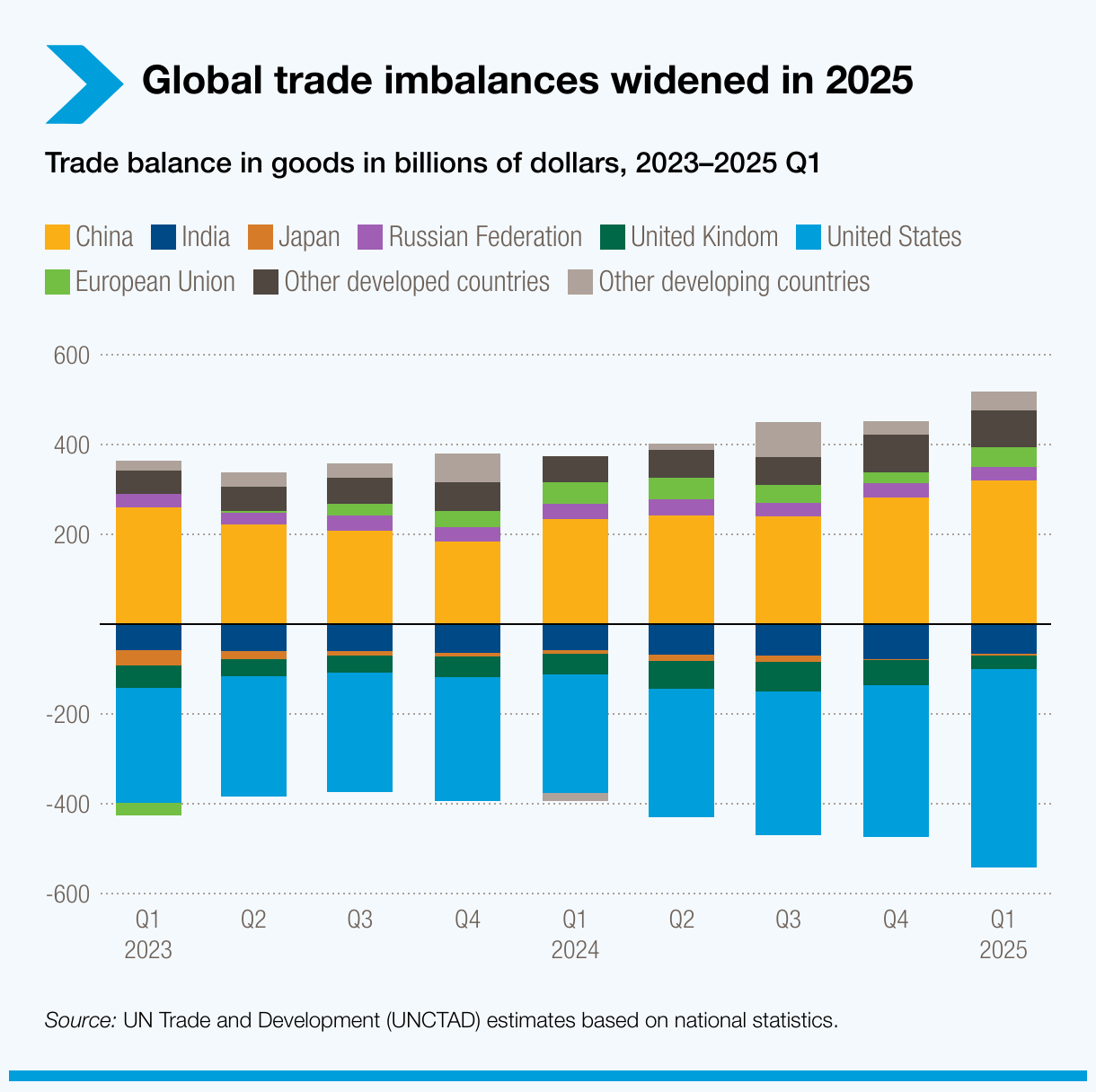
The world is tilting. If you look at the recent data from the International Monetary Fund (IMF) and the World Bank, you'll see a familiar, unsettling pattern. Money isn't flowing where it should. Instead, it’s piling up in a few specific corners of the globe while others rack up debts they might not be able to pay back. We call these global trade imbalances. For a few years, everyone pretended they went away. They didn't. They just took a nap during the pandemic.
Now, they’re back with a vengeance.
When one country exports way more than it imports, it creates a surplus. When another does the opposite, it has a deficit. On paper, it sounds like a simple accounting trick. In the real world, it’s a recipe for trade wars, currency crashes, and political anger. You can’t have a world where everyone tries to be the seller and nobody wants to be the buyer. It doesn't work. The math fails.
The Return of the Giant Surpluses
China is the obvious starting point. For decades, the Chinese economy relied on building things and shipping them elsewhere. During the middle of the 2010s, it looked like they were shifting toward a "consumer economy." They wanted their own citizens to buy more stuff. That shift stalled. Hard.
Right now, China’s industrial overcapacity is hitting levels that make Western policymakers sweat. They’re producing more electric vehicles, solar panels, and lithium batteries than their own people can ever use. Because their domestic housing market is in a tailspin, Chinese families are saving every penny instead of spending. So, where does all that extra factory output go? It gets dumped onto the global market at prices that domestic manufacturers in Europe or the U.S. can't possibly match.
It isn't just China, though. Look at Germany. Look at the Netherlands. These are "surplus hoarders." They export far more than they consume. While that sounds like a win for them, it creates a vacuum elsewhere. If Germany isn't buying, someone else has to go into debt to keep the wheels of global commerce turning. It’s a lopsided see-saw.
Why You Should Care About the Deficit Side
On the other side of the ledger, we have the United States. The U.S. has run a persistent trade deficit for decades. For a long time, this was a symbiotic relationship. China and Japan bought U.S. Treasury bonds with the dollars they earned from selling us toys and tech. This kept interest rates low in America. We got cheap stuff; they got a safe place to park their cash.
That deal is souring.
When a country runs a massive deficit for too long, it loses its industrial base. You’ve seen this in the Rust Belt. You’ve seen it in the hollowed-out manufacturing towns across the Midwest. When "buying" is the only thing your economy does well, you become fragile. If the surplus countries suddenly decide they don't want to buy your debt anymore—or if they start using that debt as a political weapon—you're in trouble.
Current account imbalances are currently widening to levels we haven't seen since the lead-up to the 2008 financial crisis. Back then, these imbalances were a huge factor in the global meltdown. They fueled a credit bubble that eventually popped. We're seeing those same ghost patterns emerge again.
The Death of the Old Trade Rules
We used to have a system for this. The World Trade Organization (WTO) was supposed to keep things fair. It's basically on life support now. The old "Washington Consensus" that free trade solves everything has been tossed out the window.
Today, we have "friend-shoring" and "de-risking." These are just fancy ways of saying "we only want to trade with people we like." The U.S. is using massive subsidies through the Inflation Reduction Act to claw back manufacturing. The EU is launching anti-subsidy investigations into Chinese EVs. This isn't just about economics anymore. It’s about national security.
When trade becomes a battlefield, efficiency dies. You end up paying more for everything. Your phone, your car, your dishwasher—all of it gets more expensive because we’re prioritizing "resilience" over "lowest cost." Imbalances drive this friction. If trade felt fair and balanced, we wouldn't be building these giant tariff walls. But it doesn't feel fair. It feels like a zero-sum game.
The Role of Currency Manipulation
You can't talk about imbalances without talking about the dollar. The U.S. dollar is incredibly strong right now. While that’s great if you’re vacationing in Rome, it’s a nightmare for trade. A strong dollar makes American exports too expensive and foreign imports too cheap. It artificially widens the deficit.
Some countries love this. They keep their own currencies weak on purpose. If your currency is cheap, your exports are cheap. It’s a way of stealing demand from the rest of the world. Economists call it "beggar-thy-neighbor" policy. It worked for a while, but the world is running out of patience. You’re seeing more aggressive currency interventions from Japan to Brazil as they try to navigate this volatility.
Why This Time Is Different
In 2006, global imbalances were mostly about private money flowing into housing bets. In 2026, it’s about government policy. Governments are now the primary drivers of where money goes. We are in an era of industrial policy.
- State-backed loans in Asia are creating massive factory gluts.
- U.S. tax credits are pulling investment away from Europe.
- Geopolitical tensions are forcing companies to build redundant supply chains.
This makes the "fix" much harder. You can't just adjust interest rates and hope the market balances itself out. You're dealing with political ego and survival. China can't just stop exporting without facing massive unemployment at home. The U.S. can't just stop borrowing without causing a domestic recession. We're locked in a grizzly bear hug.
Breaking the Cycle
If we don't fix these imbalances, the endgame is ugly. It’s a full-blown trade war. We’re talking 60% tariffs, the end of global supply chains, and a massive spike in inflation.
To avoid that, surplus countries need to spend more at home. Germany needs to invest in its crumbling infrastructure. China needs to build a real social safety net so its citizens feel safe enough to stop saving 45% of their income. On the flip side, deficit countries like the U.S. need to get their fiscal houses in order. We can't keep spending money we don't have and expecting the rest of the world to finance it forever.
Start watching the "Current Account" data in the quarterly reports. It’s a boring name for a terrifying reality. If those numbers keep diverging, the global economy is headed for a hard reset.
Don't wait for the headlines to tell you the crisis is here. Watch the flow of goods. If one side of the world is making everything and the other side is only borrowing to buy it, the bridge is eventually going to collapse. We're already seeing the first cracks in the concrete.
Check your supply chain exposure. If your business relies on a single source in a surplus-heavy country, start diversifying now. The tariffs are coming. The friction is real. The era of easy, unbalanced trade is over.