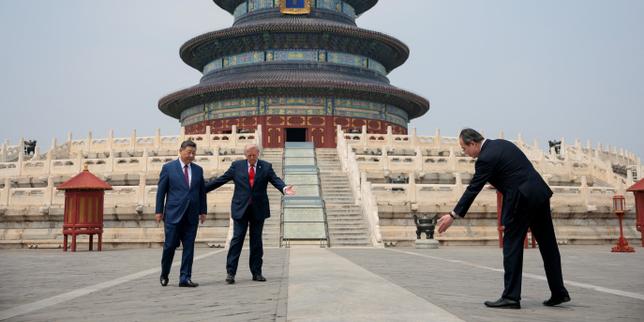
The visual of Donald Trump and Xi Jinping walking through the Great Hall of the People on May 14, 2026, was a masterclass in the theater of power. But behind the handshakes and the lavish banquet toasts lies a high-stakes geopolitical play that far outweighs the surface-level optics. Trump’s formal invitation for Xi to visit the White House on September 24 is not merely a reciprocal gesture. It is a calculated move to anchor a volatile relationship in a series of transactional wins before the American political season reaches a fever pitch.
In a two-hour closed-door session in Beijing, the two leaders bypassed traditional diplomatic niceties to hammer at the friction points of 2026: the war in Iran, the blockade of the Strait of Hormuz, and the relentless flow of fentanyl precursors. While the White House readout focused on "economic cooperation," the real story is the emerging "Strategic Stability" framework—a new paradigm designed to keep the world’s two largest economies from a collision course that neither can afford.
The Taiwan Redline
Xi Jinping was blunt. He characterized the Taiwan question as the single most critical variable in the relationship, warning that a "mishandling" of the island could lead to direct military conflict. This isn't just rhetoric. As Taiwan remains the world’s premier hub for high-end semiconductor manufacturing, any disruption there would paralyze the global tech industry.
Trump, for his part, has maintained a characteristic ambiguity. While his administration has approved an $11 billion weapons package for Taipei, the fulfillment of that order remains a massive bargaining chip. During the summit, Trump signaled he was willing to discuss the future of these arms sales, a move that sent tremors through the State Department but opened a lane for negotiation that Beijing has long sought.
The CEO Contingent
This wasn't just a meeting of heads of state; it was a corporate summit by proxy. Trump arrived in Beijing with a retinue of tech titans, including Elon Musk, Tim Cook, and Jensen Huang. Their presence underscores the reality that the U.S.-China divide is no longer just about trade deficits—it is a war for dominance in Artificial Intelligence and the electric vehicle (EV) market.
The automotive sector is particularly vulnerable. Chinese EV manufacturers reached a historic milestone in April 2026, exporting more electric units than gasoline-powered cars for the first time. Trump’s strategy appears to be an "if you can't beat them, make them build here" approach. He has teased the possibility of allowing Chinese automakers to establish manufacturing plants on American soil, provided they use American labor and facilities. It is a protectionist pivot that prioritizes domestic job creation over the total exclusion of Chinese technology.
The Middle East Equation
A significant portion of the Beijing talks focused on the Strait of Hormuz. With global energy flows at risk due to the ongoing conflict in Iran, both leaders found rare common ground. Beijing, usually hesitant to intervene in Middle Eastern security, finally signaled a willingness to help keep the Strait open. This is not out of altruism; China’s economy is deeply dependent on the steady flow of Iranian and Saudi crude.
The agreement that Iran must not possess a nuclear weapon is a rare alignment of interests. For Trump, this is a diplomatic win he can sell back home as "reining in" a global threat through superior negotiation. For Xi, it is a way to ensure that regional instability doesn't derail China's "Great Rejuvenation."
The Fentanyl Front
Domestic pressure in the U.S. regarding the opioid crisis made the fentanyl discussions a political necessity. The recent arrest of a Chinese national in connection with a Las Vegas synthetic opioid ring provided the backdrop for these talks. The leaders highlighted a need to "build on progress," but the real test will be whether Beijing follows through on cracking down on the chemical labs that supply the precursors. History suggests that such promises are often used as leverage in trade talks rather than standing as independent humanitarian commitments.
The Board of Trade and Market Access
One of the more concrete proposals to emerge is the establishment of a formal U.S.-China Board of Trade. This body would serve as a permanent mechanism to resolve commercial disputes before they escalate into full-scale trade wars. Trump’s demand for "opening up" China to American firms remains a tall order. While Xi promised that China’s doors would "only open wider," U.S. companies have heard this refrain for decades with mixed results.
The September 24 meeting in Washington will likely be the venue where these preliminary agreements are either codified or collapse. By inviting Xi to the White House just as the American electoral cycle enters its most aggressive phase, Trump is betting that he can deliver a "Phase Two" trade deal that stabilizes the economy and lowers inflation through cheaper imports and expanded agricultural exports.
The risks are immense. Xi’s warning that Taiwan independence and peace are "as irreconcilable as fire and water" remains the ultimate wildcard. If the U.S. continues its current trajectory of arms support, the "Strategic Stability" promised in Beijing could vanish before Xi’s plane even touches down at Dulles.
The strategy is clear: bind the two nations through economic dependency so deep that conflict becomes a form of mutual suicide. Whether this gamble holds through the autumn remains the defining question for the global order in 2026. The world is no longer looking for a "reset"—it is looking for a way to survive the competition without a catastrophe.