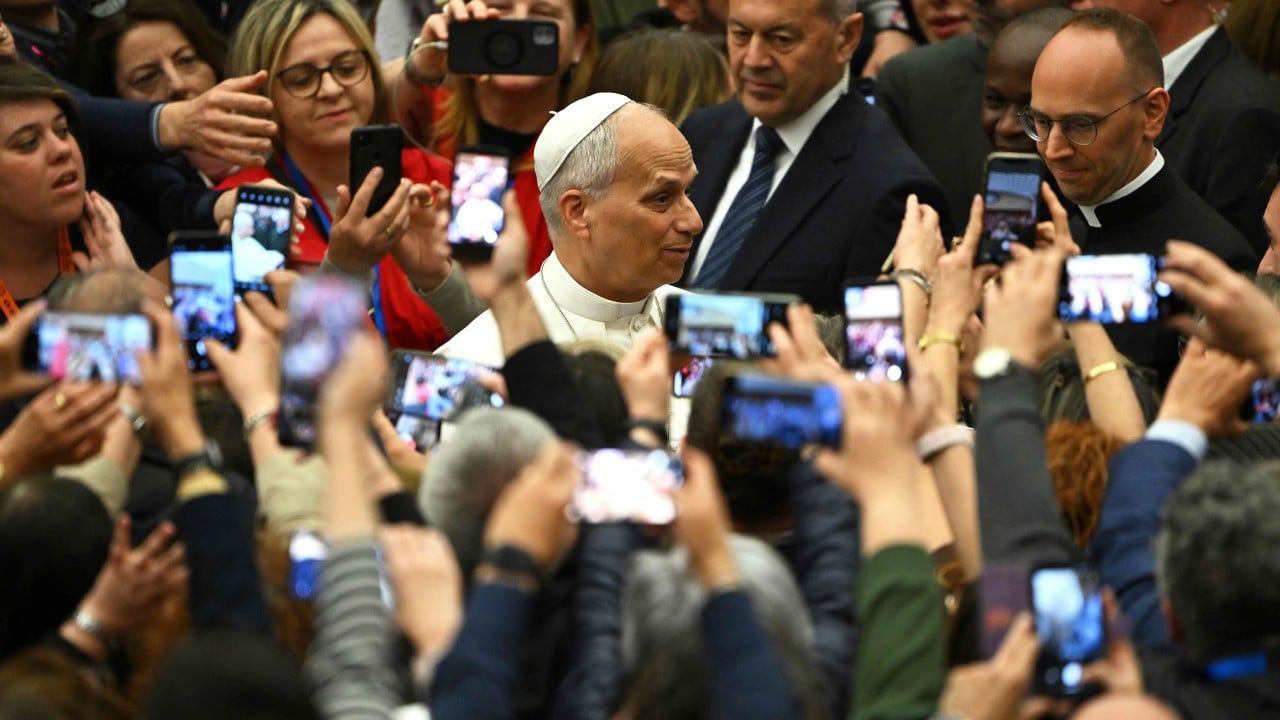
The air inside the Vatican’s apostolic palace often feels heavy with the weight of centuries, a thick silence that carries the echoes of every decree, prayer, and quiet footfall since the Renaissance. When Pope Francis speaks on the global stage, he isn't just a man in white standing behind a microphone; he is a bridge between a medieval past and an uncertain future. His latest appeal didn't center on theology or liturgy. It focused on the cold, calculated machinery of the state.
He called for the worldwide abolition of the death penalty.
It was a plea that bypassed the usual political jargon, aiming instead for the gut. To understand why this matters, you have to look past the mahogany benches of the Supreme Court or the sterile press releases of international NGOs. You have to look at a hypothetical man named Elias.
Elias sits in a cell that measures exactly six by nine feet. The walls are a shade of grey that seems to swallow light. He has been there for twelve years. Whether Elias is innocent or guilty is almost secondary to the point the Pope is making; the point is that Elias is a human being whose life has been reduced to a date on a calendar. When a state decides to end a life, it assumes a level of infallibility that no human institution has ever actually possessed.
The Pope's stance is a radical departure from the "eye for an eye" logic that has governed human justice for millennia. It is a recognition that the state, for all its power, is made of people. People make mistakes.
The Fragility of the Final Word
Justice is often sold to us as a scale, perfectly balanced and objective. We like to believe that the evidence is always clear, the witnesses are always honest, and the lawyers are always brilliant. Reality is much messier. It is a collection of grainy CCTV footage, coerced confessions, and the inherent biases of a jury that just wants to go home for dinner.
Since 1973, at least 196 people have been exonerated from death row in the United States alone.
One hundred and ninety-six.
That is not a statistic; it is a haunting collection of near-misses. Imagine being one of them. Imagine the sound of the heavy steel door sliding shut, knowing that the machinery of the world has decided you no longer deserve to breathe, while you know—with a desperate, screaming certainty—that they are wrong.
The Pope argues that even when the guilt is certain, the execution remains a failure of the imagination. It is the easy way out for a society that doesn't want to do the hard work of rehabilitation or address the root causes of violence. It is a permanent solution to a problem that is often deeply rooted in poverty, mental illness, and systemic neglect. When we kill, we stop asking why. We just close the book.
The Myth of Deterrence
One of the most persistent arguments for the gallows or the needle is the idea of the "deterrent." The logic suggests that if the punishment is terrifying enough, the crime will not happen. It’s a clean, logical theory that falls apart the moment it touches the ground.
Criminologists have studied this for decades. The data consistently shows that the death penalty does not lower homicide rates. States without capital punishment often have lower murder rates than those that cling to it. Criminals, particularly those committing acts of passion or those suffering from profound psychological breaks, are rarely performing a cost-benefit analysis in the heat of the moment. They aren't thinking about the needle; they are lost in the storm.
Pope Francis is leaning into this data, but he is also pushing further. He is challenging the idea that a human life can ever be truly "forfeit."
Consider the perspective of the executioner. We rarely talk about the person who has to pull the lever or administer the drugs. These are individuals tasked with an impossible burden. They carry the weight of a state-sanctioned killing into their homes, their dinners, and their sleep. By calling for abolition, the Pope isn't just advocating for the prisoner; he is advocating for the soul of the society that demands the execution.
A Global Shift in the Current
The world is changing, though the pace is uneven. More than two-thirds of the world’s countries have abolished the death penalty in law or practice. It is becoming an outlier’s tool, a relic held onto by a dwindling number of nations.
The Pope’s message is timed for a moment of global friction. In some places, there is a populist roar for "tough on crime" policies that see capital punishment as a symbol of strength. Francis is countering that strength is found in restraint. He is suggesting that a truly powerful society is one that can look at its worst members and still refuse to become a killer itself.
It is a difficult pill to swallow for many. When we hear about horrific crimes, our first instinct is often a primal scream for vengeance. It feels like justice. It feels like a closing of the circle. But vengeance and justice are not siblings; they are strangers. Vengeance is about the past, a desperate attempt to undo a tragedy by adding another one to it. Justice, in the sense that Francis describes, is about the future. It is about maintaining the moral high ground even when it is covered in thorns.
The Invisible Stakes
There is a specific kind of silence that happens in a prison on the night of an execution. It isn't a peaceful quiet. It’s a vacuum. The other inmates feel it. The guards feel it. The families waiting outside, on both sides of the crime, feel a hollow ache that no needle can fill.
If we accept that the state has the right to kill its citizens, we accept a fundamental breach in the contract of human rights. We admit that human rights are conditional—that they can be earned or lost based on behavior. The Pope's argument is that these rights are inherent. They are baked into the DNA of our existence. You cannot "lose" your humanity, no matter how much blood is on your hands.
This isn't about being "soft." It’s about being consistent.
If we say that killing is wrong, then the state must be the first to uphold that standard. It must be the anchor in the storm. When the state kills, it validates the very logic it claims to despise: that violence is an acceptable way to solve a problem.
The Long Walk Toward Mercy
Mercy is an uncomfortable word. It feels weak to those who want retribution. It feels unearned to those who have suffered. But mercy is the only thing that breaks the cycle.
The Pope’s plea is a call to look at the "Elias" in every prison and see a reflection of our own fallibility. He is asking us to build a world where justice is restorative, not destructive. He is asking us to imagine a courtroom where the goal isn't just to punish, but to heal a broken community.
It is a long walk. There are many who will never agree, who believe that some crimes are so dark they can only be washed away with more blood. But the white-clad figure in the Vatican is betting on something else. He is betting on the idea that humanity is capable of outgrowing its darkest impulses.
The gavel falls every day in courtrooms across the globe. The Pope is simply asking that when it falls, it doesn't sound like a coffin lid closing. He is asking for a world where we have the courage to keep the door open, even just a crack, for the possibility of change.
In the end, the measure of a civilization isn't how it treats its heroes, but how it treats those it has every reason to hate.
The needle is ready. The chemicals are mixed. The clock is ticking. The question Francis leaves us with isn't whether the prisoner deserves to die, but whether we, as a collective, deserve to kill.