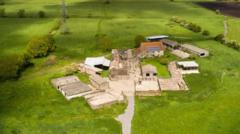
The conversion of an abandoned dairy farm into a peatland research facility is not merely a local planning update or a feel-good environmental story. It is a strategic pivot in a multi-billion dollar carbon market that remains largely unregulated and wildly speculative. While the surface narrative focuses on ecological restoration, the underlying mechanics involve the commodification of mud. Across the UK and Europe, the race to secure "nature-based solutions" has turned soggy, neglected pastures into some of the most sought-after real estate in the agricultural sector.
Peatlands are the Earth’s most efficient terrestrial carbon stores. When healthy, they hold more carbon than all the world's forests combined. When drained for grazing—as most dairy farms were in the mid-20th century—they become carbon chimneys, leaking greenhouse gases into the atmosphere as the organic matter decomposes. The logic of the research centre is simple: if we can prove exactly how much carbon a restored bog captures, we can put a price tag on it. This is about establishing the gold standard for carbon credits.
The Economics of Rewilding
For decades, the value of a farm was measured in liters of milk and the weight of livestock. That era is ending. Landowners now face a landscape where the subsidies of the past are being replaced by "public money for public goods." This creates a massive financial incentive to stop farming and start "farming carbon."
However, the transition from agriculture to environmental research is fraught with technical hurdles. You cannot simply turn off a pump and expect a bog to reappear. Peatland restoration requires sophisticated hydrological engineering. It involves blocking drainage ditches, managing water tables to within centimeters of the surface, and reintroduced specialized vegetation like Sphagnum moss.
The research centre being proposed on the site of the former dairy farm aims to solve the measurement problem. Currently, carbon markets suffer from a lack of "additionality" and "permanence." If a private company buys a credit to offset its emissions, it needs proof that the carbon being stored is actually staying in the ground. Without rigorous data from sites like this, those credits are little more than expensive pieces of paper.
Why the Dairy Industry is Running Dry
Dairy farming is increasingly a losing game for small to medium-sized operations. Input costs for feed, fuel, and fertilizer have soared, while supermarket price wars keep margins razor-thin. When you add the mounting pressure of environmental regulations regarding slurry management and nitrogen runoff, many farmers are looking for an exit strategy.
Selling a farm to a research consortium or a carbon-offsetting developer is often more lucrative than passing it to the next generation of farmers. This creates a hidden tension in rural communities. On one hand, the restoration of peatlands provides a vital service in the fight against climate change. On the other, it represents the "de-farming" of the countryside. Every dairy farm that becomes a research centre is a blow to local food production and a shift in the cultural identity of the region.
The irony is palpable. The very drainage systems that farmers were once subsidized to install are now being dismantled with equal amounts of public funding. It is a total reversal of 20th-century land management policy.
The Technical Reality of Carbon Capture
Peat is essentially a geological time capsule. It forms at a rate of roughly one millimeter per year. This slow growth makes it a non-renewable resource on a human timescale. When a dairy farm sits on deep peat, the soil is often "wasting." The oxygen introduced by drainage allows bacteria to eat the carbon, causing the ground level to actually sink.
The research at the new facility will likely focus on GHG Flux Monitoring. This involves using "eddy covariance" towers to measure the exchange of gases between the ground and the atmosphere in real-time.
Key Metrics for Peatland Success
- Water Table Depth: To stop carbon loss, the water must stay within 10cm of the surface year-round.
- Vegetation Cover: Sphagnum moss acts as a protective skin, preventing the peat from drying out.
- Methane Offsets: While wet peat stores CO2, it can release methane, a more potent but shorter-lived greenhouse gas. Balancing this equation is the "holy grail" of peat research.
If the researchers can prove that a specific management technique maximizes CO2 sequestration while minimizing methane release, they provide the blueprint for every other degraded peatland in the country. This isn't just about one farm; it's about a scalable business model for the entire north of the UK.
The Risks of a Green Gold Rush
There is a danger that the rush to restore peatlands will outpace the science. We are seeing "Green Grabbing," where investment firms buy up land to use as a hedge against their own emissions or to sell credits to the highest bidder. This drives up land prices, making it impossible for young farmers to enter the industry.
Furthermore, if the research centre fails to produce accurate, long-term data, the entire carbon credit market could collapse under the weight of "junk" offsets. We have seen this happen in forestry projects where trees were planted but never managed, leading to massive fires that released all the stored carbon back into the air. Peat is more stable than trees, but it is not invulnerable. A single drought year can undo a decade of sequestration if the water management systems are not robust.
The project on the former dairy farm is a high-stakes experiment. It is a test case for whether we can successfully pivot from an extraction-based rural economy to a restoration-based one.
The Invisible Stakeholders
While the planners and scientists debate the technicalities, the local community often feels left behind. The conversion of agricultural land into a research site doesn't just change the view; it changes the local economy. Research centres don't require the same support networks as dairy farms. They don't need local feed merchants, large-scale veterinary services, or heavy machinery repairs in the same way.
The "definitively hard-hitting" truth is that while this research is necessary for the planet, it is a symptom of a dying industry. We are witnessing the managed retreat of traditional farming in the face of a climate emergency. The former dairy farm is a pioneer in this new frontier, but it will not be the last.
To make this transition work, the research must go beyond the soil. It needs to address the social cost of land-use change. If the benefits of carbon farming only accrue to distant investors and research institutions, it will fail the very people who have lived on and worked that land for centuries.
The success of the peat centre will be measured by its ability to create a "just transition." This means finding ways to integrate food production with carbon storage—a concept known as Paludiculture, or farming on wet lands. Growing crops like reeds for building materials or sphagnum for horticulture could provide a new economic lifeline for rural areas.
Instead of simply walking away from the dairy era, we should be looking at how these research sites can create new, sustainable livelihoods that don't depend on draining the earth dry. The moss is coming, but the people need to stay.
Monitor the planning applications for neighboring plots to see how quickly the surrounding land values fluctuate following the first year of data publication.