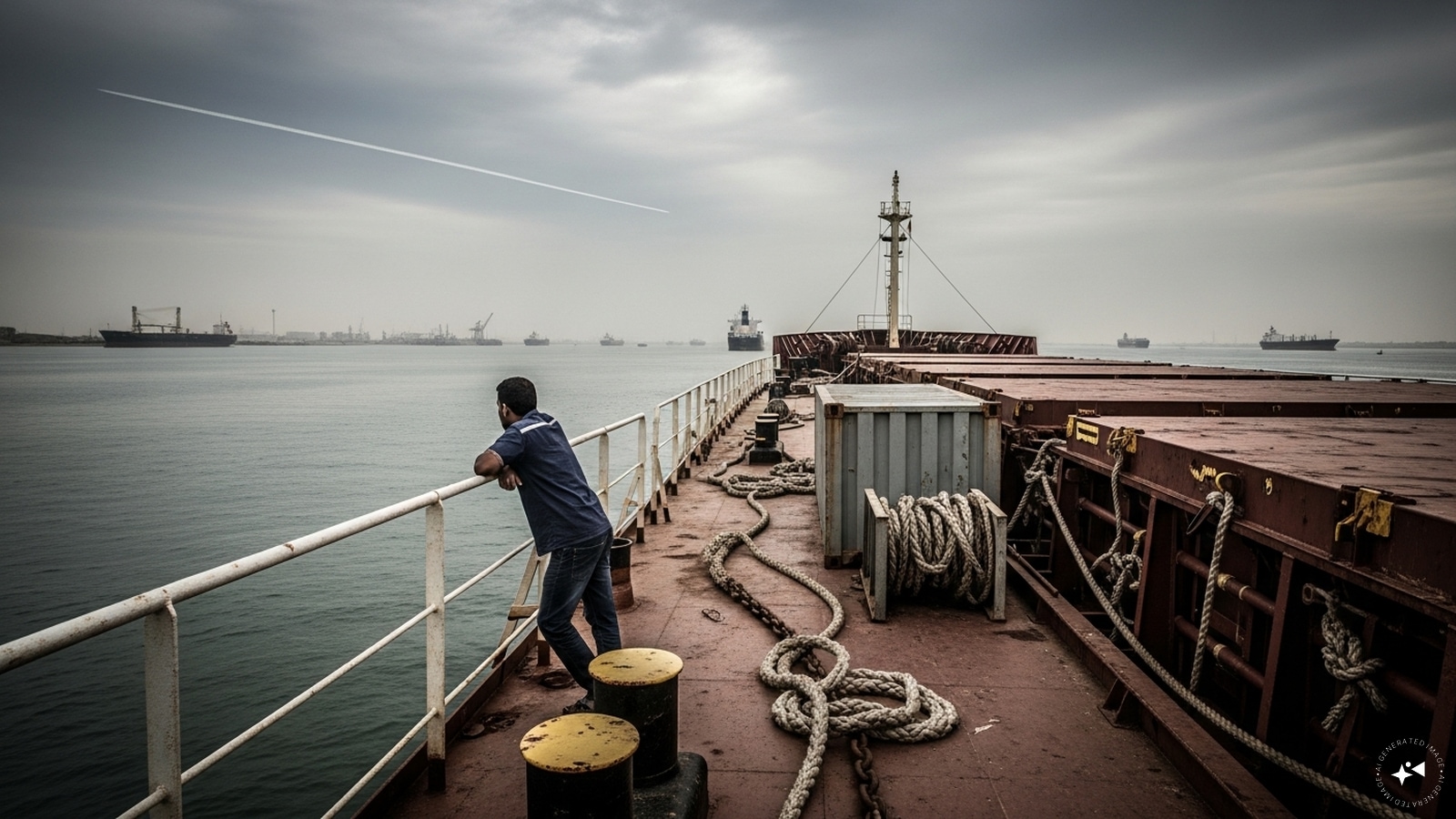
Twenty thousand seafarers sitting on 1,500 ships is not a tragedy. It is a stress test that the maritime industry was destined to fail.
Mainstream media is currently obsessed with the "humanitarian crisis" and the "supply chain meltdown." They want you to mourn the loss of predictable transit times and feel pity for the crews stuck in the heat. This narrative is a distraction. If you have spent more than twenty minutes analyzing the structural rot of global logistics, you know that the Hormuz closure is not the problem. It is the symptom of a fragile, bloated, and over-leveraged system that has survived on luck for three decades.
We are not looking at a disaster. We are looking at a correction.
The Myth of the "Essential" Route
The lazy consensus claims that the Strait of Hormuz is the "jugular vein" of the global economy. This is a dramatic metaphor used by analysts who have never looked at a fuel-switching capacity chart.
Yes, 21 million barrels of oil pass through that choke point daily. But the panic assumes that the world stops spinning if that oil is delayed by ten weeks. It doesn't. Global inventories exist for this exact reason. The "crisis" is actually a pricing war between those who hedged their risks and those who played chicken with geopolitical reality.
I have seen shipping giants burn through billions in capital because they refused to diversify their routes, betting everything on the cheapest, most vulnerable path. When you optimize for nothing but cost, you are not a genius; you are a gambler. The current "stranding" is simply the house calling in the debt.
Why 20,000 Stranded Seafarers are a Failure of Management, Not Geography
The headlines scream about 20,000 souls trapped at sea. Let's be brutal: those men and women are not trapped by a naval blockade. They are trapped by the legal cowardice of ship owners and the archaic rigidity of maritime contracts.
In a functional industry, 1,500 ships sitting idle would trigger immediate force majeure protocols that prioritize crew rotation via alternative ports. Instead, owners are keeping crews on board because it is cheaper than the administrative nightmare of offloading them in non-contracted jurisdictions.
- The Insurance Trap: P&I (Protection and Indemnity) clubs are more worried about the liability of a hull sitting empty than the psychological state of the crew.
- The Flag of Convenience Lie: Ships registered in Panama or Liberia are finding out that their "home" nations have zero diplomatic weight to negotiate safe passage or crew extraction.
If you are a CEO crying about your "stranded assets," you aren't a victim. You are the architect of this stagnation. You chose the flag, you chose the route, and you chose to underinvest in crew welfare logistics.
The Efficiency Trap: Why "Just-in-Time" is Just-Too-Late
For years, the industry has worshipped at the altar of efficiency. We built bigger ships (Ultra Large Crude Carriers) that can only fit through specific channels and dock at specific ports. We created a system with zero margin for error.
The Hormuz closure proves that $18$ knots is not a speed; it’s a vulnerability. When you have 1,500 ships stuck, you realize that the global economy is governed by the Theory of Constraints.
$$Flow = \frac{Inventory}{Throughput}$$
When throughput drops to zero at the Strait, the inventory doesn't just sit there; it rots, it depreciates, and it costs money in demurrage. The contrarian take? We need smaller, faster, more expensive ships. We need to stop chasing the "economy of scale" that turns a single point of failure into a global heart attack.
Stop Asking When it Will Open (Ask Why You Care)
The "People Also Ask" sections of the internet are flooded with queries like "When will the Strait of Hormuz reopen?" and "Will gas prices go up?"
These are the wrong questions. The right question is: "Why is your business model dependent on a 21-mile wide strip of water controlled by a volatile regime?"
If your supply chain relies on the goodwill of regional powers in the Middle East, you don't have a supply chain. You have a prayer.
Actionable advice for the 1% who actually want to survive this:
- Onshore everything that matters: If it’s critical, it shouldn't be on a slow boat from anywhere.
- Redundancy over ROI: Accept that a 15% higher transport cost is an insurance premium against total insolvency.
- Kill the Mega-Ship: The era of the 20,000 TEU behemoth is over. They are too big to pivot and too expensive to lose.
The Darwinian Upside
This closure is going to bankrupt the weakest players in the shipping industry. Good.
The companies that didn't have the cash reserves to weather a ten-week delay shouldn't be managing global trade. The "zombie" shippers who have been propped up by low interest rates and cheap fuel are finally meeting their Great Filter.
When the Strait eventually reopens—and it will—the industry will be leaner. The survivors will be the ones who realized that "globalization" was never a guarantee; it was a temporary gift of relative peace.
If you're waiting for things to "get back to normal," you've already lost. The 20,000 seafarers are a warning shot. The 1,500 ships are a graveyard of bad strategy.
Stop looking for a solution to the closure. Start looking for a way to make sure the next closure doesn't even make your internal Slack channel.
The world doesn't need the Strait of Hormuz. It needs an industry that isn't terrified of a little friction.