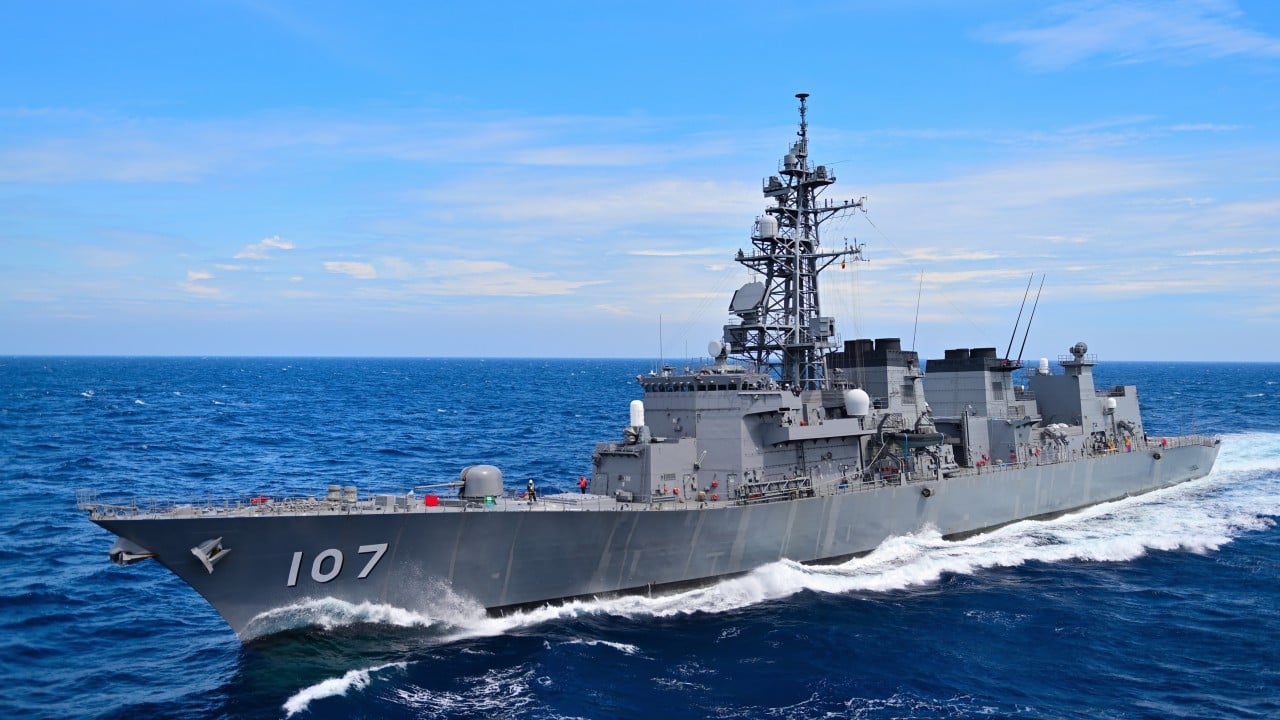
The Sazanami’s transit through the Taiwan Strait was not a routine exercise in freedom of navigation. It was a calculated shattering of a decades-old taboo. By sending a naval destroyer through the 110-mile-wide waterway separating mainland China from Taiwan, Tokyo has signaled that its period of strategic ambiguity is over. This move, timed to coincide with the anniversary of the 1972 Japan-China Joint Communiqué, transforms the Strait from a bilateral flashpoint into a multilateral front line. Japan is no longer watching from the sidelines; it is actively preparing for a regional war.
Beijing views the Taiwan Strait as its "internal waters," a claim that finds little support in international maritime law but plenty of backing in the form of the People’s Liberation Army Navy (PLAN) patrols. For years, Japan avoided sending its Maritime Self-Defense Force (MSDF) vessels through these waters to avoid provoking its largest trading partner. That restraint has evaporated. The shift reflects a grim realization in Tokyo that "a Taiwan emergency is a Japanese emergency," a phrase popularized by the late Shinzo Abe that has now become official policy in all but name.
The end of the Yoshida Doctrine
For the better part of the last century, Japan operated under the Yoshida Doctrine. This policy focused on economic growth while outsourcing national security to the United States. It worked brilliantly during the Cold War. But the rise of a modernized, aggressive PLAN has rendered the old ways obsolete.
The Sazanami’s voyage alongside Australian and New Zealand warships serves as a physical manifestation of a new security architecture. Japan is building a network of "minilaterals"—small, agile groupings of nations like the Quad and the AUKUS-adjacent partnerships—designed to fill the gaps in the traditional hub-and-spoke alliance system. This isn't just about ships in the water. It’s about a fundamental rewiring of how Tokyo perceives its role in the Pacific.
China’s response was predictably swift, involving incursions into Japanese airspace and increased naval activity near the Senkaku Islands. However, the "why" behind Japan's sudden boldness runs deeper than mere reactionary politics. Tokyo is currently undergoing its most significant military buildup since 1945, doubling its defense budget and acquiring long-range counterstrike capabilities. You don't buy Tomahawk missiles if you plan on staying behind your own borders.
Tracking the hardware of escalation
To understand the gravity of this transit, one must look at the specific capabilities of the vessels involved. The Sazanami is a Takanami-class destroyer, equipped with sophisticated anti-submarine warfare suites and Vertical Launch Systems (VLS). Its presence in the Strait is a message regarding sensor parity.
The silent battle for the seabed
The Taiwan Strait is shallow, making it a nightmare for large nuclear-powered submarines but a playground for advanced diesel-electric boats and Uncrewed Underwater Vehicles (UUVs). By sailing through the Strait, Japan is gathering critical acoustic and hydrographic data. This information is the lifeblood of modern naval warfare. Knowing the salinity, temperature, and depth of the Strait allows a navy to predict how sonar will behave.
- Acoustic Signatures: Every transit allows for the collection of electronic intelligence (ELINT) on Chinese coastal radar and sonar arrays.
- Tactical Mapping: Understanding the flow of commercial traffic versus military positioning helps in planning blockade-running scenarios.
- Interoperability: Operating with New Zealand and Australian assets proves that these navies can share data in a high-threat environment.
Beijing’s strategy has long relied on "anti-access/area denial" (A2/AD). They want to make the cost of entry into the First Island Chain so high that the U.S. and its allies won't bother. Japan’s transit effectively says the entry fee has already been paid.
The treaty day symbolism
The timing of the transit was a masterclass in diplomatic trolling. Choosing the anniversary of the 1972 treaty—the very document that established the "One China" framework for Japan—was a deliberate jab at the status quo. It suggests that if China is going to change the security environment through force, Japan is no longer bound by the gentleman’s agreements of the past.
The internal politics of the Liberal Democratic Party (LDP) also play a massive role here. With leadership transitions and a shifting public mood that is increasingly wary of Chinese influence, being "soft" on Beijing is a political death sentence. The Japanese public, once staunchly pacifist, is beginning to support a more muscular foreign policy as they watch Chinese drones circle their southern islands.
Economic entanglement versus military necessity
There is a glaring contradiction at the heart of this escalation. Japan and China remain inextricably linked through trade. Thousands of Japanese companies operate on the mainland, and the supply chains for everything from semiconductors to electric vehicle batteries run through Chinese ports.
This is the "Silicon Shield" in reverse. While Taiwan’s dominance in high-end chips is often cited as a deterrent against war, Japan’s economic exposure to China acts as a brake on its military ambitions. Or it used to. The Sazanami transit indicates that security concerns have finally overtaken economic interests in Tokyo’s hierarchy of needs.
We are seeing a process of "de-risking" that is moving from the boardroom to the boiler room. Japan is aggressively diversifying its supply chains to Southeast Asia and India, preparing for a future where the Chinese market might be closed off by sanctions or conflict.
The logistics of a blockade
If China were to move on Taiwan, a full-scale invasion is only one possibility. A blockade is more likely and arguably more effective. By controlling the Taiwan Strait, the PLAN could starve the island of energy and food.
Japan’s southern islands, such as Ishigaki and Miyako, are just a stone's throw from Taiwan's coast. If the Strait is closed, Japan’s own energy lifelines from the Middle East are threatened. The MSDF transit is a rehearsal for keeping those lanes open. It’s a declaration that Japan considers the Strait international waters and will treat any attempt to close it as an act of aggression against Japanese sovereign interests.
The missile gap
The real fear in Tokyo isn't just a naval skirmish. It’s the massive disparity in intermediate-range missiles. China has thousands; Japan and the U.S. (until recently, due to the INF Treaty) have had almost none in the region.
Japan’s current "Stand-off Defense" program is a direct attempt to fix this. They are extending the range of their Type 12 anti-ship missiles to over 1,000 kilometers. These batteries, when placed on the Ryukyu Islands, can cover the entirety of the Taiwan Strait. The Sazanami wasn't just a ship passing through; it was a spotter for a much larger, land-based fist.
The myth of the accidental war
Pundits often fret about an "accidental" collision leading to war. This is a misunderstanding of how these encounters work. Both sides are highly professional and follow strict protocols, such as the Code for Unplanned Encounters at Sea (CUES). When a "bump" or a near-miss happens, it is almost always intentional—a game of high-stakes chicken designed to test the other side's resolve.
The Sazanami didn't accidentally wander into the Strait. The Chinese fighters didn't accidentally enter Japanese airspace. These are choreographed movements in a theater of intimidation. The danger isn't a mistake; the danger is a miscalculation of how much the other side is willing to endure before it stops playing the game and starts the fight.
Washington’s quiet hand
While the Sazanami flew the Rising Sun flag, the shadow of the Stars and Stripes was everywhere. The U.S. has been pushing its allies to take more responsibility for regional security. This "integrated deterrence" relies on Japan being the cornerstone of the Pacific defense.
By taking the lead in this transit, Japan is proving it can be the regional leader Washington needs. This allows the U.S. to spread its assets more thinly across the globe, from the Red Sea to the North Atlantic, knowing that the MSDF can hold the line in the East China Sea. This shift from "junior partner" to "regional deputy" is the most significant change in Pacific power dynamics in fifty years.
The gray zone becomes red
For years, China has utilized "gray zone" tactics—actions that fall below the threshold of open conflict but still achieve strategic goals. Maritime militia vessels, sand dredgers near Taiwanese islands, and constant air sorties have exhausted the defenders.
Japan is now engaging in its own version of gray zone pushback. By normalizing naval transits through the Strait, they are eroding China’s attempt to claim the area as a private lake. They are forcing the PLAN to react, to burn fuel, to expose their radar signatures, and to reveal their tactical procedures.
The Sazanami is not the end of this story. It is the beginning of a new, more dangerous phase where the buffer zones are gone. The geography of the region hasn't changed, but the psychology of its players has shifted toward the inevitable.
Preparing for the fallout
Japanese corporations are already conducting "Taiwan contingency" drills. They are mapping out how to evacuate thousands of citizens and employees if the missiles start flying. The government is building bunkers on its southern islands. This isn't the behavior of a country that thinks a war is unlikely. It is the behavior of a country that thinks war is a matter of "when," not "if."
The Sazanami’s transit was the final piece of the diplomatic and military puzzle. It proved that the legal and political barriers that once kept the MSDF north of the Strait have been dismantled. Tokyo has decided that the risk of silence is now greater than the risk of provocation.
Watch the procurement orders. Watch the placement of missile batteries on the Nansei Islands. Watch for the next transit, because it won't be another twenty years before it happens. The next one will likely involve more ships, more nations, and a clearer message to Beijing that the Strait belongs to the world, not the party.
The era of the "quiet Japan" is over, buried under the wake of a destroyer that refused to take the long way around.