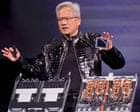
Jensen Huang does not usually look like a man seeking permission. When he stands on a stage in a stadium packed with developers, his signature black leather jacket catching the glare of the spotlights, he looks like the architect of the future. He speaks in the certainties of floating-point operations and trillions of parameters. But as he stepped onto the tarmac in Beijing, flanked by a cohort of American CEOs and the shadow of a new administration, the swagger of Silicon Valley met the cold, hard geometry of global power.
This wasn't a product launch. This was a high-wire act. Don't forget to check out our earlier post on this related article.
The facts of the trip are deceptively simple. A delegation of American business leaders, including the titan of AI hardware himself, joined a diplomatic mission to China led by Donald Trump. To the financial wires, it’s a story about trade deficits and supply chains. To the rest of us, it is a story about the soul of the machine and who gets to keep the keys.
Consider a hypothetical engineer in a small startup in Shenzhen. Let’s call her Chen. She spends her nights coaxing life out of neural networks, trying to build a system that can detect early-stage lung cancer with better accuracy than a human radiologist. For Chen, the H100 chips designed by Huang’s team aren't "geopolitical leverage." They are oxygen. Without them, her models don't learn. They don't think. They just stall. When she reads about Jensen Huang landing in her city, she isn't looking for a trade deal. She is looking for a sign that her work won't be extinguished by a pen stroke in Washington. If you want more about the background of this, Business Insider provides an informative breakdown.
The tension in that Beijing meeting room was thick enough to choke a server fan. On one side, you have an American president who views trade as a zero-sum game, a series of wins and losses tallied in a ledger. On the other, you have the Chinese leadership, increasingly convinced that their path to superpower status is paved with the very silicon that Huang sells. And in the middle? The man who turned a graphics card company into the most valuable piece of the global infrastructure.
Huang’s presence is a quiet admission of a messy truth: you cannot decouple the world’s two largest economies without ripping the heart out of the technological age.
The silicon wafer is the new oil. In the twentieth century, nations went to war over the black sludge beneath the sand because it moved armies and heated homes. Today, the struggle is over the purity of light and the precision of ultraviolet lithography. If you control the chips, you control the ability to process reality. You control the weather forecasts, the missile guidance systems, and the algorithms that decide what you buy and who you vote for.
When Huang walks through those ornate halls in China, he is carrying more than just a business plan. He is carrying the weight of a supply chain that is impossibly tangled. Nvidia might design the chips in Santa Clara, but they are born in the cleanrooms of Taiwan and packaged in facilities that span the Pacific. To tell Jensen Huang he can no longer engage with China is like telling a master chef he can no longer use salt. The dish might still look the same, but the flavor of progress disappears.
The math is brutal. China represents roughly a third of the global semiconductor market. For a company like Nvidia, losing that access isn't just a "headwind." It’s a structural collapse. But the American government sees it differently. They see every chip sold to a Chinese firm as a potential grain of sand in the gears of Western security.
It’s a clash of two different types of time.
Politics moves in four-year cycles, driven by the immediate heat of the ballot box. Technology moves in decades, driven by the slow, agonizing crawl of R&D and the exponential growth of Moore’s Law. Huang is playing the long game. He knows that if he is forced to pull out of China, the vacancy won't stay empty for long. Nature abhors a vacuum, and so does a marketplace. Domestic Chinese firms like Huawei are already working frantically to bridge the gap, turning "Made in China" from a slogan into a desperate necessity.
Imagine the dinner. The clink of fine china. The practiced smiles of diplomats. Across the table, the American CEOs—the men who run the banks, the airlines, and the tech giants—are all thinking the same thing: Don't break the world.
They are there to remind the politicians that while borders are real, the economy is a ghost that drifts through walls. A tariff on a chip is a tax on a student in Ohio who wants to learn coding. It’s a delay for a pharmaceutical company in Basel trying to simulate a new protein. It’s a drag on the very innovation that the West claims it wants to protect.
The tragedy of the modern era is that we have become so good at building bridges of data that we forgot how to talk to each other as humans. We see "the market" or "the adversary" instead of the people on the other end of the wire. Huang, an immigrant who built a trillion-dollar empire on the idea that computers should be able to see and imagine, understands the human element better than most. He knows that his chips are being used to create art, to solve hunger, and yes, to monitor populations. He lives in that gray space every single day.
There is a certain irony in seeing the kings of capital following a populist president into the heart of a communist state. It exposes the fiction that these worlds are separate. They are locked in a frantic, sweaty embrace. The "Trump trip" isn't a victory lap for either side. It’s a negotiation over the terms of a divorce that neither party can actually afford.
As the meetings concluded and the motorcades began to move back toward the airport, the headlines focused on the numbers. Billions in potential deals. Commitments to buy more American soybeans. Vague promises of "fairness."
But the real story was written in the lines on Jensen Huang’s face.
It is the look of a man who realizes that for all his brilliance, for all his specialized AI cores and high-bandwidth memory, he is still subject to the whims of men who have never looked through a microscope. He is a titan who has realized that the future isn't just written in code; it's written in the fragile, temperamental language of diplomacy.
The leather jacket is a suit of armor, but even the best armor has gaps. As the plane climbed into the hazy Beijing sky, the Great Wall looked like a tiny, jagged thread on the earth below. From that height, the walls we build between nations look remarkably thin, easily bypassed by the signals moving at the speed of light, yet they remain heavy enough to pull a giant back down to earth.
The chips will continue to pulse. The neural networks will continue to grow. But the silence in the cabin was the sound of a world realizing that the most complex calculation isn't happening in a processor. It’s happening in the space between two people who don't trust each other, holding a piece of silicon between them like a live grenade.