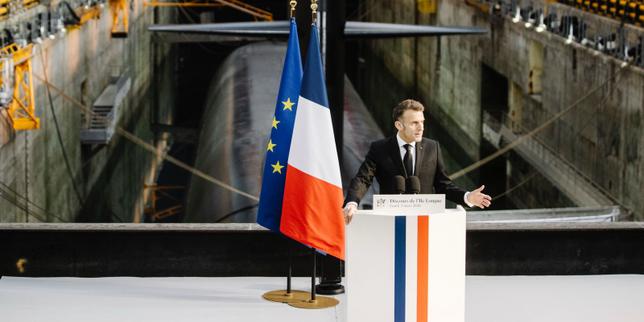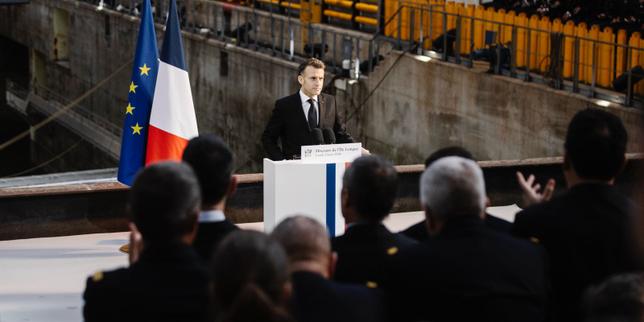
Emmanuel Macron isn't just talking about missiles and submarines anymore. He's talking about survival in a world that's forgotten how to be peaceful. When the French President stood up recently to outline the country's nuclear strategy, he wasn't just checking a box on a military to-do list. He was drawing a line in the sand. The message was simple. France will not be intimidated, and its nuclear "Force de Frappe" remains the ultimate insurance policy against a cocktail of modern threats that look nothing like the Cold War.
You've probably noticed the vibe shift in global politics lately. It’s heavier. Macron sees a world where traditional warfare blends with cyberattacks, space-based threats, and unpredictable leaders who don't follow the old rules of engagement. This isn't your grandfather’s deterrence.
The logic of the French exception
France is the only country in the European Union with its own nuclear toys. That matters. Since the days of Charles de Gaulle, Paris has maintained a "strict sufficiency" policy. They don't want the most nukes; they just want enough to make any aggressor realize that attacking France would be a very bad career move.
Macron's recent speech doubled down on this independence. He’s pushing the idea that French nuclear interests have a "European dimension." He isn't offering to hand over the keys to the launch codes to Brussels—let's be real, that'll never happen—but he is suggesting that France's shield protects more than just French soil. It's a subtle nudge to neighbors like Germany: "We’ve got the umbrella, so maybe we should coordinate how we stand under it."
The President pointed out that the "combination of threats" is the real problem. It’s not just about one big bad actor. It’s about how a regional conflict can suddenly turn into a nuclear standoff because of a misunderstanding or a desperate gamble by a failing state. He’s right to be worried. The safety net of international treaties is basically shredded at this point.
Why the old rules don't work in 2026
We used to live in a bipolar world. You had Washington and Moscow. Now? It’s a mess. Between Iran’s nuclear ambitions, North Korea’s frequent testing, and China’s massive arsenal expansion, the math has changed. Macron’s stance is that France must remain a "balancing power."
What does that actually mean? It means France wants to be the adult in the room who also happens to carry a big stick. The speech emphasized that deterrence isn't just about blowing things up. It’s about psychology. You have to convince the other guy that you're willing to use what you have if pushed too far. Macron is trying to restore that credibility. He’s signaling that the French doctrine isn't static. It evolves as the technology of our enemies evolves.
The modernization headache
Talking about nukes is expensive. Maintaining them is even worse. France is currently pouring billions into renewing its two-component system:
- The Ocean Leg: Those four Triomphant-class submarines that disappear into the Atlantic for months. They're the "second strike" capability. Even if France were wiped off the map, those subs would still be there to hit back.
- The Air Leg: Rafale fighter jets carrying ASMPA supersonic missiles. This is the more "visible" part of the deterrent.
Critics argue this money should go to hospitals or schools. Macron’s counter-argument is basically: "You won't need schools if there's no country left to run them." It’s a grim calculation, but in the current geopolitical climate, it’s one he’s clearly willing to make. He’s betting that a strong military is the only way to keep France relevant on the world stage.
The European dilemma and the NATO shadow
This is where it gets spicy. Macron has always been a fan of "European Strategic Autonomy." He wants Europe to be able to defend itself without constantly checking if the US is in a good mood. His nuclear rhetoric is a massive part of that.
However, many Eastern European countries aren't buying it. They trust the US nuclear umbrella more than they trust a French one. There’s a historical trust gap there that Macron hasn't quite bridged yet. By saying France’s "vital interests" have a European component, he’s trying to bridge that gap without actually giving up French sovereignty. It's a high-wire act.
The reality is that NATO remains the primary framework for most of Europe. Macron knows this. He’s not trying to blow up NATO, but he is preparing for a world where the US might decide it’s tired of being Europe’s security guard. He’s telling his neighbors that if the Americans leave, France is the only one left with a serious deterrent.
Managing the risk of escalation
One of the most interesting parts of Macron's recent communication is the focus on "de-escalation through strength." It sounds like a contradiction. How does having more dangerous weapons make things safer?
The idea is to prevent "fait accompli" scenarios. That's when an aggressor takes a small piece of territory and bets that you won't start a nuclear war over a few acres of land. Macron wants to make sure no one makes that bet against France or its allies. He's emphasizing that the threshold for what constitutes a "vital interest" is intentionally vague. That ambiguity is a feature, not a bug. If the enemy doesn't know exactly where the red line is, they're less likely to dance near it.
What this means for the average citizen
You might think this is all high-level posturing that doesn't affect your daily life. It does. Defense spending influences taxes. National security affects the economy. But more importantly, the stance France takes on nuclear weapons determines its influence in diplomatic rooms from the UN to the G7.
When Macron speaks about the "combination of threats," he’s also talking about energy security and technological independence. You can't have a nuclear deterrent if you can't build your own chips or refine your own fuel. It’s all connected. The "nuclear" part is just the tip of the spear for a much larger project of French national power.
Moving beyond the speech
The talk is over. Now comes the execution. France is currently in the middle of a massive Military Programming Law (LPM) that spans until 2030. This isn't just a plan on paper; it's a massive industrial mobilization.
If you're following this, keep an eye on two things. First, watch how Germany responds to these "European dimension" hints. If Berlin starts putting money into joint projects, Macron wins. Second, watch the development of the SN3G—the third-generation nuclear submarines. That's the real test of whether France can keep its technological edge.
The world is getting weirder. Macron's answer is to lean into the one thing that has kept a major power conflict off French soil since 1945. It’s not pretty, it’s not cheap, and it’s certainly not peaceful in its implications. But from the Elysée Palace's perspective, it's the only rational choice left on the table.
To really understand where this is going, look at the budget allocations for the next three years. The shift from "peace-time" procurement to "war-economy" production is already happening. Check the stock prices of major French defense players like Dassault and Thales. They aren't just companies anymore; they're the physical manifestations of this doctrine. If you want to see if a country is serious about its defense, stop listening to the speeches and start following the money. The money in France is flowing toward the atom.