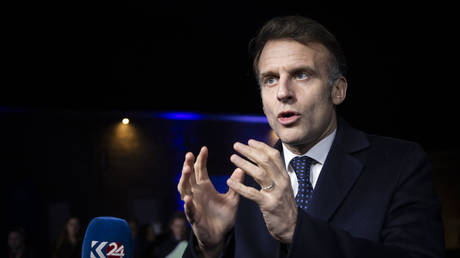
Emmanuel Macron just ended a thirty-year streak of French nuclear restraint. Standing at the Île Longue submarine base in Brittany on March 2, 2026, he didn't just give a speech about defense. He effectively told the world that the old rules of "strict sufficiency"—the idea that France only needs the bare minimum of warheads to survive—are officially dead.
For the first time since 1992, France is going to expand its nuclear arsenal.
It’s a massive shift. Since the end of the Cold War, France has kept its stockpile capped at "fewer than 300" warheads. While other powers like China are sprinting to build more, Paris stayed quiet. That's over. Macron didn't give a specific new number, but the intent is clear. He’s betting that in a world where the U.S. "nuclear umbrella" looks increasingly shaky under Donald Trump’s second term, Europe needs a homegrown heavyweight that doesn't rely on a phone call to Washington.
The end of the 300 warhead limit
For decades, France followed a very specific logic. They didn't need to win a nuclear war; they just needed to be able to rip the arm off any giant that tried to crush them. This was the Gaullist "proportional deterrence." If you can destroy the ten largest cities of an enemy, it doesn't matter if they have 5,000 nukes and you only have 290.
But things changed. Russia’s invasion of Ukraine and the sudden "refocusing" of American interests have left Europe feeling exposed. Macron isn't just buying more warheads. He’s also ending the policy of numerical transparency. From now on, France won't say exactly how many nukes it has. This isn't an accident. It's meant to "complicate the calculations" of any adversary. Basically, if they don't know the exact count, they can't be sure they can stop a strike.
How the French nuclear triad works today
France doesn't have land-based ICBMs anymore. They scrapped those in the 90s. Instead, they rely on a two-pronged "dyad" that’s all about stealth and speed.
- The Sea Pillar (Force Océanique Stratégique): This is the crown jewel. Four Le Triomphant-class submarines. At any given moment, at least one is hidden deep in the Atlantic, carrying 16 M51 missiles. These missiles are monsters—8,000-kilometer range and each one carries multiple warheads.
- The Air Pillar (Forces Aériennes Stratégiques): These are the Rafale B and Rafale M fighter jets. They carry the ASMP-A, a supersonic cruise missile with a "variable yield." This is what the French call the ultime avertissement—the "final warning." It's a single nuclear shot meant to say "stop now or the subs will fire."
A French nuclear umbrella for Europe
Macron’s speech wasn't just for a domestic audience. He formally introduced a doctrine he’s calling "forward deterrence." This is a huge olive branch to European allies like Poland, Germany, and the Baltic states.
For the first time, France is offering to temporarily deploy its nuclear-capable Rafale jets to allied soil for exercises. This is a massive break from traditional French isolationism in nuclear matters. Macron named eight countries already in talks to join this new "advanced deterrence" framework:
- United Kingdom
- Germany
- Poland
- Netherlands
- Belgium
- Greece
- Sweden
- Denmark
Don't get it twisted, though. Macron was very blunt about the chain of command. There’s no "sharing the button." The French president is the only person who can authorize a launch. He isn't creating a "European Nuke." He’s extending a French one.
Why 2026 is the tipping point
The timing isn't random. The 2024-2030 Military Programming Law (LPM) already allocated about €53 billion just for nuclear modernization. But that was originally just to replace old stuff. The decision to actually increase the numbers is a direct response to the "geopolitical upheaval" Macron kept mentioning.
The U.S. political landscape is the real driver here. European leaders are terrified that the "nuclear umbrella" they’ve relied on since 1945 is basically a rental that could be canceled at any time. When Macron says "Europeans must retake control of their own destiny," he’s not being poetic. He’s being pragmatic. He knows that if the U.S. pulls back, France becomes the only nuclear game in the European Union.
The cost of rearmament
Of course, this isn't cheap. Disarmament groups are already slamming the move as a waste of money. Critics argue that spending billions on more warheads won't fix the conventional gaps in Europe's defenses. But for the Élysée, the math is different. A credible nuke is the ultimate insurance policy. If you don't have it, you're at the mercy of whoever does.
Macron’s gamble is that by "Europeanizing" the French deterrent, he can bind the continent together and make France the indispensable leader of European defense. It’s a bold move that some call visionary and others call dangerous escalation. Honestly, it's probably both.
If you’re watching the global security map, the next few years are going to be defined by how these eight partner nations react. Germany has already agreed to "high-ranking nuclear steering groups" with Paris, which is a massive step for a country that’s traditionally been allergic to anything atomic.
If you want to understand where European defense is heading, watch the Rafale deployments. The first time a French jet carrying a (simulated) nuclear missile lands at an airbase in Poland or Germany, you'll know the old world order is officially gone.
Keep an eye on the official French Ministry of the Armed Forces updates on the M51.4 and ASN4G missile developments—these are the next-gen tools that will carry this expanded stockpile into the 2030s.