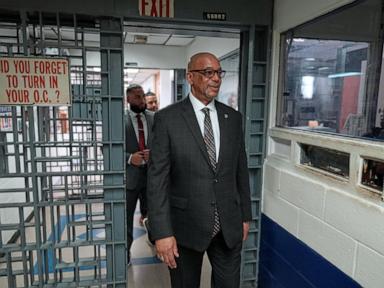
The air inside a jail has a specific, heavy weight. It is a thick cocktail of floor stripper, industrial-grade detergent, and the sharp, metallic tang of adrenaline that never quite dissipates. For most people, this scent is a warning. For Lynelle Maginley-Liddie, it was once the backdrop of a life behind bars. Now, it is the smell of her office.
New York City’s Department of Correction is a behemoth often described in terms of its failures—violence, crumbling infrastructure, and a federal oversight battle that has dragged on for years. But the appointment of Maginley-Liddie as the new commissioner changed the geometry of the conversation. She isn’t just another bureaucrat with a resume polished in Ivy League halls. She is a woman who, decades ago, wore the same uniform as the people she now oversees. Not the officer’s uniform. The inmate’s.
The View from the Other Side of the Bars
Thirty years ago, a young woman sat in a cell block on Rikers Island. She wasn't a career criminal or a mastermind. She was caught in the gears of a system that often grinds up the vulnerable before they have a chance to find their footing. To the guards, she was a number. To the city, she was a statistic.
The experience of incarceration is a sensory assault that stays in the marrow. It’s the sound of a heavy steel door slamming shut—a noise so final it vibrates in your teeth. It’s the indignity of having your movements dictated by a whistle or a barked command. When Maginley-Liddie talks about reform, she isn't citing a white paper written by a consultant in a midtown high-rise. She is remembering the way the light looks through a reinforced window when you don't know if you'll see the sun without a fence in the way for years.
This lived experience creates a rare bridge in a city defined by its divides. To the officers, she is a boss who understands the volatility of the floor. To the incarcerated, she is a symbol of a possibility they are often told doesn't exist for them: a way out that leads to a way up.
Turning the Ship in a Storm
Running New York’s jails is widely considered the most thankless job in municipal government. The system is a pressure cooker. On one side, you have a workforce of thousands of officers who feel abandoned by the city, working double shifts in environments where "safety" is a relative term. On the other, you have a population of detainees—most of whom are awaiting trial and haven't been convicted of anything—living in conditions that human rights advocates have labeled a catastrophe.
Maginley-Liddie walked into this role not as a stranger, but as someone who had already spent years climbing the internal ladder of the department. She served as an attorney and a high-ranking deputy before the mayor handed her the keys to the entire kingdom.
The skepticism was immediate. Critics wondered if an insider, even one with her unique history, could truly dismantle the culture of violence that has come to define Rikers Island. But those critics often overlook the power of tactical empathy.
Consider a hypothetical scenario that plays out every day in the intake centers: A young man is brought in, terrified, reacting with bravado and aggression because that is the only armor he has. A traditional administrator might see a disciplinary problem to be solved with isolation. A commissioner who has sat in that intake room sees a human being whose nervous system is failing him.
The Invisible Stakes of Reform
We often talk about jail reform as a matter of policy—changing the rules on solitary confinement or upgrading security cameras. These are important, but they miss the emotional core of the issue. The real stakes are found in the transition between being a ward of the state and being a neighbor.
If a jail functions only as a warehouse for human beings, it produces broken people. When those people are released—and the vast majority are—they return to the Bronx, to Brooklyn, and to Queens. If they spent their time in a state of constant survival, they don't just "turn off" that trauma when they cross the bridge back to the city.
Maginley-Liddie’s presence suggests a shift in the philosophy of the Department of Correction. Her leadership is rooted in the radical idea that the person behind the bars today could be the person leading the department tomorrow. It’s a vision that requires the system to see the potential in people rather than just their rap sheets.
But the challenges are brutal. The federal government has repeatedly threatened to take over Rikers Island, citing a "culture of defiance" among staff and a persistent lack of safety. For the new commissioner, every day is a high-wire act. She must gain the trust of a disillusioned workforce while simultaneously demanding higher standards of accountability. She must pacify federal judges while navigating the murky waters of city politics.
The Weight of the Keys
There is a specific kind of burden that comes with being "the first" or "the only." Maginley-Liddie carries the weight of representation for every person who has ever been counted out.
Success for her isn't just a lower incident rate or a cleaner audit. It’s the dismantling of a cycle. It’s proving that the most qualified person to fix a broken system is often the person the system tried to break.
The story of her appointment isn't just a feel-good human interest piece. It is a cold, hard look at the necessity of perspective. For decades, the city tried to manage its jails through force, through bureaucracy, and through distance. None of it worked. Now, the city is trying something different: proximity.
When she walks the halls of the jail today, she isn't just looking at the locks. She is looking at the faces. She knows that every person in a cell is a story that hasn't been finished yet. She knows because she was one of them.
The bridge connecting Queens to Rikers Island is long, narrow, and intimidating. For most, it is a one-way trip into a nightmare. For Lynelle Maginley-Liddie, that bridge became a path to a different kind of power—the power to ensure that the nightmare doesn't have to be the end of the road.
She sits at a desk now, surrounded by the emblems of authority. But when the doors click shut, she still hears the echo of the cell block. It’s the sound that keeps her awake. It’s the sound that tells her the work is far from over.
The keys she holds are heavy, but they are finally in the hands of someone who knows exactly what it feels like to be on the other side of the lock.