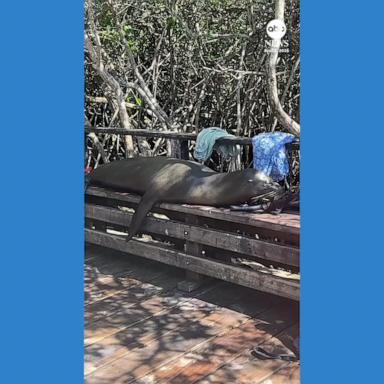
The video plays on a loop across social media feeds. A sea lion, slick and muscular, heaves itself onto a public dock or sandy stretch, nudges a tourist’s discarded backpack, and settles in for a nap. Viewers hit the share button, adding heart emojis and exclamations about the animal being cute, funny, or charmingly audacious. Behind the screen, the reality is far more clinical. What the average observer sees as a humorous moment of interspecies interaction, a wildlife biologist sees as a red flag signaling a broken system.
When wild marine mammals begin incorporating human items into their resting behaviors, the boundary between nature and tourism has already collapsed. This is not a story about animals being clever. This is a story about animals being driven by the relentless, often unmanaged, proximity of human crowds.
Sea lions are not pets. They are apex predators weighing upwards of six hundred pounds with a biting force capable of crushing bone. Over the last decade, I have observed the shifts in behavior at coastal hotspots from the Galapagos to the California coast. We have reached a point where the local wildlife has been forced to adapt to our mess, and we are misinterpreting their survival strategies as entertainment.
The Mechanics Of Pinniped Habituation
The psychological transition from wild animal to habituated beggar is subtle but profound. These creatures operate on a cost-benefit analysis. When an animal like a sea lion encounters a human, its instinct is to flee. However, in high-traffic tourist zones, that instinct is constantly tested. If the animal flees every time a person walks by, it loses valuable energy reserves and prime resting territory. Eventually, the animal learns that the human is not a threat but a nuisance to be tolerated.
This tolerance is the first step toward habituation. Once the animal stops viewing the human as a potential predator, it starts viewing the area around the human as a resource. A backpack, sitting on a warm patch of concrete or sand, becomes a convenient pillow. The scent of salt, sweat, and perhaps leftover snacks clinging to the bag makes it a sensory target. The animal is not stealing the bag because it wants the human’s sunscreen or camera gear. It is claiming the space the bag occupies.
We are observing a massive failure in spatial management. When we allow crowds to press into the immediate habitat of marine mammals, we are essentially forcing them to share their living room. In some locations, the sea lions have become so acclimated that they no longer view the arrival of a tour group as an event. They simply wait for the space to be occupied and then work around the occupants.
The Biological Cost Of The Viral Moment
There is a grim irony in the way these clips go viral. The more we celebrate these interactions, the more we incentivize the very tourism practices that endanger the animals. When a sea lion interacts with a human, the potential for zoonotic disease transmission exists. Pinnipeds can carry leptospirosis, a bacterial infection that can be transmitted to humans. The risk is low, until it is not.
Beyond disease, there is the stress factor. While a sea lion may appear calm while lounging on a bag, its physiological state is often far from relaxed. These animals are vigilant. They are constantly scanning their environment. A nap in the middle of a crowd is not true rest. It is a period of high-alert sensory processing. When a tourist moves too quickly, makes a loud noise, or gets too close, the sea lion can react with explosive aggression. I have seen the damage a startled sea lion can inflict. It is not pretty. It is a laceration requiring stitches and a frantic evacuation of the beach.
We also have to consider the nutritional impact. When sea lions lose their fear of humans, they start associating humans with food. This leads to the "begging" phenomenon seen in some harbors. They stop hunting the fish they are evolved to catch and start lurking near docks, waiting for human handouts. This change in diet is catastrophic for their long-term health, leading to malnutrition and vulnerability to parasites.
Regulatory Failure In Protected Areas
Most of these incidents occur in areas that are technically protected. We have the laws. We have the signage. We have the marine mammal protection acts. Yet, enforcement is almost nonexistent. Governments are trapped in a conflict between the economic pull of tourism and the mandate to protect wildlife.
Local businesses thrive when crowds swarm the beaches to see the sea lions. If a town were to strictly enforce a fifty-yard exclusion zone, the crowds would disperse, and the revenue would drop. Consequently, the signs are often poorly placed, the barriers are insufficient, and the wardens are stretched too thin. The current approach is to hope that visitors act responsibly. That is a failed strategy. Humans are pack animals, and in a group, our individual responsibility drops to near zero. We follow the leader, we push for the best angle for a photo, and we ignore the warning signs because the animal is "right there."
The infrastructure needs to change. If we want to continue sharing spaces with wild marine mammals, we need physical, hard barriers. Not just a rope that a child can step over, but raised boardwalks or elevated viewing platforms that separate the human walkway from the animal’s haul-out zone. This is the only way to effectively stop the accidental interactions. It is expensive, it limits the "up close and personal" experience that tourists pay for, but it is the only way to preserve the wild nature of the animal.
The Psychology Of The Spectator
Why do we insist on being so close? It is a modern entitlement. We believe that nature is a curated experience designed for our consumption. When we pay for a tour or travel to a remote coast, we feel we have purchased the right to an interaction. If the sea lion does not come up to the fence, we feel cheated.
This sense of ownership over the animal experience is what drives the risk. People feel that because they have traveled thousands of miles, they deserve the perfect photo. They are willing to stand inches from a territorial male to get the shot. They do not realize that the animal’s tolerance is finite. One day, a visitor will push the wrong individual, and the headline will change from "Sea lion borrows backpack" to something far more tragic involving emergency services and the permanent removal or euthanasia of the animal.
It is a mistake to view these animals as sentient beings capable of understanding our social contracts. They are governed by biological imperatives. They are not choosing to "borrow" our things. They are responding to an environment that has been stripped of its natural barriers by our presence. We have created a situation where the animal is acting perfectly within its instincts, and the human is acting completely without common sense.
When The Boundary Collapses
The normalization of these events is a warning. When we see a sea lion napping on a backpack, we are looking at the end result of a long, slow degradation of wildlife habitat. It starts with a few people, then a dozen, then a hundred. The animal is pushed further and further into the margins until the margins disappear entirely.
If we truly care about the wildlife we claim to love, the solution is radical detachment. We must accept that there are places where humans simply do not belong, or where our presence must be strictly mediated by technology and distance. We should be content to observe from a distance, through a lens, without the need for physical encroachment.
The reality of wildlife conservation is rarely as photogenic as a viral clip. It is boring, it is restrictive, and it involves a lot of "no." It requires us to suppress our desire for the selfie in favor of the animal's right to space. Until we make that shift, these incidents will continue to escalate. We will keep filming, and the animals will keep suffering the consequences of our curiosity. The next time you see a headline about a sea lion napping on a bag, do not look for the humor. Look for the encroachment. Look for the failure of our own restraint. Look at the animal and ask whether it would be sleeping there if we had simply stayed where we belonged.