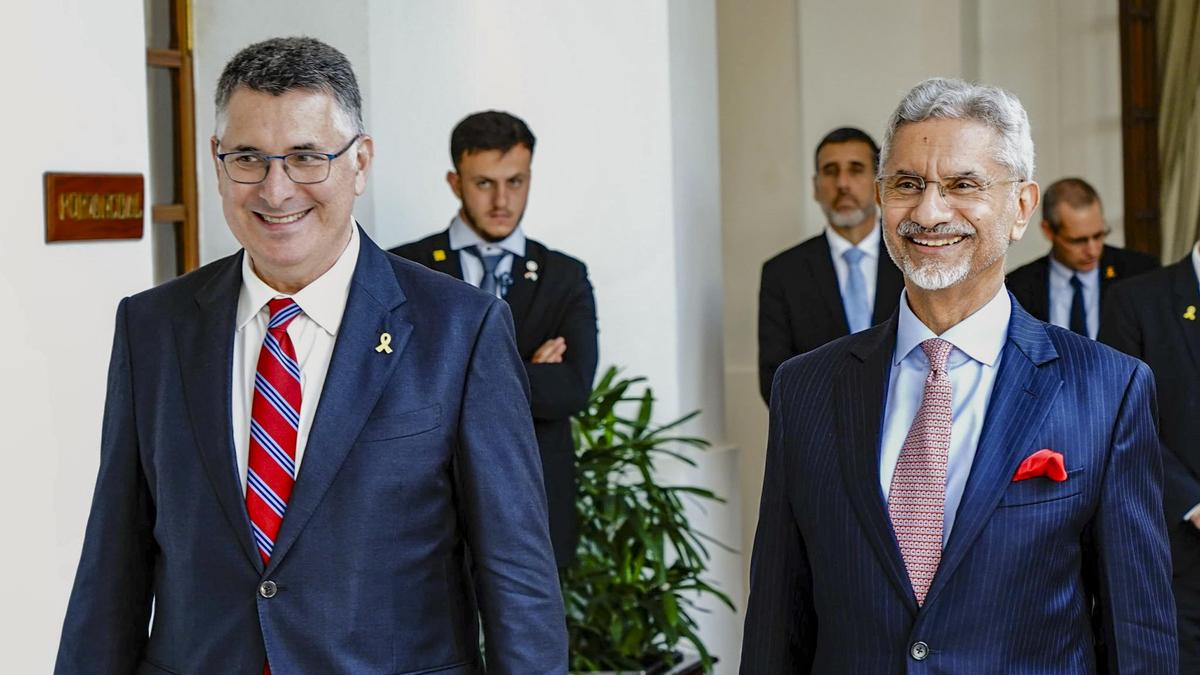
The communication between Indian External Affairs Minister S. Jaishankar and Israeli Foreign Minister Gideon Sa’ar serves as a formal calibration of two diverging yet interdependent geopolitical trajectories. While surface-level reporting characterizes such interactions as "updates on the situation," a structural analysis reveals a sophisticated balancing act involving energy security, maritime trade stability, and the preservation of the India-Middle East-Europe Economic Corridor (IMEC). This engagement is not merely a diplomatic courtesy; it is a high-stakes synchronization of national interests where India seeks to mitigate the spillover effects of a multi-front conflict while Israel seeks to solidify its legitimacy and security partnerships beyond the Western sphere.
The Tri-Lens Analytical Framework
To understand the substance of these discussions, one must apply a tripartite framework that governs India’s current West Asian strategy. Meanwhile, you can read similar stories here: The Brutal Truth About the Backchannel Negotiations and the Blockade.
- The Stability Mandate: India’s primary objective is the containment of the conflict to prevent a regional conflagration that would destabilize the 9 million-strong Indian diaspora and disrupt the flow of remittances.
- The Connectivity Imperative: The IMEC represents a generational infrastructure project. Continued hostilities in the Levant and the Red Sea create a physical and financial bottleneck for this corridor.
- The Strategic Autonomy Balance: India must maintain a "de-hyphenated" relationship, supporting Israel's security requirements while simultaneously advocating for Palestinian statehood and maintaining energy ties with Iran.
Maritime Security and the Red Sea Bottleneck
A critical component of the Jaishankar-Sa’ar dialogue centers on the functional degradation of trade routes. The Houthi-led disruptions in the Red Sea have forced a re-routing of cargo around the Cape of Good Hope, increasing transit times by 10 to 14 days and elevating freight costs by roughly 150% to 200% for specific Indian exports.
From a strategic consultant’s perspective, the "cost of conflict" for India is measured in the erosion of competitive pricing for its textile, chemical, and agricultural exports to Europe. Israel, conversely, views maritime security through the lens of survival and the breaking of its economic isolation. The synchronization of these two perspectives leads to a shared tactical interest in the "Information Fusion Centre – Indian Ocean Region" (IFC-IOR) and other intelligence-sharing mechanisms. India is not a combatant in the Red Sea, but it is a primary stakeholder in its "freedom of navigation"—a term used to signal opposition to non-state actor interference without committing to a Western-led military coalition. To understand the complete picture, check out the recent analysis by Reuters.
The IMEC Viability Assessment
The Abraham Accords provided the diplomatic infrastructure for the IMEC. The current crisis has placed this project in a state of "strategic hibernation." The dialogue between New Delhi and Jerusalem serves to assess the minimum security conditions required to resume the project’s momentum.
For India, the IMEC is a counter-weight to China’s Belt and Road Initiative (BRI). For Israel, it is the ultimate integration tool into the Asian economic ecosystem. The "different aspects" of the crisis mentioned in official statements likely refer to the physical security of the proposed rail and port links. If the Haifa port—managed by India’s Adani Group—remains under the threat of Hezbollah’s long-range precision munitions, the financial risk premiums for the corridor become prohibitive. Therefore, India’s "update" from Sa’ar likely focused on the Israeli Defense Forces' (IDF) success in degrading Northern Front capabilities to a level that permits commercial de-risking.
Intelligence Synthesis and Counter-Terrorism Cooperation
The Indo-Israeli relationship is underpinned by a deep, non-publicized layer of technology transfer and intelligence cooperation. In the context of the West Asia crisis, this involves:
- Signals Intelligence (SIGINT): Monitoring the movements of regional proxies and the technical specifications of unmanned aerial vehicles (UAVs) being deployed.
- Cybersecurity Defense: Protecting critical infrastructure from state-sponsored hacking attempts that often surge during periods of kinetic warfare.
- Tactical Learning: The Indian military establishment analyzes the IDF's urban warfare tactics and missile defense performance (Iron Dome, David’s Sling, and Arrow systems) as a data-gathering exercise for its own border defense strategies.
This exchange is a "value-for-value" transaction. India provides Israel with a massive market for its defense technology and a significant diplomatic voice in the Global South that prevents total international isolation. Israel provides India with the technological "force multipliers" necessary to maintain an edge in its own neighborhood.
The Iranian Variable and the De-Hyphenation Strain
The most complex "aspect" of the crisis is the role of Iran. India maintains a strategic interest in the Port of Chabahar, which serves as its gateway to Central Asia and a bypass to Pakistan. The escalation between Israel and Iran puts New Delhi in a precarious position where its two primary strategic partners in West Asia are in a state of direct kinetic confrontation.
Jaishankar’s communication with Sa’ar must be viewed in tandem with India’s ongoing dialogue with Tehran. New Delhi functions as a "rational bridge," potentially conveying the limits of escalation that regional powers are willing to tolerate. India’s goal is to prevent a scenario where it is forced to choose between the Israeli "high-tech and defense" pillar and the Iranian "energy and connectivity" pillar. The pressure on this de-hyphenated policy is at its highest point since the 1979 revolution.
Economic Resilience and Energy Volatility
While India has diversified its energy imports—notably increasing its intake of Russian crude—the West Asian region still accounts for a significant portion of its oil and gas requirements. Any disruption to the Strait of Hormuz would trigger a price shock that would jeopardize India’s fiscal deficit targets.
The "aspects" discussed likely included an assessment of the risk to energy infrastructure. Israel’s potential targeting of Iranian energy assets, or vice versa, would lead to a global price spike. India’s diplomatic intervention here is focused on "targeted containment"—ensuring that while kinetic actions continue, the global energy supply chain remains insulated. This is a pragmatic, data-driven approach to diplomacy where the primary metric of success is the stability of the Brent Crude index.
The Structural Realignment of West Asian Power
The current conflict is accelerating a shift from a "bipolar" regional struggle to a more fragmented, "multipolar" competition. India is positioning itself as a neutral arbiter of trade and a provider of security through its naval presence in the Arabian Sea.
The engagement with Gideon Sa’ar signals that India recognizes the "New Reality" of Israeli politics—a rightward shift that prioritizes security over immediate diplomatic concessions. By engaging with Sa’ar, Jaishankar is ensuring that India’s interests are accounted for in Israel's "day after" planning. This involves:
- Labor Mobility: Finalizing the frameworks for Indian workers to replace Palestinian labor in the Israeli construction and technology sectors, a move that provides India with high-value employment opportunities while solving Israel’s labor crisis.
- Agri-Tech and Water Security: Continuing the long-term bilateral projects that are essential for India’s internal food security, which remain decoupled from the immediate kinetic conflict.
- Multilateral Coordination: Aligning votes or abstentions in international forums like the UN to minimize friction while adhering to "principled neutrality."
Strategic Recommendation for Global Stakeholders
The Indo-Israeli dialogue is a leading indicator of regional stabilization efforts. Observers should monitor the frequency of these high-level exchanges as a proxy for the viability of the IMEC. If the communications shift from "security updates" to "logistics and trade agreements," it will signal that the peak of the kinetic risk has passed.
For institutional investors and policy planners, the takeaway is clear: India is not distancing itself from Israel despite the humanitarian and political costs of the conflict. Instead, it is deepening its technical and strategic integration. The "cost function" of abandoning Israel is too high for India's long-term maritime and technology ambitions. Conversely, India's role as a "stabilizing heavy-weight" is indispensable for Israel's long-term integration into the Indo-Pacific economic theater.
The strategic play here is to treat the West Asian crisis as a temporary—albeit violent—interruption to a long-term structural realignment. The India-Israel axis is being stress-tested, and current data suggests the relationship is pivoting toward a "Security-First" model that will define the region's architecture for the next decade. Stakeholders should prioritize the monitoring of Indian naval movements in the North Arabian Sea and the progress of the Haifa port expansion as the two primary variables defining the success of this alignment.