The ink was still wet on the front pages when the first commuters reached the kiosks at Union Station. They didn’t just pick up the paper; they stared at it. There is a specific kind of silence that falls over a city when the tectonic plates of power shift overnight. It isn't the silence of peace. It is the held breath of a crowd waiting for the second shoe to drop.
In Washington, the air felt electric, humming with the frantic energy of a political class that had just realized the floor was no longer beneath their feet. Across the Atlantic, in the gilded, quiet corridors of London, a very different kind of energy was at work. While one capital screamed, the other whispered.
The Tremor in the District
Imagine a staffer in a windowless office on Capitol Hill. Let’s call him Elias. He has spent a decade learning the rules of the road—who to call, which sub-committee chairs hold the real levers, and how to predict the legislative weather. By 7:00 AM, his phone is a glowing brick of notifications. The headlines aren't just reporting news; they are reporting a rupture.
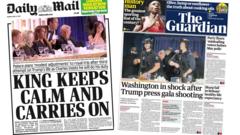
The front pages described a "Washington in shock." This isn't the theatrical shock of a scandal or a leaked memo. This is the existential dread of a system that has suddenly lost its North Star. When the newspapers use words like "upheaval" or "disarray," they are trying to describe the look on Elias’s face as he realizes his entire Rolodex might be obsolete by noon.
The stakes aren't abstract policy points. They are human. If the center doesn't hold, the funding for a rural hospital in Ohio disappears. If the shock deepens, a trade agreement that keeps a manufacturing plant in Michigan open begins to fray. The "shock" is the sound of a thousand gears grinding to a halt because no one knows who is driving the machine anymore.
The Stoic across the Sea
While Washington vibrated with panic, the British broadsheets painted a portrait of a man who seemed to be living in a different century, or perhaps just a different reality.
King Charles III sat behind a mahogany desk. He watched the same global chaos through the lens of a thousand-year-old institution. The headline "King keeps calm" isn't just a nod to a wartime slogan. It is a description of a survival strategy. For a monarch, calm is the only currency that matters. If the King panics, the institution dissolves.
Think about the weight of that quiet. While the political world is obsessed with the next fifteen minutes, the man in the palace is thinking about the next fifty years. He is the anchor in a storm that he didn't ask for and cannot control. There is a profound loneliness in that kind of composure. It is the isolation of a person who has been told that their only job is to be a symbol of stability while everything they symbolize is being questioned.
The Friction of Two Worlds
The contrast between these two headlines reveals a fundamental truth about how we handle crises. Washington is a city of "doing." It reacts. It pivots. It leaks. It fights. It is a nervous system permanently stuck in fight-or-flight mode.
The Monarchy is a culture of "being." It exists. It endures. It waits.
When these two worlds collide—the frantic, democratic pulse of America and the slow, rhythmic heartbeat of the British Crown—the friction creates a heat that burns through the news cycle. We are watching a live experiment in how human beings process instability. Do we scream into the void like a D.C. strategist, or do we stare it down with a stiff upper lip like a King?
The Invisible Stakes
Beneath the ink and the bold fonts, there is a hidden cost to this divergence. The shock in Washington creates a vacuum. In nature, a vacuum is quickly filled, usually by something more volatile than what was there before. When leaders are stunned, they are vulnerable. They make decisions based on fear rather than foresight.
In London, the "calm" carries its own risk. To be too calm is to risk appearing indifferent. While the King maintains his composure, the streets outside the palace gates are navigating the same economic anxieties and social fractures that are tearing at the fabric of Washington. Silence can be interpreted as strength, but it can also be mistaken for a lack of empathy.
Consider the person reading these headlines on a park bench in London or a subway car in New York. They aren't thinking about the constitutional implications of a shocked Washington or a calm King. They are thinking about their rent. They are thinking about why the world feels like a car spinning out of control on black ice.
The newspapers provide the play-by-play, but they rarely capture the vertigo.
The Language of the Unspoken
There is a reason we still look at physical newspapers during moments of historical gravity. A digital headline can be edited. It can be deleted. It is ephemeral. But a front page—heavy, tactile, and permanent—is a record of a moment that cannot be undone.
When "Washington in shock" is printed in black and white, it becomes a historical fact. The shock is codified. When "King keeps calm" hits the stands, it sets a standard for the day's behavior. These papers aren't just reporting the mood; they are enforcing it.
The real story isn't the politics or the royalty. It is the realization that we are all, regardless of our station, just trying to find a way to stand still while the world spins. We look to Washington to see if the builders are still building. We look to the King to see if the foundation is still there.
Tonight, the lights in the West Wing will stay on long past midnight. Shredders will whir. Coffee will grow cold in ceramic mugs. In the Palace, the lights will go out at the usual time. The hallways will be silent. Two different ways of answering the same terrifying question: What do we do when the world changes?
The paper on the sidewalk gets wet in the rain. The ink bleeds. The headlines blur. But the feeling of that morning—the sharp, cold realization that the old rules have evaporated—stays in the marrow of the bone.
Washington is still shaking. The King is still sitting. And the rest of us are left to decide which of them has the right idea.