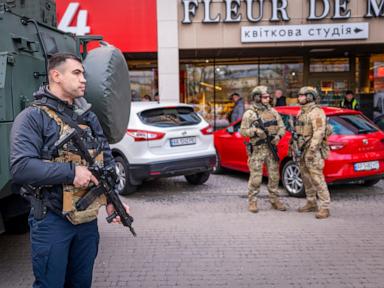
The headlines are always the same. "Police Neutralize Threat." "Gunman Killed After Standoff." We treat these eruptions of violence in Kyiv as isolated glitches in the social fabric—random acts of madness stopped by the bravery of a tactical unit. That narrative is comfortable. It is also entirely wrong.
When the Kyiv police shot dead a gunman who had already claimed five lives, the media hailed it as a success of containment. This is a lie born of convenience. By the time a sniper takes a shot, the system has already failed five times over. We are obsessed with the "kinetic finish"—the dramatic end of a siege—because it absolves us of looking at the technological and psychological rot that makes these events inevitable in the 2020s.
The Illusion of Containment
Most crime reporting operates on the "Broken Window" fallacy’s more violent cousin: the idea that a dead shooter equals a closed case. It doesn't. In modern urban environments like Kyiv, a hostage situation isn't a static event; it’s a failure of predictive policing and a catastrophic breakdown of digital signal intelligence.
We keep hearing about "lone wolves." There is no such thing as a lone wolf in a world where every radicalization path is logged, tracked, and monetized by social algorithms. To call a gunman "unpredictable" in 2026 is to admit that our multi-billion dollar surveillance states are looking at the wrong data points.
- The Reactionary Lag: Police response times are irrelevant when the damage is done in the first 180 seconds.
- The Media Feedback Loop: By broadcasting every "standoff," we provide the exact platform the perpetrator desired. The police didn't "stop" him; they gave him his finale.
- The Failure of Non-Lethal Tech: Why are we still relying on lead bullets in high-density urban zones? The persistence of lethal force as the primary "solution" proves a lack of innovation in neural-disruption or advanced incapacitation tech.
Stop Calling It a Success
Five people are dead. Let’s sit with that.
If a commercial airliner crashed and killed five people, there would be a global grounding of that fleet. When five people die in a hostage crisis, we give the police department a PR win because they killed the "bad guy." This is a participation trophy for a massacre.
True "success" in these scenarios should be measured by the Pre-Event Interdiction Rate. If the perpetrator reached the point of taking hostages, the security apparatus already lost the war. We are celebrating the cleanup crew while the house is still smoldering.
I have spent years analyzing security protocols in high-conflict zones. The pattern is always the same: authorities ignore the "leakage"—the digital signals and behavioral red flags—and then act surprised when the pressure cooker explodes. We prioritize the "Right to React" over the "Duty to Prevent."
The Tactical Fallacy: Why Snipers Aren't the Answer
The public loves the image of a specialized unit (KORD or similar) taking the "clean shot." It’s cinematic. It feels like justice. In reality, it is a desperate, last-ditch admission of intellectual bankruptcy.
When you kill a gunman, you kill the data. You destroy the only link to the network, the motive, and the supply chain of the weaponry used. Dead men tell no tales, and they certainly don't reveal which Telegram channels provided the blueprint for their assault.
We should be demanding why—in an era of drone swarms and localized EMPs—we are still sending human beings into hallways to trade gunfire. The "bravery" of the officer is often used as a shield to hide the "obsolescence" of the tactic.
The Cost of Lethal Resolution
| Metric | Traditional Tactical Response | Proactive Signal Interdiction |
|---|---|---|
| Human Cost | High (Hostages + Suspect) | Low (Early Detention) |
| Intelligence Gained | Zero (Suspect Deceased) | High (Interrogation/Network Mapping) |
| Social Impact | Fear/Copycat Incentive | Stability/Deterrence |
| Resource Drain | Massive (SWAT/Media/Legal) | Minimal (Data Analysis/Social Work) |
The Counter-Intuitive Truth About "Mental Health"
The go-to excuse for every mass casualty event is "mental health." It’s a lazy catch-all that allows politicians to shrug their shoulders.
The truth? Most of these actors aren't "crazy" in the clinical sense. They are hyper-rational actors responding to a perverse incentive structure. They see a world that ignores them unless they are holding a weapon. By framing this as a "mental health crisis," we ignore the architectural crisis of our cities and the algorithmic crisis of our information streams.
If you want to stop the next gunman in Kyiv or anywhere else, you don't buy more armored vehicles. You dismantle the celebrity-incel pipeline. You stop rewarding violence with 24-hour news cycles. You treat the digital footprint of a potential shooter with the same urgency as a suitcase nuke.
The "People Also Ask" Problem
People often ask: "How can police respond faster?"
That is the wrong question. Speed isn't the issue; proximity is. We don't need faster police; we need fewer reasons for police to be there.
Another common query: "What laws can stop this?"
Laws don't stop bullets. Laws are post-hoc justifications for state action. The only thing that stops an active shooter before they start is a society that identifies "outliers" not as targets for the police, but as failures of the community.
Why We Won't Change
We won't change because the current system is profitable. It's profitable for the defense contractors selling "tactical gear." It's profitable for the news networks that thrive on "Breaking News" banners. It's even profitable for the politicians who get to look "tough on crime" while standing in front of a crime scene tape.
We have built a civilization that prefers a violent resolution to a quiet prevention. We would rather watch a gunman die on a livestream than do the hard work of identifying him six months ago when he was just a lonely guy buying body armor on a credit card.
The Actionable Pivot
If you are a city planner, a security professional, or a concerned citizen, stop asking for more "boots on the ground."
- Demand Data Transparency: Why wasn't the "leakage" flagged?
- Defund the Spectacle: Stop clicking on the shooter’s manifesto. Stop sharing their name.
- Invest in Non-Kinetic Interception: Push for technologies that disable, not destroy.
The Kyiv shooting wasn't a victory for law enforcement. It was a funeral for five innocent people and a loud, ringing alarm that our "security" is nothing more than a high-priced illusion.
We are not safer because the gunman is dead. We are just waiting for the next one to realize that the police will help him finish his story with a bang.
Stop celebrating the kill shot. Start questioning why the gun was ever loaded.