NASA is selling you a map of a territory that might not exist.
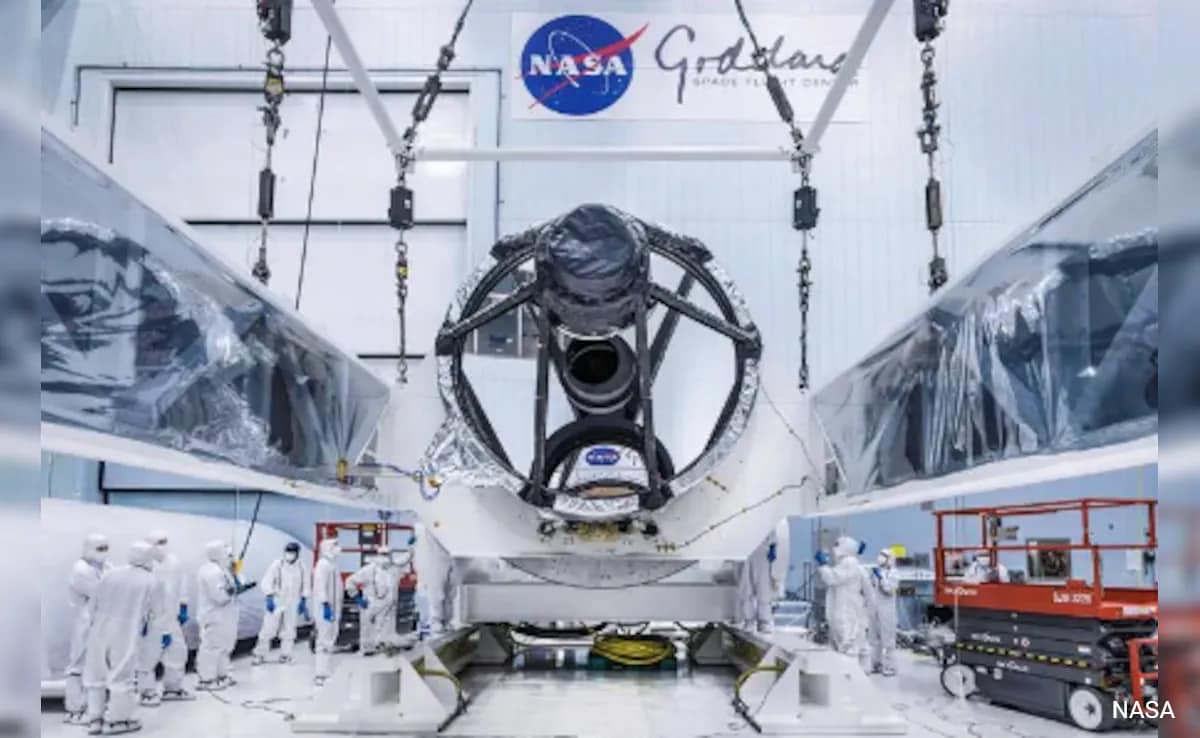
The hype machine is currently redlining over the Nancy Grace Roman Space Telescope. They call it the "Atlas of the Universe." They promise it will finally "solve" dark matter and dark energy. The narrative is neat, tidy, and almost entirely misleading. We are told that by giving this machine a field of view 100 times greater than Hubble, we will pull back the curtain on the 95% of the cosmos currently hiding in the shadows.
But here is the truth the press releases won't touch: We are building a high-definition camera to find a phantom. If our current understanding of gravity is fundamentally broken, Roman isn't going to find dark matter. It’s just going to provide us with the most expensive evidence of our own ignorance in human history.
The Field of View Fallacy
The central selling point of Roman is its scale. While James Webb (JWST) is a sniper rifle—looking deep into tiny patches of the sky to see the first stars—Roman is a wide-angle lens. It aims to survey billions of galaxies, mapping the large-scale structure of the universe to see how dark energy pushes things apart.
The "lazy consensus" assumes that more data equals better answers. It doesn't. We have been collecting data on galactic rotation curves and gravitational lensing for decades. Every time the data doesn't fit the Standard Model (Lambda-CDM), we don't question the model; we just invent a new property for the "dark" stuff to explain the discrepancy.
Roman is designed to measure the "W" parameter—the equation of state for dark energy. We expect to find it's a cosmological constant. But if the data comes back and says it isn't, or if the distribution of dark matter doesn't align with our WIMP (Weakly Interacting Massive Particles) theories, the scientific community won't admit the theory is dead. They will ask for a bigger telescope.
I have watched research teams burn through ten-year grants chasing particles that refuse to show up in any detector on Earth. Roman is the cosmic version of that sunk-cost fallacy.
Dark Matter is a Placeholder, Not a Fact
We need to stop treating "Dark Matter" as a noun and start treating it as a verb. It is a mathematical "fudge factor" used to keep General Relativity from falling apart at the seams when we look at galaxies.
$G_{\mu\nu} + \Lambda g_{\mu\nu} = \frac{8\pi G}{c^4} T_{\mu\nu}$
In Einstein’s field equations, if the energy-momentum tensor $T_{\mu\nu}$ (the visible stuff) doesn't account for the curvature $G_{\mu\nu}$ we observe, we assume there is invisible mass. The alternative—that the laws of gravity change at low accelerations—is treated as heresy by the institutional elite.
Modified Newtonian Dynamics (MOND) or emergent gravity theories are often scoffed at because they don't play well with the Cosmic Microwave Background. Fine. But after forty years of searching for a particle that hasn't blinked once in a liquid xenon tank, who is really the one clinging to a fairy tale? Roman is built on the assumption that the "dark" sector is a substance. If it's actually a misunderstanding of how spacetime curves over vast distances, Roman’s wide-angle surveys will just give us a sharper image of a mistake.
The Microlensing Gamble
Roman plans to use "gravitational microlensing" to find thousands of exoplanets and rogue planets. This is objectively cool tech. By watching how a foreground star’s gravity bends the light of a background star, we can spot tiny planets.
However, the "People Also Ask" crowd wants to know if this will find Earth 2.0. The honest answer? Probably not. Roman is looking at the crowded center of the Milky Way. It's looking for statistical distributions, not habitable worlds we can actually study. It’s a census, not a search for neighbors.
We are obsessed with the "what" and "where" while ignoring the "why." We are counting planets like beads on an abacus while our fundamental physics remains stalled since the 1970s. We have thousands of confirmed exoplanets now. Has that moved the needle on our understanding of life's origin? No. It has just filled out a spreadsheet.
The Data Deluge Problem
Roman will generate a staggering amount of data—roughly 1.4 terabytes a day. For context, Hubble takes years to produce what Roman will produce in days.
The industry insiders talk about this as a win. It isn't. It’s a bottleneck. We do not have enough qualified human eyes or even "unbiased" algorithms to parse this without falling into the trap of confirmation bias. We train our AI models on our existing theories. If you train a neural network to find "dark matter halos," it will find them—even if what it’s actually looking at is a ripple in a gravity field we don't understand yet.
We are entering the era of "Big Data Astronomy," where the sheer volume of information acts as a smokescreen for the lack of new ideas. We are substituting processing power for intellectual breakthroughs.
The Institutional Cost of Certainty
The Roman telescope is named after a pioneer, and it deserves to fly. But it shouldn't be sold as a "mystery solver." It should be sold as a "risk."
If Roman finds that dark energy changes over time, it breaks the Standard Model. If it finds that the "clumpiness" of the universe doesn't match our simulations, it breaks the Standard Model. The risk is that the people running the mission are too invested in the Standard Model to let it break.
I’ve seen this in aerospace and academia alike: when the data contradicts the prestige of the senior principal investigator, the data gets "recalibrated."
Imagine a scenario where the Roman survey shows a distribution of matter that perfectly fits a modified gravity theory but requires us to throw out the last 50 years of dark matter research. Do you think the press release will lead with "Einstein Was Wrong"? Or will they invent "Complex Dark Matter" or "Self-Interacting Dark Matter" to bridge the gap?
Stop Asking if We Are Alone and Start Asking if We Are Blind
The competitor article wants you to feel small and inspired. I want you to feel skeptical and demanding.
We are spending billions to look at the sky through a lens ground to the specifications of a theory that is currently failing every laboratory test. The Nancy Grace Roman Space Telescope is a masterpiece of engineering. It is a marvel of optics. But it is also a massive bet that our current map of the universe isn't just a collection of "here be dragons" warnings.
We don't need another atlas if the geography we are mapping is an illusion created by our own rigid equations. We don't need more pixels. We need a new perspective.
Roman will give us the pixels. The perspective is up to us, provided we aren't too afraid to admit that the "dark" mysteries might just be the shadows of our own misconceptions.
Go ahead, buy the poster. Watch the launch. But when the first "revolutionary" results come out, look for the data points they had to throw away to make the curve fit. That’s where the real universe is hiding.