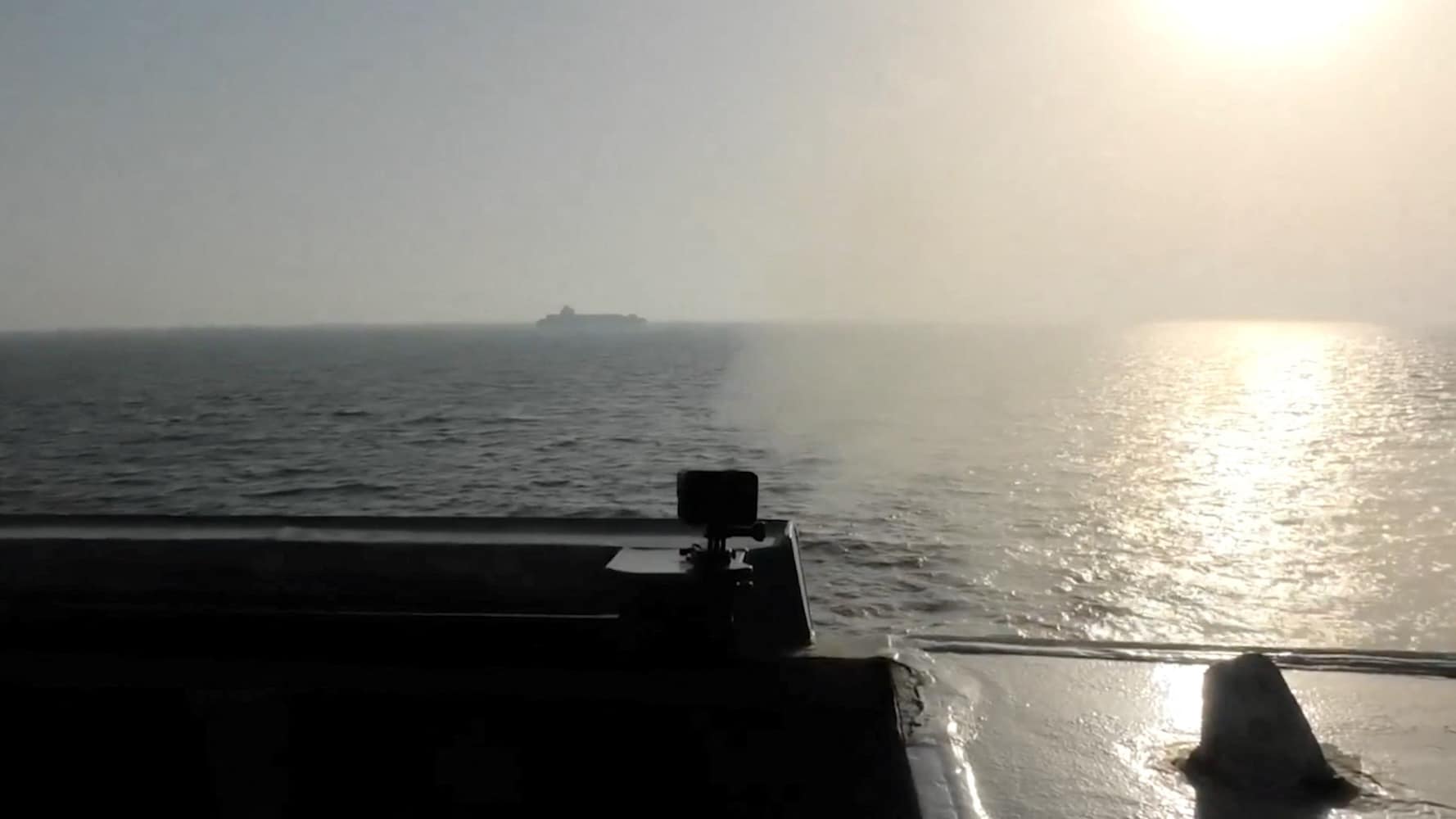
The air in the Strait of Hormuz does not just sit; it weighs upon you. It is a thick, humid curtain of heat that smells of brine, burnt oil, and the sharp, metallic tang of anxiety. I remember the first time I transited those waters. The sky was a pale, washed-out blue, and the horizon felt impossibly close, constricted by the jagged coastlines that funnel the world’s most precious commodity through a throat barely wide enough to swallow.
When you read that the United States has seized an Iranian ship, your eyes likely gloss over. You see headlines about oil tankers, military posturing, and geopolitical brinkmanship. It sounds like distant static, a background noise in the constant hum of modern life. You assume it is a game played by men in suits in Washington, Tehran, and Beijing. Meanwhile, you can read related stories here: The Brutal Truth Behind the Eric Swalwell Downfall.
But it is not a game. It is a chokehold.
Consider the vessel in question. Let us call her the Saman. She is a rusted leviathan, a tanker scarred by years of salt spray and neglect. On her bridge, Captain Ahmed stares at the radar. He has spent thirty years navigating these waters, knowing every sandbar and every current. He is not a diplomat. He is a sailor who wants to see his daughter in Bandar Abbas by the weekend. To see the full picture, we recommend the recent report by The Washington Post.
Then, the alarm.
It is not the blare of a movie siren. It is a sharp, jagged sound that cuts through the hum of the engine. A US destroyer has locked onto them. The instructions are cold, precise, and absolute. Stop. Heave to. Prepare to be boarded. In that moment, the political narrative—the sanctions, the nuclear talks, the grand strategic competition between superpowers—vanishes. All that remains is the terror of a boarding party, the uncertainty of who has the guns, and the visceral reality that one wrong move will turn a commercial vessel into a fireball.
When the US marines touch the deck of the Saman, they aren't just seizing cargo. They are physically altering the flow of the global economy.
This is the part the news reports miss. The Strait of Hormuz is the world’s jugular. Roughly a fifth of the world’s oil consumption passes through this bottleneck. If you live in London, Tokyo, or New York, your morning commute, the cost of your groceries, and the warmth of your home are all tethered to the navigation charts of this tiny, violent strip of water.
When the news cycle shifts to China’s reaction, it is easy to view their stern warnings of "escalation" as standard diplomatic theater. Beijing issues a statement. Washington ignores it. The world spins on.
But look closer. China is not merely posturing for the sake of appearances. They are the world’s largest importer of crude oil. Their hunger for energy is a beast that never sleeps. When they warn of escalation, they are not worried about abstract principles of sovereignty. They are looking at their own supply lines. They are looking at the possibility that the Strait could be closed, not by a diplomat’s pen, but by a single sunken tanker.
If that throat closes, the world chokes.
Imagine it. A single blocked channel. Oil prices spike. Shipping insurance premiums skyrocket. Factories in the Pearl River Delta slow their output because the raw materials are sitting on a tanker stuck in a holding pattern. The cost of manufacturing surges. Inflation, already a fragile thing, cracks under the weight.
You think this is a remote problem? Think of the supply chain. Everything you touch, from the plastic casing of your phone to the polyester in your shirt, relies on petrochemicals. When the price of oil rises, everything rises. You pay for it at the pump, sure, but you also pay for it in the grocery aisle, in your utility bill, and in the quiet, creeping anxiety of a volatile market.
We live under the illusion of separation. We believe the actions of a ship captain thousands of miles away have no bearing on our own kitchen table. We are wrong. The world is smaller than we want to admit, and we are all tied to the same anchor.
When the US decides to seize a ship, it is an exercise of raw, kinetic power. It says, We can stop the flow. When China threatens escalation, it is an acknowledgment of vulnerability. It says, We are terrified you will stop the flow. Both sides are dancing on the edge of a razor. One miscalculation—a stray shot, a nervous sailor, a failure of radio communication—and the dance ends.
I think of the crew on the Saman. They are caught in a vise. They are pawns in a match that spans continents, but they are the ones who feel the cold steel of a rifle barrel against the skin. They are the ones who worry if their families will receive their pay if the ship is impounded. They are the human cost of a strategy that prioritizes the movement of oil over the lives of men.
We often talk about the "global order" as if it were a solid, unmoving thing. It isn't. It is a fragile construct maintained by the constant, aggressive policing of these tiny, narrow spaces. We maintain order by ensuring that the ships keep moving.
But what happens when the ships stop?
We have become so accustomed to the steady rhythm of globalization that we have forgotten how easily it can be interrupted. We see the supply chains as invisible wires, always there, always humming. We forget that those wires run through some of the most dangerous, unstable, and contested waters on the planet.
The warning from China is a signal that the status quo is fraying. They are signaling that their tolerance for US unilateralism in these waters has reached a limit. It is a challenge. It is a dare. It is a sign that the chessboard is being overturned, and the pieces are sliding toward the edge of the table.
You might wonder why this particular event warrants such alarm. Is it not just another day in the Persian Gulf? Perhaps. But a single match does not always start a forest fire. Sometimes, it just burns a hand.
However, when the air is dry, when the winds are high, and when the brush is tinder-ready, a single match is enough to incinerate the entire forest.
The escalation the diplomats talk about is not a sudden explosion. It is a gradual, grinding increase in tension. It is the ships moving closer to the shore. It is the fighter jets circling in the dark. It is the tightening of the noose.
Every time a ship is seized, the line is drawn deeper in the water. We are moving toward a point where the risks will eventually outweigh the rewards. And when that happens, the global economy will have to reckon with a reality it has spent decades trying to avoid.
The sea is indifferent to our politics. The water in the Strait will continue to rise and fall with the moon, regardless of which flag flies over the ships that pass through it. The currents do not care about borders or sanctions.
But we care.
We care because we are inextricably linked to those ships. We are the cargo. We are the consumers. We are the silent partners in every geopolitical gamble taken in the dark, humid heat of the Strait.
The next time you see a headline about a ship seized, don't look away. Do not dismiss it as a distant, abstract problem. Listen to the warning. Look at the water.
There is a storm brewing, and it is heading for us all. The only question is how much of our world will remain when the winds finally die down and the ships are allowed to sail again.