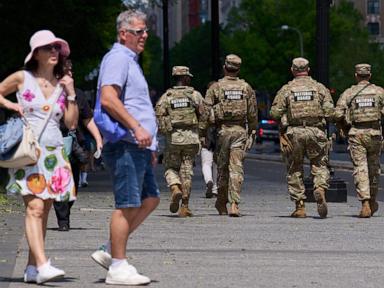
Walk down Constitution Avenue today and you’ll see them. They aren’t tourists. They aren't lobbyists. National Guard troops are still patrolling the streets of Washington, D.C., and nobody seems to have a clear date for when they'll actually leave. It’s a strange, lingering sight that has transformed the nation’s capital into something resembling a green zone.
The initial surge made sense to many after the events of January 6. Tension was high. Security was non-existent. But we’re long past the inauguration, and the camouflage hasn't faded into the background. Instead, it’s become part of the city's architecture. If you're looking for a sign that American civil discourse is fractured, look at the humvees parked near the Smithsonian. They tell a story of a government that’s terrified of its own shadow.
The Cost of a Constant Military Presence
Maintaining thousands of troops in a major American city isn't cheap. It’s also not particularly efficient. We’re talking about millions of dollars every week. These funds come from taxpayers who might prefer seeing that money go toward infrastructure or education rather than paying for young men and women to stand behind black metal fencing.
The financial burden is only half the story. You have to consider the human element. These Guard members have lives. They have jobs back home in places like Ohio, Pennsylvania, and Virginia. They're missing births, birthdays, and career opportunities. When a deployment that’s supposed to be a temporary emergency measure stretches into months with no defined exit strategy, morale drops. It’s a grind. I’ve talked to people who live in the District; they’re tired of the checkpoints. The troops are tired of the sidewalk. It's a lose-lose situation that keeps dragging on because no one in leadership wants to be the person who signed the order to "relax" right before something happens.
Security Theatre or Necessary Shield
Is D.C. actually safer with the Guard there? That's the million-dollar question. Some argue that the mere presence of uniformed personnel acts as a massive deterrent. It’s hard to storm a building when there’s a line of soldiers with riot gear. But others see it as security theatre. Most of these troops aren't even armed with live ammunition in many scenarios, or they’re essentially acting as highly overqualified traffic wardens.
The Secret Service and the Capitol Police are supposed to handle domestic security. By leaning on the National Guard indefinitely, the government is admitting that its primary law enforcement agencies aren't up to the task. That’s a massive red flag. It’s basically a band-aid on a bullet wound. We should be fixing the intelligence failures that led to the breach in the first place, not just throwing more fatigues at the problem.
Life Behind the Perimeter
Living in D.C. right now feels restrictive. I’m not just talking about the fences. It’s the vibe. The city used to feel like the "People’s House." Now it feels like a fortress. You can't just wander near the reflecting pool without hitting a barrier. Businesses in the downtown core are struggling because the foot traffic is gone. Who wants to grab lunch in a place that feels like a combat zone?
The psychological impact on the public is real. When you see soldiers every day, your brain stays in a state of low-level "fight or flight." It reinforces the idea that your neighbor is a threat. It makes the political divide feel physical. We’re literally fencing ourselves off from each other.
Why the Deployment Keeps Getting Extended
Bureaucracy is a powerful force. Once a military machine starts rolling, it’s hard to stop. Every few weeks, a new "credible threat" appears in an intelligence report. These reports are often vague. They mention "unspecified groups" or "online chatter." Because the stakes are so high, officials choose the path of least resistance: keep the troops.
It's a classic case of risk aversion. If a politician sends the Guard home and a window gets broken the next day, their career is over. If they keep the Guard there for an extra six months and nothing happens, they get to say their "vigilance" kept the peace. It's a cynical cycle. It ignores the long-term damage to the military's relationship with the civilian population. The National Guard is meant for natural disasters and genuine short-term domestic crises. It wasn't designed to be a standing army for the streets of the capital.
The Problem of Mission Creep
What started as "protect the transition of power" has morphed into "provide general support." That’s mission creep in its purest form. When the goalposts keep moving, the finish line disappears. We’ve seen this in overseas conflicts, and now we’re seeing it at home.
The Guard is now being used to fill gaps in Capitol Police staffing. That’s not their job. If the Capitol Police are understaffed, they need to hire more officers. Using the military as a temp agency for law enforcement is a dangerous precedent. It blurs the line between civilian policing and military action. In a democracy, that line needs to be thick and clear.
Breaking the Cycle of Permanent Mobilization
We need a clear set of metrics for withdrawal. "Until it feels safe" isn't a metric. It’s a feeling. We need specific intelligence thresholds or law enforcement milestones that, once met, trigger a drawdown.
If you’re following this closely, keep an eye on the budget hearings for the Department of Defense and the Department of Homeland Security. That’s where the real pressure will come from. Money is the only thing that moves the needle in Washington. When the cost becomes politically untenable, the troops will go home.
Until then, the sight of soldiers roaming the National Mall will remain a stark reminder of where we are as a country. It’s a visual representation of a system that’s currently holding its breath. We can’t hold our breath forever.
If you live in the area or plan to visit, prepare for delays. Check the latest road closure maps provided by the D.C. Department of Transportation before you head out. Don't expect the barriers to move anytime soon. Stay informed by following local reporters who are actually on the ground, rather than just reading national headlines that gloss over the daily reality of a militarized capital. Demand transparency from your representatives about the specific exit plan for these units. It’s your city, and it’s your Guard.