The ice melts before the drink is finished. In the Vedado district, a bartender named Alejandro—let’s call him that, because names in Havana are currently heavy with the weight of consequence—watches a bead of condensation trail down a warm glass of rum. He doesn't bother reaching for the freezer. The compressor has been silent for six hours. Outside, the streetlights are dead eyes staring at a city that used to breathe neon.
Havana’s nightlife was never just about tourism. It was the city's pulse, a syncopated rhythm of jazz, reggaeton, and the clinking of glasses that defied the friction of history. But a new kind of silence has settled over the Malecon. An energy blockade, tightened by geopolitical knots and a crumbling power grid, has finally pulled the plug. This isn't just a story about darkened dance floors. It is a story about the slow evaporation of a culture’s primary survival mechanism: its joy.
The Architecture of Shadows
To understand the stakes, you have to understand the grid. Cuba’s energy infrastructure is a patchwork quilt of Soviet-era thermal plants that are essentially gasping for air. They are tired. They are old. They were built for a different century, and they require a steady diet of heavy crude oil that is becoming increasingly hard to find. When the tankers from traditional allies slow down, the lights don't just flicker. They vanish.
Consider the logistics of a blackout. In most cities, a power failure is an inconvenience—a chance to find candles and wait for the "all clear." In Havana, it is a calculated subtraction of life. When the power goes, the water pumps stop. When the pumps stop, the heat becomes a physical weight. Without fans or air conditioning, the humid Caribbean air turns into a thick blanket that smothers sleep.
For the small business owners who poured their life savings into paladares (private restaurants) or boutique bars during the brief thaw of the mid-2010s, these blackouts are a financial guillotine. Food spoils in hours. Expensive imported meats, sourced through Byzantine supply chains, turn into waste. The loss isn't measured in kilowatts; it’s measured in the vanishing hopes of a middle class that was told the future was finally arriving.
The Ghost of the Buena Vista Social Club
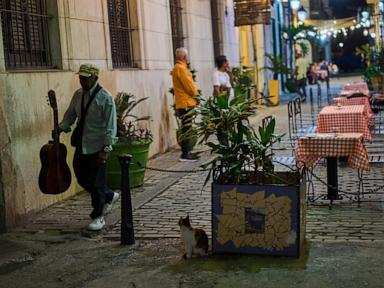
Walk down Calle 23 on a Tuesday night. Historically, the air would be a chaotic symphony. You would hear a trumpet weeping from a second-story window and the bass of a passing Lada shaking the pavement. Now, there is only the mechanical groan of portable generators. They sit on sidewalks like noisy, gasoline-scented beasts, providing a small circle of light to those who can afford the fuel.
But fuel is the second half of the tragedy.
The blockade doesn't just target the electricity; it targets the very movement of the island. Lines at gas stations stretch for kilometers, snaking through neighborhoods like weary metal serpents. Drivers sleep in their cars for days, holding their place in line for a few liters of the precious liquid. If you use that gas to run a generator for your bar, you can’t use it to drive your family to the countryside. You are forced to choose between your livelihood and your life.
The legendary nightlife—the kind that drew Hemingway, the kind that inspired a thousand films—depended on an illusion of abundance. It required the idea that the party would never end. When the lights go out at 10:00 PM, the illusion shatters. The tourists stay in their hotels, huddled near the industrial-sized generators that keep the lobby lights humming, while the rest of the city fades into a deep, colonial darkness.
The Human Cost of a Blown Fuse
Imagine a young musician named Elena. She plays the upright bass. For years, her income depended on the 11:00 PM set at a jazz club in Old Havana. She needs that gig to buy milk on the informal market, where prices have drifted into the stratosphere due to inflation and scarcity.
When the energy crisis hit its peak, her club stopped booking live acts. It was too expensive to run the lights and the sound system for a dwindling crowd. Now, Elena sits on her balcony. The darkness is so absolute that she can see stars she hasn't seen since childhood. It is beautiful, in a terrifying way. She isn't thinking about the cosmos, though. She is thinking about the fact that her instrument is warping in the heat and she hasn't earned a Cuban Peso in three weeks.
This is the invisible stake. It is the degradation of talent. It is the forced migration of the creative class. When a city loses its ability to power its stages, its artists begin to look for stages elsewhere. The "brain drain" of Cuba is often discussed in terms of doctors and engineers, but the "soul drain" is just as devastating. The dancers, the mixologists, the percussionists—they are all looking at the dark horizon and wondering if the lights will ever come back on for good.
The Mathematics of Scarcity
The numbers tell a grim story, though they feel cold compared to the reality on the ground. Recent reports indicate that the island's energy deficit often exceeds 30% of total demand during peak hours. That means at any given moment, nearly a third of the country is in the dark. The government attributes this to the "Maximum Pressure" campaign of foreign sanctions, which restricts the ability of tankers to dock and prevents the purchase of spare parts for those aging power plants.
But the blame is a secondary concern to a man trying to keep his children cool in a concrete apartment that has become an oven.
The strategy of an energy blockade is meant to create internal pressure, to turn the dial of daily life until the heat becomes unbearable. Yet, the resilience of the Cuban people is a double-edged sword. They have become masters of the "make-do." They fix engines with wire and hope. They find ways to chill beer in buckets of salt and ice. They keep going. But "keeping going" is not the same as thriving. It is survival, and survival is an exhausting full-time job that leaves no room for the creation of art or the building of a future.
A City Caught Between Eras
There is a strange, haunting beauty to Havana in the dark. Without the glare of modern life, the Spanish colonial shadows regain their dominance. The city feels like it has slipped back into the 19th century. You can hear the ocean hitting the sea wall with a clarity that the daytime roar of traffic usually masks.
But this beauty is a trap. It is a romanticization of a crisis.
The tourists who find it "authentic" don't have to worry about the insulin spoiling in a dead refrigerator or the student trying to study for exams by the flickering yellow light of a kerosene lamp. The nightlife was the bridge between Cuba and the rest of the world. It was the place where the political disappeared and the human took over. In the dark, that bridge is harder to find.
The bars that remain open are defiant. They use candles. They play acoustic sets. They serve rum neat because there is no ice. There is something noble in that defiance, a refusal to let the circumstances dictate the spirit. But you can see the strain in the eyes of the servers. You can hear it in the way the music ends early, a hurried finale before the next scheduled blackout begins.
As the sun sets over the Gulf of Mexico, the city braces itself. The golden hour is no longer a prelude to a celebration; it is a countdown. One by one, the districts will lose their glow. The neon signs for the "Floridita" and the "Bodeguita del Medio" will flicker and die.
Havana is a city designed for the light. Its colors—the seafoam greens, the faded corals, the vibrant yellows—require the sun or the bulb to exist. In the shadows, the city loses its skin. It becomes a skeleton of itself, waiting for a spark, waiting for a current, waiting for the simple dignity of a fan turning in the heat.
The music hasn't died, but it is holding its breath. It is waiting for the day when the only thing people have to fear in the dark is the end of a song, not the end of a way of life. For now, Alejandro wipes the bar in the gloom, the warm rum sits heavy in the glass, and a whole nation listens to the silence of a grid that has forgotten how to hum.