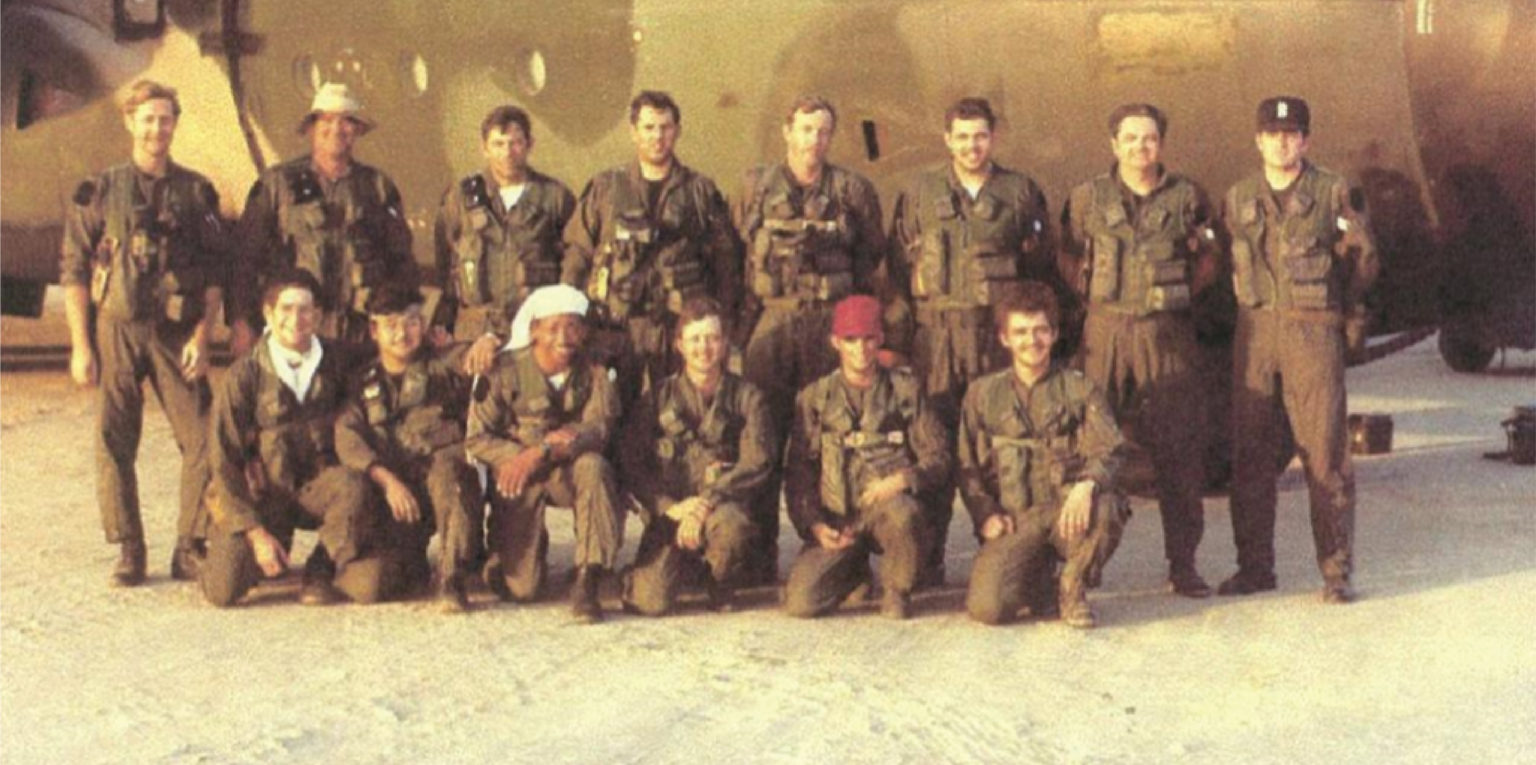
History is written by the cautious, but it is remembered by those who simplify. For forty-six years, the media has peddled the same tired narrative: Operation Eagle Claw was a humiliation, a symbol of American decline, and a mechanical farce in the Great Salt Desert. This "lazy consensus" views the April 1980 mission as a string of avoidable errors that buried the Carter administration.
They are wrong.
Eagle Claw was the most sophisticated, high-stakes gamble in the history of special operations. It didn't fail because of "bad planning." It failed because it was the first time anyone attempted to merge disparate military cultures into a single, cohesive strike force under conditions that pushed the laws of physics to their breaking point. If you want to understand why modern special ops look the way they do today, you have to stop looking at Desert One as a funeral and start seeing it as a laboratory.
The Myth of the "Avoidable" Mechanical Failure
Critics love to point at the RH-53D Sea Stallion helicopters as the weak link. They claim the mission was doomed by "old tech." This ignores the brutal reality of the environment. The haboob—a massive, unforeseen suspended dust storm—wasn't just "bad weather." It was an atmospheric anomaly that rendered state-of-the-art sensors useless.
Standard military logic says you don't fly into a wall of dust. But standard logic doesn't rescue 52 hostages from a fortified embassy in the heart of a hostile capital. The decision to proceed was a calculated risk, not a lapse in judgment. When people ask "Why didn't they have more backup helicopters?", they reveal their ignorance of the logistical ceiling. You cannot park an entire fleet in the middle of a sovereign nation without being detected. The mission required a footprint so small it was almost invisible. That invisibility came at the cost of redundancy.
The Command Structure Fallacy
The "People Also Ask" sections of history sites often focus on "Who was to blame for the Desert One crash?" The premise is flawed. The blame shouldn't lie with the pilots or the ground commanders. The fault lay in the systemic lack of "jointness" in the US military at the time.
Before 1980, the Army, Navy, and Air Force operated like rival corporations that shared a logo but hated each other’s guts. Eagle Claw forced them into the same room. The friction wasn't a mistake; it was a symptom of a fractured system that had never been tested at this scale.
- The Army (Delta Force): Wanted surgical precision.
- The Navy/Marines: Provided the heavy lift (helicopters).
- The Air Force: Managed the long-range transport (C-130s).
The crash between the helicopter and the EC-130 was the physical manifestation of a lack of integrated training. We learned that you cannot "handshake" a mission of this complexity. You have to live it.
Why "Success" Would Have Been Bloodier
Imagine a scenario where the helicopters arrived safely at Desert One. Imagine they made it to the "Mountain" hideout. The second phase involved trucking Delta operators into Tehran, storming the embassy, and extracting hostages via a soccer stadium.
The casualty estimates for a "successful" Eagle Claw were horrifying. We’re talking about a potential body count in the hundreds. By failing at the refueling point, the mission arguably saved the United States from a protracted urban war in the streets of Tehran that would have made the Black Hawk Down incident look like a skirmish. The failure at Desert One was a tactical catastrophe that prevented a strategic apocalypse.
The Birth of the Modern War Machine
If Eagle Claw is a "failure," then it is the most productive failure in the history of warfare. Out of the charred remains of those aircraft, the United States built the most lethal special operations infrastructure on the planet.
- USSOCOM: The creation of United States Special Operations Command was a direct result of the Holloway Commission’s report on the mission. No more "rival corporations."
- The 160th SOAR: The "Night Stalkers" were born because the regular Marine pilots in Eagle Claw weren't trained for the specific, grueling demands of clandestine low-level flight.
- The Goldwater-Nichols Act: This restructured the entire Department of Defense to ensure that the "jointness" missing in 1980 became the law of the land.
When Iran tries to use the 46-year-old anniversary to mock the US, they are mocking a version of the American military that no longer exists. They are taunting a ghost. The current US capability to project power into denied airspace was forged in the fire of that desert.
The Cost of Innovation
In the tech world, we celebrate "failing fast." We talk about "iterative design." Yet, in military history, we demand perfection on the first try of a prototype mission. Eagle Claw was the prototype. It was the "Minimum Viable Product" of long-range hostage rescue.
The downside of this contrarian view? It costs lives. Eight men died at Desert One. To call their sacrifice a "failure" is a disservice to the technical and physical boundaries they pushed. They were the test pilots for a new way of war.
Stop Asking if it Worked
The question "Was Operation Eagle Claw a failure?" is the wrong question. The right question is: "Would the US be more or less prepared for modern threats if Eagle Claw had never been attempted?"
The answer is less. Far less.
We would still have silos. We would still have pilots who couldn't talk to ground troops. We would still be relying on luck instead of the integrated, multi-platform dominance that defined the Bin Laden raid or the rescue of Captain Phillips.
History isn't a scoreboard of wins and losses. It’s an evolution of capability. Iran can celebrate the anniversary of a mechanical accident all they want. While they look backward at a 46-year-old pile of scrap metal, they are ignoring the fact that the failure they are mocking is exactly what taught their adversaries how to never fail again.
The desert didn't swallow American pride. It burned away the incompetence of the old guard.
Clean your goggles and look at the data. Desert One wasn't the end. It was the brutal, necessary beginning of the modern era.