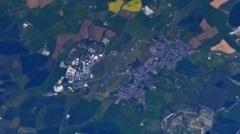
The capture of a specific terrestrial target from a Low Earth Orbit (LEO) platform represents a complex intersection of orbital mechanics, atmospheric optics, and human operational constraints. While general media accounts treat an astronaut’s photograph of their alma mater as a serendipitous moment of nostalgia, the event actually serves as a case study in high-velocity precision targeting. To successfully document a sub-kilometer feature from a platform traveling at approximately 7.6 kilometers per second, an observer must navigate a narrow window of opportunity defined by the ballistic trajectory of the International Space Station (ISS) and the physics of light transmission through the atmosphere.
The Geometries of Orbital Photography
The primary constraint on orbital imaging is the Ground Track Synchronization. The ISS does not pass over every point on Earth during every orbit. Due to the orbital inclination of 51.6 degrees, the station’s path shifts longitudinally with every revolution because the Earth rotates beneath it. This creates a spatial bottleneck. Expanding on this idea, you can find more in: The Digital Prohibition Fail Turkey Is Exporting Blind Ignorance.
For an astronaut to photograph a specific university campus, three variables must align:
- Slant Range and Nadir Proximity: The best resolution is achieved when the target is at "nadir"—the point directly below the spacecraft. As the angle from nadir increases (the look angle), the light must travel through a thicker cross-section of the atmosphere, increasing Rayleigh scattering and reducing image contrast.
- Solar Elevation Angle: Proper illumination of terrestrial structures requires a solar angle that provides enough shadow to define three-dimensional forms without washing out textures. Mid-morning or mid-afternoon passes are technically superior to high-noon passes for architectural identification.
- The Time-on-Target (ToT) Window: At an altitude of roughly 400 kilometers, the "window of visibility" for a specific campus lasts less than 40 seconds. The effective window for a high-resolution shot, accounting for the limits of handheld stabilization, is often reduced to a 5-to-10-second burst.
The Optical Bottleneck: Diffraction and Motion Blur
The quality of an orbital photograph is governed by the Resolution-Stability Tradeoff. Unlike automated Earth-observation satellites that use TDI (Time Delay Integration) sensors to compensate for high-speed motion, an astronaut uses commercial off-the-shelf (COTS) digital SLR cameras. Experts at Mashable have shared their thoughts on this trend.
The theoretical limit of what can be seen is defined by the diffraction limit of the lens. Using a 400mm or 800mm lens, the spatial resolution (the smallest object that can be distinguished) typically ranges from 3 to 6 meters per pixel. However, achieving this requires neutralizing the 27,000 kilometer-per-hour velocity of the platform.
The Mechanism of Smear Compensation
To prevent motion blur, the astronaut must employ "manual tracking," a physical technique where the photographer pivots the camera in the inverse direction of the orbital flight path. Even a micro-vibration during the shutter release will cause "pixel smear," where the light from a single point on the ground spreads across multiple sensor sites. The shutter speed must be kept extremely high—often $1/1000$ of a second or faster—to freeze the motion, which in turn necessitates a higher ISO setting, introducing electronic noise into the image.
The resulting data quality is a function of:
$$Q = \frac{L \cdot A}{V \cdot S}$$
where $L$ is lens focal length, $A$ is atmospheric clarity, $V$ is relative velocity, and $S$ is the sensor’s signal-to-noise ratio.
Atmospheric Interference and the Blue Shift
A significant hurdle in space-to-ground photography is the Aerosol Optical Depth (AOD). The 100 kilometers of atmosphere between the lens and the university campus act as a variable filter. Nitrogen and oxygen molecules scatter shorter blue wavelengths more effectively than longer red wavelengths. This phenomenon, known as "path radiance," adds a veil of blue light over the image, reducing the dynamic range of the campus buildings against the surrounding foliage.
Experienced orbital observers utilize circular polarizers or post-processing histograms to "de-haze" the image. This isn't merely an aesthetic choice; it is a requirement to recover the edge contrast needed to identify specific landmarks like stadium perimeters, library quads, or iconic clock towers.
The Cognitive Load of Target Identification
Identifying a 50-acre university campus from 400 kilometers up is a high-stakes task in pattern recognition. From orbit, the familiar ground-level landmarks disappear, replaced by macro-geographies. An astronaut does not look for a building; they look for a "geographic anchor."
- Primary Anchors: Large, immutable features such as coastlines, river confluences, or major interstate interchanges.
- Secondary Anchors: Urban grids and city parks that provide a coordinate system relative to the primary anchor.
- The Target: The specific university footprint, identified by its unique geometry (e.g., a circular drive or a specific stadium shape).
This process is aided by "Target Sheets" provided by ground support teams at the Crew Earth Observation (CEO) office. These sheets predict the exact second the target will appear and provide wide-field reference photos to guide the astronaut's eye. Without this structured data, the probability of acquiring a small target at orbital speeds is near zero.
The Value of Human-in-the-Loop Observation
While high-resolution commercial satellites like WorldView or Dove constellations provide automated, multispectral imagery, they lack the "intent-driven" flexibility of a human observer.
The human-in-the-loop advantage manifests in two ways:
- Real-time Obliquity: A satellite is usually fixed in a downward-looking or specific off-nadir tilt. An astronaut can instantly adjust the angle to capture the "glint" of a building’s windows or the specific texture of a roof, providing a perspective that fixed sensors might miss.
- Dynamic Response: If a specific campus is partially covered by clouds, an astronaut can wait for a momentary "hole" in the cumulus layer to trigger the shutter, a feat that automated systems struggle to replicate without sophisticated real-time cloud-masking algorithms.
Operational Constraints and Hardware Limitations
The environment of the ISS creates a unique set of hardware challenges. Cosmic radiation constantly bombards the camera sensors, leading to "hot pixels"—permanent bright spots on the image sensor. Over time, cameras on the ISS degrade significantly compared to those on Earth.
Furthermore, the windows of the ISS (typically in the Cupola or the Destiny Lab) are not simple glass. They are multi-pane assemblies of fused silica and borosilicate glass. Each pane introduces two additional surfaces for potential reflection and refraction. To minimize internal reflections, astronauts must shroud the camera and the window in dark cloth, creating a makeshift "darkroom" to ensure the sensor only captures the light coming from the Earth.
Structural Implications of Orbital Documentation
The act of photographing a university from space is a demonstration of Command and Control (C2) Mastery. It proves the ability to synchronize orbital mechanics, hardware optimization, and human cognitive focus onto a singular terrestrial point.
The data lifecycle of such a photograph follows a rigid path:
- Acquisition: High-speed, high-ISO capture in RAW format.
- Downlink: Transmission via the Space Network’s Ku-band high-speed data link.
- Cataloging: Metadata tagging by the Johnson Space Center, including the ISS's exact GPS coordinates and the camera’s pitch, roll, and yaw at the moment of capture.
This ensures that the image is not just a photograph, but a geolocated data point that can be overlaid with GIS (Geographic Information System) maps for sub-meter accuracy.
The Tactical Execution of Nadir Imaging
To maximize the success rate of future orbital photography, mission planners should prioritize the use of high-frame-rate, global-shutter sensors to eliminate the "rolling shutter" distortion caused by the station's velocity. Current CMOS sensors can struggle with the relative motion, creating a slight "lean" in vertical structures. Moving toward global shutter technology would allow for a reduction in shutter speed requirements, enabling lower ISOs and higher color fidelity.
Additionally, the integration of Augmented Reality (AR) overlays in the camera’s viewfinder could solve the "target acquisition" problem. By projecting the university's boundaries onto the viewfinder based on real-time telemetry, the "hunt" time is eliminated, allowing the observer to focus entirely on optical stabilization and framing.
The ultimate strategic play for orbital observation lies in the transition from opportunistic photography to systematic, human-augmented sensor fusion. By leveraging the unique perspective of the ISS, observers provide a layer of "contextual metadata" that purely automated systems cannot generate, turning a simple photo of a university into a masterclass in precision remote sensing.